

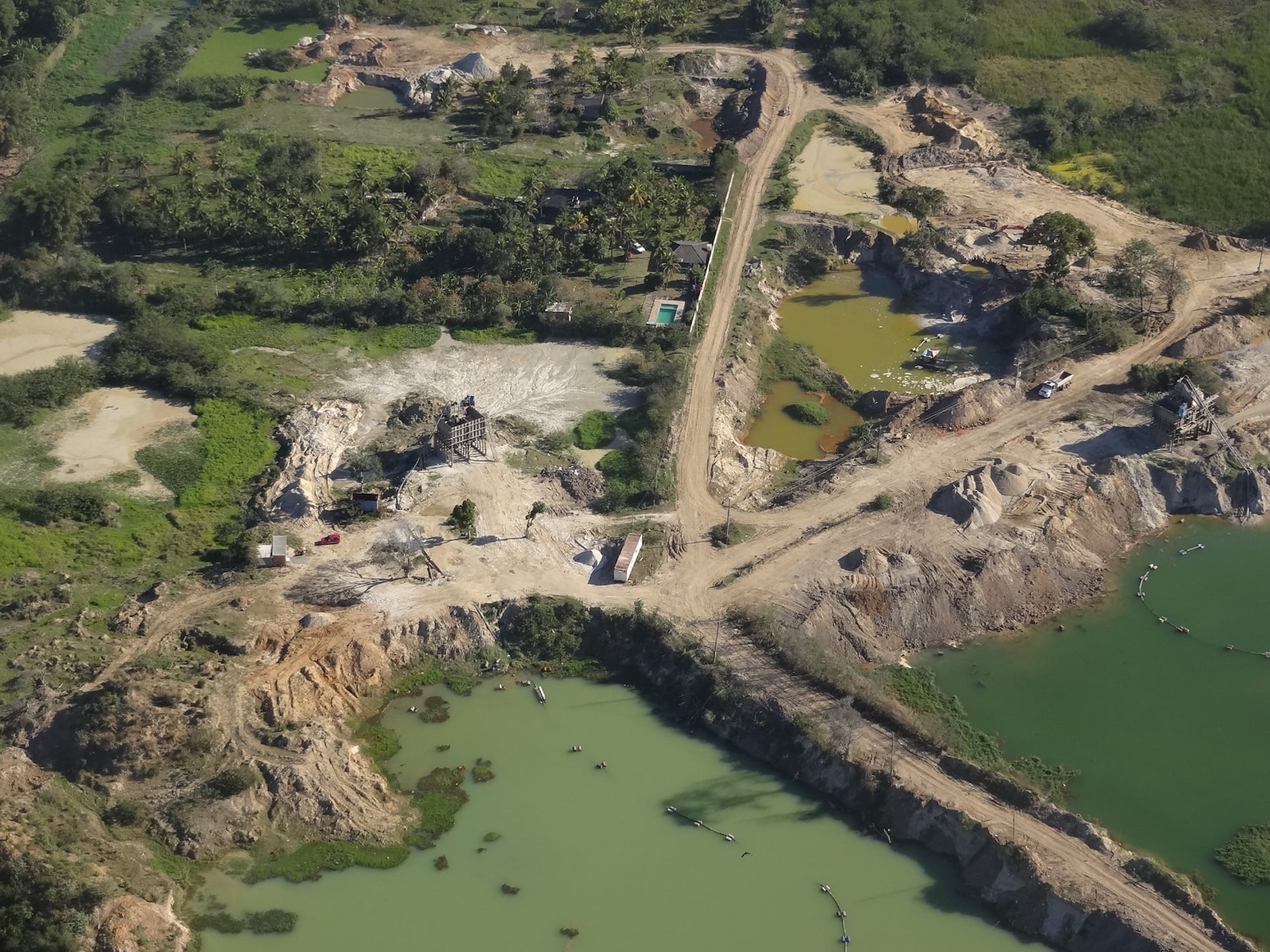
With global consumption of river and marine sand hovering around 50 billion tons per year, international organizations such as the United Nations Environment Programme (UNEP) have long warned of the risk of depletion and the serious environmental consequences tied to its growing scarcity. In this context, China stands as the world’s leading consumer, whose vast and sustained demand has already fueled illegal extraction and trafficking networks in parts of Asia and Africa — and is increasingly raising concerns in Latin America.
“Sand is one of the most important aggregates in construction, and its extraction is one of the most impactful and unsustainable mining activities, especially in the absence of controls,” Luís Fernando Ramadon, a professor at the Brazilian Police Academy and specialist in water resource management at the Federal University of Rio de Janeiro, told Diálogo. Ramadon is the former head of the Operations Unit at the Federal Police’s Environmental Police Station and founder of the website Action Against Environmental, Mineral, and Wildlife Trafficking Crimes (ACCAMTAS).
The surge in consumption is driven primarily by the construction sector, which absorbs nearly 90 percent of extracted sand, mainly for cement and asphalt production. This growing pressure on resources has also attracted criminal networks in Latin America, where sand trafficking often follows the same routes and logistics used for illegal mining and drug trafficking.
From Brazil to Colombia and across the Caribbean, cases reflecting this trend are multiplying. One of the most striking occurred in 2008 on Coral Spring Beach, on Jamaica’s northern coast, where the equivalent of about 500 truckloads of sand disappeared in a single night.
China’s role
China’s enormous demand — which, during its urban construction boom between 2011 and 2014, used more cement than the United States did throughout the entire 20th century — has already been linked to illicit extraction networks in other regions of the world, including Asia and Africa.
Experts warn that similar dynamics may be emerging in Latin America. While Chinese actors do not typically appear directly in illegal extraction, their role as intermediaries, financiers, or end buyers has been documented across multiple extractive sectors.
As noted in recent testimony before the U.S.-China Economic and Security Review Commission, the Chinese modus operandi in Latin America follows recurring patterns, regardless of the natural resource being exploited. “Chinese actors rarely appear in illegal extraction, though they occasionally participate in the recruitment of workers,” Vanda Felbab-Brown, a senior fellow in Foreign Policy at the Brookings Institution said. The expert also highlights the key role of Chinese-linked intermediaries, who may be criminal groups or formally legal companies and who “finance production, supply equipment and inputs, obtain false documents, organize transportation and export, and act as key buyers.”
These patterns, observed in sectors such as gold and timber, are increasingly relevant to sand, particularly in regions where weak oversight and expanding extractive activity create opportunities for illicit supply chains to develop. In Latin America, limited enforcement capacity and opaque commercial networks contribute to conditions in which such dynamics can take root.
In the Peruvian Amazon, in the department of Loreto and around Iquitos, the illegal extraction of white sand has destroyed some 260 hectares of varíllales forests — a unique ecosystem that grows on nutrient-poor, highly acidic white sand soils — in just a few years. The loss is especially severe: These forests can take up to a century to regenerate and play a critical role as natural filters for rainwater, helping sustain the Nanay River, on which local communities depend.
These dynamics are not theoretical. In other regions, Chinese actors have already been linked to both harmful and illegal sand extraction practices. In Mozambique, a Chinese-owned company was accused of causing severe environmental damage through coastal sand mining operations, while in Taiwan’s waters, authorities have repeatedly intercepted Chinese dredging vessels engaged in illegal sand extraction. Together, these cases illustrate how China’s demand for construction materials can project beyond its borders — sometimes operating in legal gray zones, and in other cases crossing into outright illicit activity.
For experts, these cases offer a preview of how similar dynamics are already taking shape in Latin America, where high demand, established trafficking routes, and uneven oversight create comparable conditions.
The case of Brazil
Chinese companies often establish operations in areas where economic and strategic interests converge. This is the case in Camaçari, in Bahia state, where in October 2025 the BYD Group inaugurated its first automotive factory in Latin America, in a region already affected by illegal sand mining.
The area illustrates how legal economic activity and illicit extraction can coexist within the same geographic and regulatory space. In March 2025, the Federal Police operation Pirates of the Dunes III dismantled a network that was illegally extracting and selling sand from dunes and surrounding areas near Salvador, where authorities had previously identified clandestine export routes for green quartz to China in 2024.
According to Ramadon, nearly 68 percent of the sand consumed in Brazil is sourced illegally, generating losses of some $5.78 billion. The sector is often controlled by militias — paramilitary groups frequently composed of former police officers — which use illegal sand extraction as a source of revenue and to build in the territories under their control, particularly in Rio de Janeiro.
“The militias use sand extraction as a source of financial resources, just as they control the trade in gas, internet, and alternative transportation,” Ramadon said. “They impose fees for access or for providing ‘security’ at extraction and distribution sites.”
One of the most well-known cases involves Luis Antonio da Silva Braga, known as Zinho, leader of the Bonde do Zinho militia, who surrendered to authorities in January 2023. The group expanded into the municipality of Seropédica, about 75 kilometers from Rio de Janeiro, where illegally extracted sand remains competitive. “In Seropédica, there are currently about 90 authorized quarries that sell a cubic meter of sand for between $13 and $18, while at illegal quarries — without licenses or concessions — the price is around $10,” Ramadon said.
The environmental and social impact
Sand extraction causes severe and often irreversible environmental damage.
“It leads to the degradation of beaches, rivers, and lagoons; alters watercourses; increases sedimentation and soil erosion; destroys protected areas, flora, and fauna; and contributes to air pollution through higher particulate levels,” Ramadon explained.
In the Dominican Republic, illegal extraction is affecting water security and ecosystems along the Nizao, Yuna, and Yaque del Norte rivers. The sector generates around $1 billion annually, driven by tax evasion and low costs that make illegal operations highly competitive.
In Panama, in March, the Ministry of Commerce and Industry confirmed the extraction of some 500,000 cubic meters of sand from the seabed at Punta Chame for a 2.5-kilometer coastal landfill linked to an unauthorized tourism project.
In Colombia, illegal extraction has also been linked to corruption and violence. In Córdoba, journalist Rafael Moreno — who investigated environmental crimes and local corruption, including illegal resource extraction — was murdered in 2022, underscoring the risk associated with exposing these networks.
The necessary measures
According to experts, nearly 80 percent of the sand traded globally originates from unregulated or poorly documented sources, facilitated by regulatory gaps and lack of enforcement.
For Ramadon, the response must be comprehensive. “Administrative intelligence is needed to rigorously monitor legal extraction, from the source to distribution,” he said. “At the same time, police action is essential to combat illegal extraction and identify those responsible.”
This must be complemented by stronger institutional coordination, mapping of illegal extraction sites, and expanded academic research.
According to UNEP, global consumption of sand and aggregates has reached such levels that, without sustainable management, demand could far exceed available resources by 2050 — transforming sand from a seemingly abundant material into a critical and contested resource.
Beyond the environmental problem dimension, the implications are broader: infrastructure, urban development, and economic growth all depend on sand. Its increasing scarcity risks fueling conflicts, illicit economies, intensifying competition over natural resources, and further straining governance in vulnerable regions.