

At the start of the 21st century, when Ecuador was facing the closure of Western financing due to high debt, China burst onto the scene with million-dollar loans, promises of accelerated development, and a seductive discourse of cooperation between equals. The offer was as timely as it was strategic.
Today, China is not only Ecuador’s main trading partner but is also the financier of key projects across strategic sectors, including energy, oil, and telecommunications. But the price has been high. What began as a pragmatic alliance, ostensibly beneficial to both sides, has turned into an asymmetrical relationship marked by flawed projects, negative environmental impacts, corruption scandals, and a growing loss of sovereignty.
The Coca Codo Sinclair hydroelectric plant — as discussed in the first part of this report — is the most emblematic symbol of these broken promises. Financed and built by China at a cost of some $2.8 billion, it promised to cover up to a third of the country’s electricity demand. However, a decade after it began operating, the project has still not been officially handed over to the Ecuadorian state due to ongoing issues, primarily more than 17,000 cracks in its structure. The case has escalated to international arbitration, exposing an asymmetrical relationship that reflect troubling patterns of dependency.
An unbalanced FTA
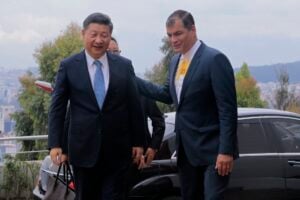
Despite this background, China continues to expand its influence in Ecuador. In 2024, Ecuador became the fourth in Latin America to sign a Free Trade Agreement (FTA) with China. A year later, the signs of imbalance are evident.
In its report, Panama, Ecuador, and China: The Dangers of Short-Term Calculations, the United States Institute of Peace (USIP) issued a warning that the FTA disproportionately favors China. According to the report, the agreement grants Beijing preferential access to 99 percent of Ecuador’s current exports, primarily agricultural products like bananas, pineapples, and dragon fruit. But the FTA lacks key protections for labor rights, environmental standards, and intellectual property.
“The agreement does not provide mechanisms that allow Ecuador to demand reciprocity or sustainability conditions in bilateral trade,” Evan Ellis, an expert on Sino-Latin American relations and a research professor at the U.S. Army War College Strategic Studies Institute told Diálogo.
The data reinforce this trend. Between 2022 and 2024, Ecuador’s non-oil exports to China fell by 17.1 percent. Conversely, China’s imports — vehicles, technology, and industrial goods — continued to grow, widening the trade gap. “The treaty accentuates Ecuador’s dependence on high value-added products, while the country limits itself to exporting raw materials without industrial processing,” Ellis added.
Even in strategic sectors such as bananas, China holds only the fifth-largest market share for Ecuador’s exports. For shrimp, another key product, Ecuadorian exporters face non-tariff barriers that severely limit their access to the Chinese market.
As Ecuador deepens its economic openness with China, experts are looking at the broader impact of Beijing’s presence in the country, issuing warning about the true cost of this growing relationship. “It’s particularly worrisome that we put up our most valuable resource, oil, as collateral, and that should lead us to question what development model we want as a country,” Ecuadorian investigative journalist Christian Zurita told Diálogo.
The hidden cost of debt
The financial underpinnings of Ecuador’s relationship with China have emerged as one of its most problematic aspects. A dramatic surge in Chinese foreign direct investment into Ecuador occurred between 2006 and 2007, rocketing from $11.9 million to $84.8 million. In 2007, the debt to China stood at over $7 million. A decade later, this figure had ballooned to nearly $7.5 billion.
According to the investigation by journalistic organization Fundación Mil Hojas, The Secrets of Chinese Debt, China disbursed more than $24 million in loans to Ecuador during the Rafael Correa administration. Many of these agreements were made under obscure conditions: They were often classified as confidential, granted without public bidding, and included the obligation to hire Chinese companies. “Ecuador signed the most opaque, onerous, and complex contracts in its history with China,” Zurita said.
One of the most controversial mechanisms has been payment in oil. “Loans to China are not repaid with money, but with oil, which has left the country in unprecedented dependence,” Zurita added.
Initially, China tried to secure its loans with state-owned real estate, as it did in several African countries. However, as journalist Zurita explained to Diálogo, in Ecuador it encountered a somewhat more solid institutional framework that prevented this formula from being implemented. When this failed, Beijing opted for a more secure guarantee: oil. “There have been years when up to 80 percent of oil exports have been committed to payments to China, leaving the country with no fiscal maneuvering room or energy sovereignty,” Zurita said.
To make matters worse, China does not consume Ecuadorian crude oil directly: It resells it on the international market at significant margins. “Just because of the difference in the agreed price, Ecuador has lost around $4 billion,” Zurita estimated.
ECU 911: China has eyes on Ecuador
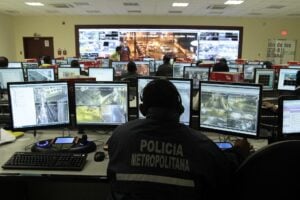
Ecuadorian oil also served to build one of the most ambitious surveillance systems in Latin America: the ECU 911 Integrated Security Service. Financed with Chinese loans and built by the Chinese state-owned China National Electronics Import & Export Corporation (CEIEC) and Huawei, the system was inaugurated in 2012 and initially deployed more than 4,300 cameras and 16 monitoring centers.
Presented as a symbol of modernization and state efficiency, the system has gradually incorporated cutting edge technology like drones, thermal cameras, and artificial intelligence. But behind this narrative of innovation lies a less visible reality: China’s structural penetration into the digital architecture of Ecuadorian public order.
“China has aggressively promoted itself to the world, but particularly in Latin America, as a model of public security worth emulating,” said Henry Ziemer, an associate fellow with the Center for Strategic and International Studies (CSIS). According to his research, this technology has also served to erode democracy.
“It is no longer just about financing or infrastructure transfer, but about the adoption of a model of state control with profound implications for technological sovereignty, citizen privacy, and ultimately the democratic stability of the country,” Ziemer told Diálogo.
In 2018, The New York Times reported that some of the information captured by ECU 911 was sent to the National Intelligence Secretariat (SENAIN), which was used to spy on opponents during the Correa administration. Although SENAIN was dissolved, the technological infrastructure remains active.
Experts warn that beyond internal surveillance, the real risk is the possible external access to sensitive data by the Chinese Communist Party (CCP). The companies responsible — Huawei and CEIEC — have been internationally identified as having ties to Beijing’s intelligence apparatus. “Although the specific agencies in Ecuador responsible for controlling the information collected by these systems may change, the safeguard is that China’s overall level of access and control remains virtually intact,” Ziemer warned.
Ecuador is not the only case. Systems similar to ECU 911 have been implemented in countries such as Bolivia, with BOL-110, also developed by CEIEC; in Venezuela, where the system known as the Homeland Card (Carnet de la Patria) was designed by the Chinese state-owned company ZTE; and in countries outside the region, such as Angola, which has adopted versions of these surveillance systems with the backing of Chinese state-owned companies. In all cases, Ellis pointed out that “a common pattern repeats itself: The promise of technological efficiency that leads to growing dependence on security.”
Growing concern
The ECU 911 system, a symbol of technological cooperation between Ecuador and China, is currently undergoing a structural crisis.
At least 1,100 of its 6,500 cameras were out of service by 2022, reducing its operational capacity to 83 percent, Juan Zapata, then director of ECU 911, told the National Assembly.
Zapata also acknowledged that the system was anchored to a closed protocol platform that made it difficult to update and expand. “Closed systems mean that Ecuador will have difficulty implementing its own software updates, fixing vulnerabilities, or integrating new devices without China’s assistance, and create dangerous security gaps at a time of rising criminal violence,” Ziemer explained.
The technical difficulties are compounded by language and operational barriers. Much of the software, technical manuals, and protocols are written in Chinese. In addition, many of the technicians trained by CEIEC have left their positions in recent years, further weakening the system’s operation just as insecurity intensifies in the country.
But that was not the only revelation made at that hearing. According to the same officials, several of the technicians who resigned were subsequently hired by CEIEC at higher salaries. Added to this is the complication caused by the sanctions imposed by the U.S. Treasury Department on CEIEC, which prevented the commercial relationship with this company from continuing, given that Ecuador operates under a dollar-based financial system.
In view of this situation, ECU 911 asked CEIEC to propose an alternative company that was not sanctioned and had the necessary knowledge to guarantee the functioning of the system. However, according to the testimonies presented to the National Assembly, CEIEC’s response was a proposal with a 300 percent increase in costs and a significant reduction in service conditions. The budget, previously $500,000 for 12 months of comprehensive maintenance, which ensured the normal operation of the system and coverage in case of failures, ballooned to $1.5 million for only six months of limited technical support, without maintenance tasks, and with a liability waiver clause in case of system failures.
Currently, the contract with CEIEC has not been renewed, and Ecuador is exploring agreements with Western suppliers. “The new orientation of the Ecuadorian government is not to consider any Chinese company for future contracts in its surveillance system,” Ellis said.
For Ziemer, this decision reflects a broader trend. “What we are seeing is how countries in the Western Hemisphere are beginning to recognize that China is not a panacea for their infrastructure and security needs.” As an example, he cited the projects announced in 2017 by China in Panama under the Belt and Road Initiative. “Of five flagship initiatives, three have failed or face critical delays, including the ambitious fourth bridge over the Canal,” he said.
But to think that this decision marks the end of Chinese influence in the country would be naive, Ellis warned, noting that “Chinese influence persists and remains deep.” Companies such as Dahua continue to play a leading role in commercial and residential surveillance architecture, while Huawei maintains a dominant position in strategic sectors such as telecommunications and cloud services.
“One key fact cannot be ignored: Huawei already has a head start. Its infrastructure is in place, cannot be easily dismantled, and that gives it a strategic position in the country’s digital future, especially in the rollout of the 5G network,” Ellis said. He stressed that this situation represents a “real straitjacket” for Ecuador, as any attempt to diversify its technology providers or reclaim digital sovereignty will inevitably confront critical infrastructure designed and controlled by a company with close ties to the CCP.
Non-recoupable investment
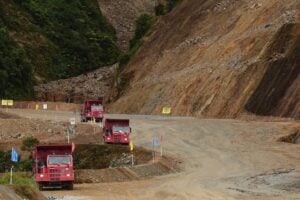
To this scenario is added the advance of Chinese mining companies, which arrived in Ecuador along with large oil-backed loans. Initially presented as a symbol of development and South-South cooperation, it has become a constant source of environmental, social, and institutional conflict.
According to the 2023 report Human Rights and Chinese Business Activities in Latin America, released by 22 civil society organizations, large-scale mining with Chinese capital has deepened inequalities, weakened environmental institutions, and caused forced displacement of communities.
The Río Blanco project stands as one of the most emblematic examples of Chinese-backed venture in Ecuador. Operated by Ecuagoldmining South America S.A., a company controlled by Chinese entities with direct ties to Junefield Mineral Resources Holding Ltd. and Hunan Gold Group, this project has been linked to the drying up of vital water sources, the diversion of natural watercourses, and the dispossession of land from the ancestral inhabitants of the area without effective guarantees for their rights.
Although there are no official data, investigative journalist Christian Zurita maintains that Chinese companies control “two-thirds” of the country’s largest mines, and their expansion continues. “It’s worrisome that China is positioning itself as a dominant player not only in existing deposits, but also in those yet to be exploited,” he said.
In May 2025, Canadian company Lumina Gold sold the Cangrejos project to CMOC Singapore, a subsidiary of the Chinese conglomerate CMOC Group, partly state-owned. The transaction, valued at $421 million, transferred ownership of the project located in an area known for intense informal mining. “This new acquisition could become the largest gold operation in Ecuador,” Ellis said. At the same time, the Chinese state-owned company Jiangxi Copper acquired a stake in the Australian company SolGold, operator of the Cascabel project, thus reinforcing the growing presence and dominance of Chinese capital in the Ecuadorian mining sector.
The lack of contractual transparency is another critical issue. “Chinese companies are exporting unprocessed minerals: gold, rare earths, even uranium,” Ellis said. Without effective state control mechanisms over the volumes or nature of the minerals extracted, the situation, Ellis said, “undermines the country’s sovereignty over its strategic resources. We don’t really know what’s going on in the Chinese mining enclaves.”
Added to this is the impact of illegal gold. China is one of its main destinations. A striking discrepancy was highlighted in the 2021 edition of the report, Following the Money from Illicit Gold, published by the Organization of American States Department Against Transnational Organized Crime: In 2019, while Ecuador officially reported gold exports of $77 million, China simultaneously recorded imports from Ecuador of $339 million. “This is a parallel channel of unregulated trade that further erodes the institutionality and legality of the sector,” Ellis said.
What began as a promise of prosperity has instead become a stark warning for Ecuador. China’s presence in the nation’s mining sector has not only left a trail of environmental and social damage but has also weakened the state’s control over its own natural resources. “Instead of sustainable development, the legacy of these investments is more like an unpayable bill: an investment that is difficult to recover, with deep scars on the territory, on national sovereignty, and on public trust,” Zurita concluded.
This article is the second of a two-part investigation. Read Part I here.