
Organized crime in Brazil is undergoing a profound transformation. The continued expansion of drug trafficking — illustrated by sharp increases in drug seizures in parts of the country, including a reported 40 percent rise in Pará state in 2025 — combined with the growing exploitation of Brazil’s financial ecosystem, including parts of the fintech sector, is reshaping criminal networks and challenging state responses. This evolving landscape underscores the need for sustained law enforcement innovation and deeper regional and international cooperation.
This transformation is reflected in the structure of criminal organizations themselves. On one hand, the two dominant groups, the First Capital Command (PCC) and the Red Command (CV), have consolidated and expanded into new markets, including beyond Brazil’s borders. At the same time, the local criminal ecosystem has fragmented, giving rise to a proliferation of factions — estimated at roughly 88 — including groups such as Bonde dos Maluco, Os Mano, Comando Classe A, and Comboio do Cão.
“The proliferation of these groups stems from a combination of structural factors: the expansion of illicit markets, the fragmentation of criminal control at the local level, increased recruitment in prisons, and the state’s limited capacity to maintain an effective presence in urban peripheries, border areas, and logistics corridors,” Rodrigo Duton, a senior police officer in Rio de Janeiro and public security researcher, told Diálogo.
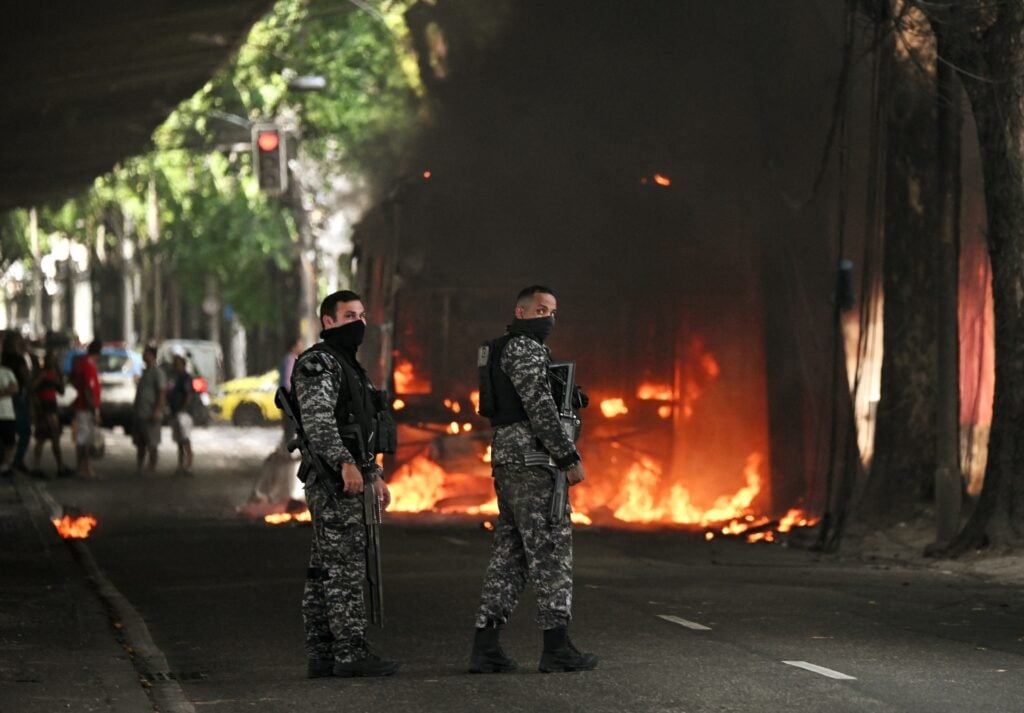
The effects of this transformation are already visible on the ground. The forced displacement of residents from a village in Ceará amid a conflict between rival factions, and the presence in Rio de Janeiro of members of groups from other Brazilian states during Operation Containment — launched on October 28, 2025, to halt the expansion of the CV — illustrate how localized instability increasingly intersects with broader criminal networks.
The characteristics of the new criminal organizations
The proliferation of factions, particularly in the northeast, has intensified competition over territory and illicit markets, driving violence and undermining local governance. In the state of Bahia alone, the Geneva-based think tank, Global Initiative Against Transnational Organized Crime (GI-TOC), recorded more than 3,500 violent incidents linked to criminal disputes between May 2022 and April 2025.
Some factions have emerged as splinter groups from larger organizations, such as the Primeiro Comando Puro (PCP), which formed after breaking away from the PCC. Others operate as localized extensions of larger networks, such as the Terceiro Comando Puro (TCP) Cangaço, active in Ceará as an extension of the TCP based in Rio de Janeiro.
“There are pragmatic agreements to reduce costs and increase profits, but clashes occur when routes, retail markets, prisons, ports, or areas of criminal control become the subject of dispute. This hybrid model explains why factions like the PCC and CV remain central, even while coexisting with regional groups,” says Duton.
The consequences of this criminal fragmentation are directly affecting civilians. In Ceará, the number of people forced to flee their communities has grown rapidly as families abandon homes under pressure from rival factions. One example is the case of Uiraponga, in the municipality of Morada Nova: once home to roughly 2,000 inhabitants, only a handful of families remain.
The new geographies of the PCC and the CV
The PCC is currently Brazil’s most internationally connected criminal organization. Founded in the São Paulo’s prison system in 1993, it is estimated to have nearly 40,000 members, with at least 2,000 operating across 28 countries. Strategic alliances — including with the Italian ’Ndrangheta and Balkan mafias — have supported its international reach, including to Asia. “Its expansion strategy relies less on direct military conquest and more on profitable alliances and the regulation of illicit markets,” explains Duton.
While the PCC has pursued a more business-oriented, transnational model, the CV has followed a territorial and relationship-based strategy. Originating in Rio de Janeiro’s prison system in the late 1970s, the CV has steadily expanded its influence into strategic areas of the Amazon and the tri-border region between Brazil, Colombia, and Peru.
“The CV is transforming from a faction strongly linked to armed urban drug dealing into an organization more connected to Amazonian corridors, cross-border alliances, and converging economies — that is, drugs, illegal extraction, timber, predatory fishing, and territorial control,” Duton said.
Through its alliance with Família do Norte, the CV has secured influence over portions of the Solimões River in the Amazon, a key route for moving narcotics acquired in Peru toward urban markets in Brazil. In March 2026, police in Mato Grosso uncovered a training site inside an indigenous area where young recruits were being instructed in weapons handling, jungle survival, and tactical skills, reflecting ongoing disputes with the PCC over key trafficking corridors near Brazil-Bolivia border.
New paradigms of confrontation
This changing landscape requires more than traditional law enforcement responses. “At the national level, it is necessary to reduce the role of prisons as incubators for criminal factions, improve detention conditions, invest in prison security and rehabilitation, and avoid mass incarceration policies that facilitate criminal recruitment,” Duton said.
At the same time, the increasingly transnational nature of organized crime makes deeper international cooperation essential. “The most promising approach combines intelligence sharing, joint investigations, tracking financial flows, port and customs cooperation, and the exchange of data on weapons, cargo, and communications, in addition to technical support for the most vulnerable border countries,” Duton added.
Coordination among regional partners, with support from international institutions, is becoming increasingly critical. In February 2026, Brazil signed an agreement with Interpol to lead a regional task force focused on combating organized crime, strengthening access to global databases, and enabling real-time cooperation among Latin American law enforcement agencies.
Cooperation with the United States is also part of this evolving security framework. In April, Brazil’s Federal Revenue Service and U.S. Customs and Border Protection launched Project MIT (Mutual Interdiction Team), which provides for coordinated actions and intelligence sharing between the two countries, particularly in efforts to combat arms and drug trafficking.
This security cooperation extends across multiple domains, including maritime security, intelligence sharing, and efforts to disrupt transnational criminal networks. This includes participation in information-sharing and operational coordination mechanisms such as with U.S. Joint Interagency Task Force South (JIATF-S), which supports partner nations in countering illicit trafficking.
In parallel, Bolivia and the United States recently resumed operational counternarcotics cooperation after a 17-year break, a development relevant to Brazil given Bolivia’s role as a major producer and transit country for cocaine destined for Brazilian and global markets.
“The problem is not just drug trafficking, but the consolidation of criminal actors capable of connecting illicit markets, co-opting officials, infiltrating the legal economy, and exporting regional instability,” concludes Duton.