
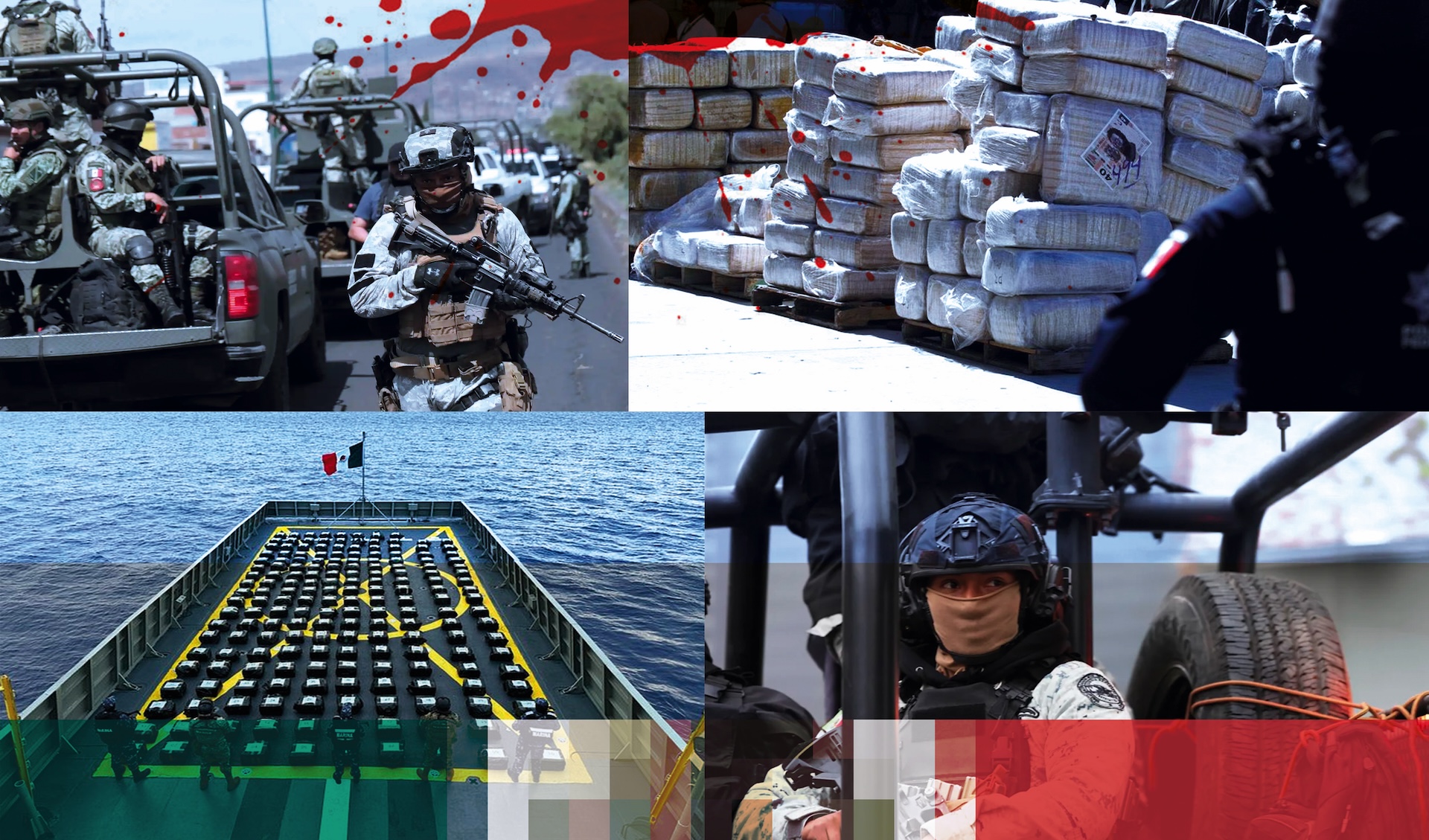
Recent operations against transnational criminal organizations (TCOs) — including maritime drug seizures in the Pacific Ocean and the arrests of alleged members of the Tren de Aragua (TdA) and the Jalisco New Generation Cartel (CJNG) — highlight growing operational coordination between Mexico and the United States in confronting organized crime networks operating across the hemisphere. These actions underscore the bilateral commitment to combating TCOs whose activities affect both countries and extend far beyond their borders.
Maritime and land operations: Binational coordination in action
In recent maritime operations in the Pacific, the Mexican Navy (SEMAR) and the U.S. Coast Guard worked in close coordination to intercept drug trafficking shipments. In one such operation on February 11, authorities seized 188 packages of cocaine west of Clarion Island in the Revillagigedo Archipelago, a remote Mexican island chain in the Pacific Ocean. According to SEMAR, the operation was carried out in conjunction with Joint Interagency Task Force South (JIATF-S), a U.S. Southern Command (SOUTHCOM) component.
Such operations reflect the growing depth of bilateral cooperation to counter illicit activities in the maritime domain, where intelligence sharing and operational coordination are key to success. “The exchange of information with the United States has generated favorable results for both countries,” said Mexico’s Secretary of Security and Citizen Protection Omar García Harfuch.
Separately, Mexican authorities also conducted significant operations on land targeting members of major TCOs. In February, Mexican security forces neutralized Nemesio Rubén Oseguera Cervantes, known as “El Mencho,” the leader of the CJNG, during a military operation in the western state of Jalisco. The operation, which benefited from intelligence cooperation with the United States, represented one of the most significant blows against organized crime in recent years.
In mid-January, in the state of Michoacán, federal and state forces arrested seven alleged members of the CJNG during operations in the Tierra Caliente region, where the cartel disputes control of territory with other criminal organizations and successor groups operating in the area, including factions linked to La Familia Michoacana, Los Caballeros Templarios, and the Sinaloa Cartel.
Days earlier, in Mexico City, Mexican authorities arrested six alleged members of the TdA in connection with crimes including extortion, human trafficking, and drug trafficking. Among those arrested were Lesli Valeri, accused of managing payments related to sexual exploitation networks, and Bryan “N,” an alleged financial operator with arrest warrants linked to trafficking and organized crime.
“The drug trafficking and transnational organized crime phenomenon cannot be tackled by a single country, not even the United States, and requires convergence between states and multilateral mechanisms,” Javier Oliva Posadas, professor and researcher at the National Autonomous University of Mexico, told Diálogo. According to Oliva Posadas, the dismantling of CJNG and TdA cells, along with the large seizure of cocaine, reflects concrete progress in the framework of technical interoperability between Mexico and the United States.
Transformation and expansion of criminal networks in Mexico
These operations take place in a broader context of transformation in the structure and activities of organized crime in Mexico.
According to the Global Organized Crime Index, criminal organizations have evolved from local networks into complex national and transnational structures capable of controlling the production and distribution of drugs such as cocaine, methamphetamines, and fentanyl. In addition, these organizations have diversified their activities to include extortion, human trafficking, kidnapping, fuel theft, and illegal logging, expanding their influence and weakening institutional capacities in several regions.
A report by the Panamerican University in Mexico highlights that criminal groups frequently resort to corruption, bribery, and influence peddling to protect their structures, which has facilitated their infiltration into key institutions. At the same time, cartels such as the CJNG and the Sinaloa Cartel have consolidated international supply chains for chemical precursors — primarily sourced from China and increasingly from India — to produce synthetic drugs.
Although the CJNG and TdA engage in many of the same criminal activities, they have important structural differences. According to Oliva Posadas, the CJNG originated as a drug trafficking organization and later diversified its activities into areas such as fuel theft, extortion, and even attempts to influence local political processes. In contrast, the TdA, despite its international expansion, primarily focuses on crimes such as extortion, human trafficking, and migrant smuggling, with comparatively less involvement in large-scale drug trafficking.
In recent years, the group has expanded from Venezuela into several countries in South and Central America and has established criminal cells linked to migrant smuggling, extortion, and sexual exploitation networks.
The Global Organized Crime Index also emphasizes that violence remains a central component of these organizations’ operations. Criminal groups frequently employ lethal tactics to dispute territories and impose control, exacerbating homicide rates and undermining governance in several regions.
Areas of bilateral cooperation: Recent advances
Cooperation between Mexico and the United States extends beyond operational actions and has increasingly been reinforced through institutional agreements and joint training exercises.
In February, the Mexican Senate authorized the participation of 19 members of the U.S. Navy in a military training exercise in Campeche, carried out February 15-April 16. These exercises seek to strengthen the operational capabilities of special forces units from both countries and improve coordination in complex security environments.
Similarly, in January, Minister García Harfuch met with Kash Patel, director of the Federal Bureau of Investigation (FBI), during which both parties agreed to strengthen the exchange of strategic information and the detention of priority criminal targets. Likewise, in December 2025, during the second meeting of the Mexico-United States Security Implementation Group, authorities from both countries agreed on concrete measures to address emerging threats such as the use of drones by criminal organizations and fentanyl trafficking. The agreement also included improvements in extradition procedures and financial investigations targeting illicit networks.
Since September 2025, both governments have maintained a high-level group tasked with monitoring progress on bilateral security commitments. This mechanism operates on the basis of reciprocity and mutual trust to dismantle criminal organizations, curb drug and arms trafficking, and disrupt illicit flows of people and resources.
Military diplomacy and shared challenges
Beyond operation cooperation and training exercises, bilateral engagement has also expanded through military diplomacy. Oliva Posadas highlighted its role in strengthening the relationship between the two countries. In this context, he referenced a meeting held in January 2026 at the recently inaugurated U.S. Embassy complex in Mexico City, with the participation of representatives from the Mexican Navy, along with members of the U.S. Northern Command.
These meetings represent an important channel for strengthening military dialogue and coordinating responses to shared threats.
“Mexico’s geographical position and its relationship with the United States and Canada place it in a key strategic environment in terms of defense and cooperation,” Oliva Posadas said, emphasizing that bilateral agreements have generated levels of trust that allow both countries to address security challenges across the hemisphere in a coordinated manner.
The strengthening of cooperation between Mexico and the United States not only targets organized crime directly but also contributes to building a more resilient security partnership capable of responding to transnational threats that affect both nations and the wider region.