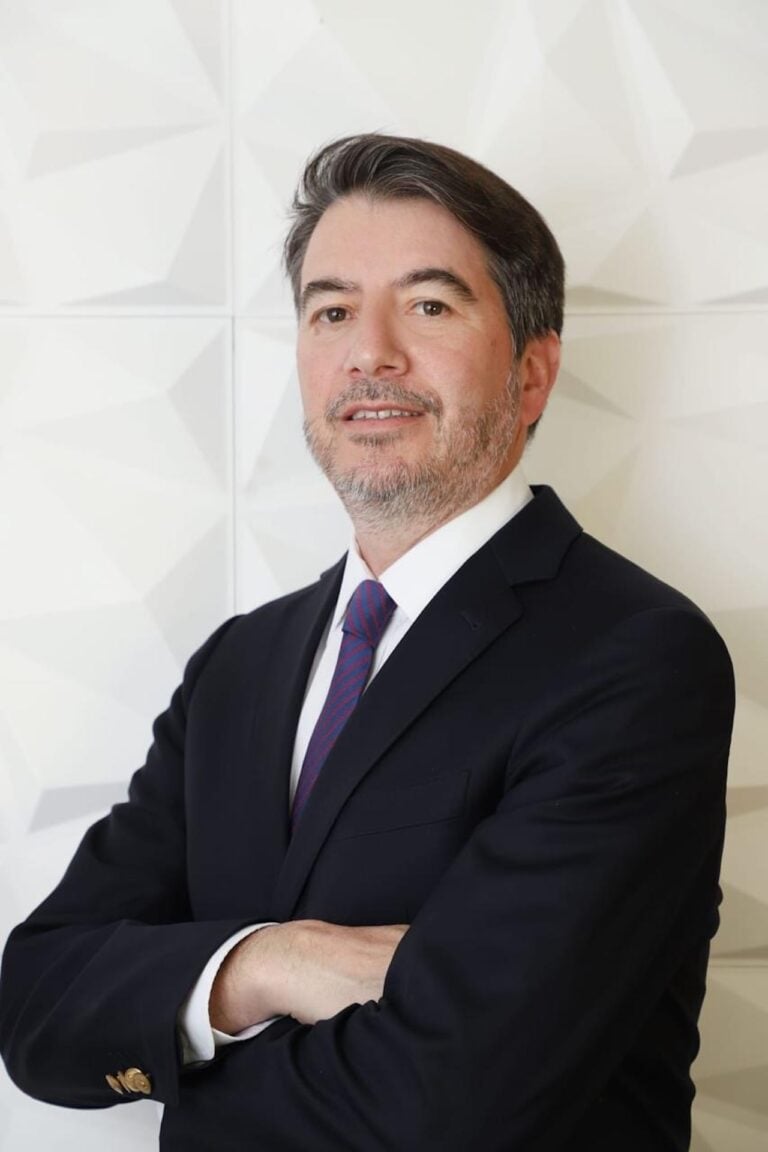


At the head of the Ecuadorian Armed Forces’ Joint Command since December 2023, at a very critical time in the history of the South American country, Admiral Jaime Patricio Vela Erazo must, among many challenges, maintain the operational rhythm of the Armed Forces to curb transnational criminal groups and bring back security to the people. Diálogo had the opportunity to speak with Adm. Vela about his priorities, challenges, and collaboration with the United States, among other topics, during the South American Defense Conference (SOUTHDEC) of August in Chile.
Diálogo: Adm. Vela, you have been leading the Ecuadorian Armed Forces’ Joint Command since December 2023. What have been your biggest challenges and priorities so far?
Admiral Jaime Patricio Vela Erazo, chief of the Ecuadorian Armed Forces’ Joint Command: The biggest challenge I have faced so far after eight months in office has been to maintain the operational rhythm of the Armed Forces in the fight against terrorist groups and organized armed groups related to transnational organized crime. In this context, my priorities have been to exercise assertive leadership with the personnel, to provide the forces with the necessary means to sustain operations, and to exchange information with partner countries.
Diálogo: How has your almost 40 years of experience with the Ecuadorian Navy prepared you to assume this post?
Adm. Vela: During service in any branch of the armed forces, the institution offers us constant training and improvement through different courses. Likewise, my time in operational and administrative units has given me a broad spectrum of military planning for peacetime, crisis, conflict, or war. Today my country is experiencing a non-international armed conflict, unprecedented in the hemisphere. The Ecuadorian Armed Forces are responding to this challenge with firmness, commitment, and professionalism — fundamental pillars that our institution cultivates in all of us who belong to it.
Diálogo: Ecuador has been plagued by a wave of violence, for which President Daniel Noboa declared an “internal armed conflict” in January. In July, President Noboa again decreed a state of emergency, the third time this year. How is coordination with the National Police to neutralize the organized crime that threatens the country and its citizens?
Adm. Vela: Since the beginning of the operations, after the declaration of the non-international armed conflict or internal armed conflict, we created what we call the “Security Block,” formed by the Armed Forces and the National Police. The plans that we had separately were updated to generate fully coordinated plans to create synergy in operations and to be more forceful in our fight against terrorist groups and transnational organized crime.
Diálogo: In March, the Ecuadorian Air Force received its first C-130 Hercules aircraft, delivered by the United States. How has this aircraft benefited the operations of the Armed Forces so far?
Adm. Vela: This aircraft, after the training phase, has become a very important means in the operations we carry out. Troop transport, material transport, spare parts, and even medical evacuations are some of the tasks that the C-130 has accomplished.
It has completed more than 158 missions, 172 flight hours, has transported throughout Ecuador more than 117,372 pounds [53,240 kilograms], a total of 5,950 passengers, and 26,700 pounds [12,111 kilograms] of drugs seized for prosecution.
Diálogo: The Kentucky National Guard also has C-130s among its assets, which will be advantageous for knowledge exchanges. What other types of exchanges have you been conducting with your U.S. partner under the U.S. Department of Defense’s State Partnership Program?
Adm. Vela: The cooperation with the Kentucky National Guard is beneficial to the interests of the Armed Forces, promoting and consolidating, among other things, collaboration in training and provision of equipment for military operations in a wide range, as well as in terms of exchange of experiences, training in response to natural disasters, training for crisis response, etc.
As an example, this year alone we have already had two expert exchanges in Ecuadorian territory. The first was in the Special Forces Brigade “Patria” where a team of experts in Detention Center Operations arrived, which is highly propitious for security issues. And the second was with the participation of a team of experts in first aid and care of the wounded in combat in the Infantry Brigade “Pichincha” to exchange experiences and training in this area.
Diálogo: The United States and Ecuador are working together to address drug trafficking and organized crime activities, especially along Ecuador’s northern border with Colombia. Among the various instruments signed by Ecuador and the United States is the Status of Forces Agreement, which allows for a deepening of military relations between the two countries. How, in more concrete terms, has the support of the United States, and more specifically of U.S. Southern Command (SOUTHCOM), been in this regard?
Adm. Vela: Beyond any agreement that have been signed, I believe that the support of the United States toward our country has become evident with the continuous demonstrations of friendship on the part of Mrs. General Laura Richardson [SOUTHCOM commander until November 7, 2024]. Undoubtedly, her interest shown both in her visit to Ecuador, as well as in her statements at the hemispheric level, related to what is happening in my country, and show the importance she attaches to our bilateral relations.
The following are some of the most concrete ways in which this support has been expressed:
– Military training: in areas such as maritime interdiction, intelligence, special operations, and the fight against organized crime. This has allowed Ecuador to strengthen its capacity to detect and combat drug trafficking.
– Military equipment: Various military equipment such as patrol boats, vehicles, weapons, and communication systems have been delivered to improve the ability of Ecuadorian forces to operate in challenging environments such as the Pacific Ocean.
– Intelligence exchange.
– Technical advice.
– Financing.
Diálogo: Another threat that Ecuador faces is illegal, unreported, and unregulated (IUU) fishing. China is the biggest culprit, being one of the greatest threats to marine ecosystems as it depletes fish stocks and undermines a country’s ability to feed its population. What progress has been made in monitoring and preventing IUU fishing?
Adm. Vela: Regarding IUU fishing, we have been able to consolidate the Maritime Authority Exercise “GALAPEX,” which this year had its third edition with the active participation of several countries in the region, as well as Europe, Asia, and even organizations such as the European Union and the United Nations Office on Drugs and Crime (UNODC). We seek to confront this scourge in a regional manner and great progress has been made in this fight, understanding that, possibly, within this illicit action, other illegal activities may be hidden. We brought to this meeting [SOUTHDEC] an initiative to increase the exchange of information regarding the foreign-flagged fishing fleet that remains in the southern part of the Western Hemisphere from the maritime domain of Argentina to Ecuador, especially near the Galápagos Islands, passing through the maritime domains of Chile and Peru.
Diálogo: What progress has been made in cyber defense?
Adm. Vela: Ecuador in 2020 was accepted as a permanent member of the Ibero-American Cyberdefense Forum (FIC), through which it participated in sessions to articulate actions to strengthen hemispheric cyberspace security, in addition to sharing information on common cyberthreats that affect member states. Likewise, in 2021, we became part of the Cyber Defense Forum of the Inter-American Defense Board, as well as the Computer Security Incident Response Team of the Americas (CSIRT) and the Inter-American Committee Against Terrorism (CICTE-OAS), instruments through which regional cooperation in the field of cyber defense is consolidated.
As of 2021, the cyber defense component was included within the Memorandum of Understanding (MOU) that allows the Cyber Defense Command to be part of the Kentucky National Guard training program. Under this program, the Armed Forces have been trained in cyber defense tactics, techniques, and procedures, where Ecuador was considered to host two cyber exercises in 2023 and 2024 as part of multinational exercise Resolute Sentinel.
During internal operations, the Cyber Defense Command has managed to dismantle several data networks in detention centers, which are used by organized criminal groups, known as terrorists, to commit transnational crimes through cyberspace.
Thanks to the support of an expert in critical infrastructure from the United States, the Cyber Defense Command in 2023, developed the digital critical infrastructure of the defense sector and the methodology for cataloging the State’s digital critical infrastructure, which is under development with 16 state agencies.