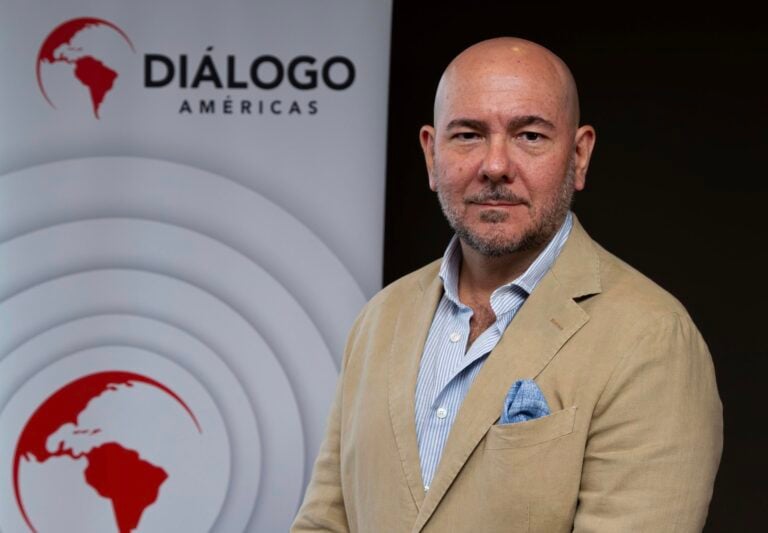

In a context where organized crime affects numerous communities across Latin America, citizen security has become one of the population’s primary concerns. For Cristian Zamora, mayor of Cuenca, Ecuador, and president of the Latin American Federation of Cities, Municipalities, and Associations of Local Governments (FLACMA), strengthening citizen participation and community cohesion is a fundamental part of the solution.
During the 2026 Mayors of the Americas Summit, organized by Florida International University (FIU) and held in Doral, Florida, in late April, Diálogo spoke with Zamora about the role citizens play in security, the challenges facing local governments, and the lessons that could help strengthen citizen security across the region.
Diálogo: Based on your experience in public service, how have you seen the impact of organized crime evolve, and how is it affecting citizens’ daily lives?
Cristian Zamora, mayor of Cuenca and president of the Latin American Federation of Cities, Municipalities, and Associations of Local Governments (FLACMA): Ecuador was, until not long ago, a peaceful country. Unfortunately, in recent years the country has taken a different path and now records some of the highest homicide rates in the region.
This problem is not evenly distributed throughout the country; it is concentrated in specific areas, but that does not make it any less concerning. Organized crime has clearly been one of the main drivers of this phenomenon. There has also been a lack of public policy and investment at different levels of government that has contributed to the situation.
Security is a state responsibility, but organized crime has begun to erode something fundamental: people’s peace of mind. When a society loses its sense of security, it also loses stability, opportunities for development, and the ability to build a better future. Young people are particularly vulnerable, as criminal organizations often target them as they expand their influence.
Diálogo: From your perspective, what role do citizens play in improving security, and why is their participation essential in confronting criminal networks?
Zamora: Citizens are fundamental. Cuenca, the city I serve as mayor, is one of the safest cities in Latin America, in contrast to the situation experienced in other parts of the country.
Our violent death rate per 100,000 inhabitants is very low. I believe one of the reasons is precisely the role played by citizens.
There is a strong sense of cohesion within neighborhoods. People respond, come together, and know one another. These are not isolated communities where no one knows their neighbors. That connection among residents is essential for responding to challenges such as insecurity and organized crime.
In fact, I believe part of the root problem in many cities is the growing disconnection among citizens themselves. That is why, through our Citizen Security Council, we continuously promote neighborhood life, community organization, and citizen participation so that we can look after one another.
Diálogo: How can this citizen-participation strategy be applied in other cities?
Zamora: Part of the answer lies in urban planning. Cuenca has not promoted urban growth based on gated developments where people have little or no interaction with one another.
Here, people still see each other in the streets, recognize their neighbors, and maintain everyday relationships within their communities. That level of integration helps people get to know one another and reinforces the idea that citizens have tremendous power to protect their surroundings.
When security problems have arisen, communities have organized themselves to defend their neighborhoods and send a clear message that they will not allow their peace and tranquility to be disrupted.
We have also implemented technological tools such as community alarm systems connected to mobile phones. When an emergency occurs, neighbors receive an alert that enables them to respond collectively. That capacity for community organization is essential in confronting insecurity.
Diálogo: For citizens who believe that reporting a crime may be risky or ineffective, what message would you give them?
Zamora: If trust in reporting crimes is lost, much more than an information mechanism is lost; the connection between citizens and institutions is weakened. I understand that many people are afraid, and in many cases that fear may be justified.
That is why, beyond simply encouraging people to report crimes, it is essential to have a system capable of protecting information and guaranteeing an effective response.
Many people lose faith because they report crimes and see no results. Public policy and investment must focus on protecting those who cooperate with authorities, safeguarding confidential information, and, above all, providing rapid responses. Without protection and results, it is very difficult for citizens to maintain confidence in the system.
Diálogo: What are the main challenges municipalities face when criminal groups attempt to influence communities, local economies, or public trust?
Zamora: One of the main challenges is coordinating effectively with different levels of government, whether state, national, or federal, depending on how each country is organized.
Security is a multidimensional issue. If only the city acts, or only the province acts, or only the national government acts, important efforts are made, but results remain limited if there is no coordination among all levels of government.
Unfortunately, partisan political issues sometimes interfere with that coordination. As a result, citizens — who should be at the center of all actions — are pushed aside. We must be attentive to extreme positions on either side when they prevent different actors from working together on issues as important as security.
Diálogo: As president of the Latin American Federation of Cities, what common challenges do you see across the region, and what could help strengthen citizen security?
Zamora: One of the most important challenges is financing. Throughout our region, resources are always a challenge. Municipalities need access to funding to invest in infrastructure, security, health care, and other essential services.
I believe those resources should be more accessible, less bureaucratic, and easier for local governments to obtain and manage. Municipalities are the institutions closest to the people and the first to receive their demands.
Another challenge I see is growing political polarization across the region. At times, extreme positions emerge that make dialogue and consensus-building more difficult.
Society is nuanced. Not everything is black and white. Diversity, cooperation, dialogue, and respect for democracy are where we find common ground to address shared challenges.
People are not concerned with whether an official belongs to one political tendency or another. They want to feel safe, live in peace, and be able to work. In that sense, I believe the political class has a responsibility to set aside differences when dealing with issues as important as citizen security.
Diálogo: Where does security rank among citizens’ concerns?
Zamora: In Ecuador, and I would say throughout much of the region, security is a top priority.
What is the value of having other aspects of life resolved if a person does not feel safe walking down the street or fears for the safety of their family? Security is the foundation upon which many other aspects of well-being are built.
In Cuenca, every time we conduct surveys or public consultations, security appears among the population’s top concerns. If people do not feel safe enough to work, study, or carry out their daily activities, their quality of life is inevitably affected.
That is why security remains one of the primary expectations citizens have of their authorities. People expect concrete actions to address the factors that undermine peace and social stability, particularly those related to organized crime and illicit activities.
Diálogo: From your perspective, how does international cooperation — particularly with partners such as the United States — translate into tangible benefits for citizens at the local level, and how can these efforts be further strengthened?
Zamora: The United States is a very important partner for the region, and there is significant cooperation through national governments. That is positive and should continue.
However, I believe it is also worth considering how some of those efforts can reach local governments more directly — municipalities, provinces, departments, or states, depending on each country.
Many strategies are designed at the national level, but they do not always reach the level closest to citizens with the same intensity. Yet that is precisely where challenges related to insecurity, violence prevention, and the recruitment of young people by criminal organizations are confronted.
In areas such as counternarcotics efforts and the prevention of organized crime, greater cooperation with local governments could generate significant results because of the close relationship these institutions maintain with the population.
Diálogo: Looking ahead, what should be prioritized to strengthen citizen security and reinforce trust between communities and institutions?
Zamora: I believe the first priority is providing rapid and concrete responses from the institutions responsible for security.
In Cuenca, for example, security is primarily a state-level responsibility. However, that does not mean local governments can ignore the problem. Citizens do not distinguish between levels of government; they simply expect their authorities to help solve problems.
That is why coordination is essential. Political leaders must work together so that public policies produce tangible results for citizens.
We must also prevent partisan differences from becoming obstacles to cooperation. Security requires sustained collaboration among institutions, communities, and different levels of government.
Only through that integrated effort will we be able to more effectively confront organized crime and the illicit activities that threaten the peace and development of our societies.