

In a powerful demonstration of international cooperation, Ecuador and the United States concluded Operation Pulpo (Octopus) in late March, a highly successful joint counternarcotics mission in the Eastern Pacific. The operation disrupted key maritime smuggling routes used by narcoterrorist networks, resulting in significant drug seizures and highlighting the evolving nature of multinational efforts to counter narcoterrorism.
The Eastern Pacific remains a primary corridor for narcoterrorists transporting cocaine and other illicit commodities from South America toward Central America, North America, the South Pacific, and Australia. Traffickers employ difficult-to-detect methods, including go-fast boats, low-profile vessels, semi-submersibles — often referred to as “narco-subs” — fishing vessels, and commercial shipping containers. The sheer scale of this maritime domain presents a complex challenge for any single nation’s air, naval, and law enforcement forces.

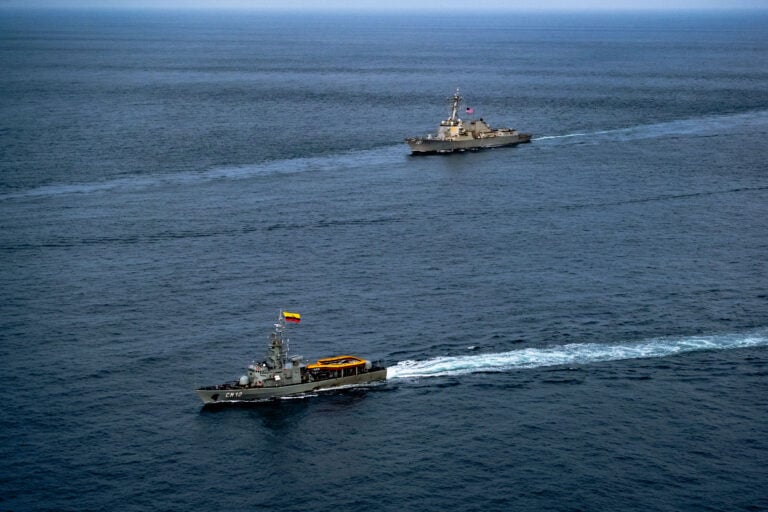
Recognizing this challenge, Operation Pulpo leveraged a groundbreaking cooperative model: the U.S. Ship Special Mission (SSM) capability. This approach allows U.S. vessels operating under the tactical control of Joint Interagency Task Force South (JIATF-S) to embark and deploy high-speed interceptor boats and partner nation crews.
By operating hundreds of miles offshore, the U.S. “mothership” effectively serves as a forward-deployed launch platform, dramatically extending the range, endurance, and operational tempo of Ecuador’s maritime forces. This enables Ecuadorian teams to conduct interdictions in international waters far beyond their traditional patrol areas — without requiring deployment of large naval assets of their own.
“The SSM concept is a paradigm shift in the fight against narcoterrorism,” said a spokesperson for U.S. Southern Command’s (SOUTHCOM) JIATF-S, which leads international counternarcotics operations in the region. “It pairs the endurance and reach of U.S. naval assets with the specialized expertise of our highly skilled Ecuadorian partners, creating a potent and agile force multiplier. Operation Pulpo is a testament to what we can achieve when we work together.”
This “mothership” model enabled real-time action on intelligence gathered by JIATF-S, allied, and partner nation assets. Instead of returning to shore or relying on limited-range patrols, Ecuadorian interceptor teams remained forward-positioned at sea, ready to launch at a moment’s notice.
Once a suspicious vessel was detected, teams deployed directly from the SSM platform, rapidly closing the distance to conduct boardings and inspections under Ecuadorian legal authority. This seamless integration of intelligence, assets, and jurisdiction proved highly effective in disrupting narcoterrorist activity.
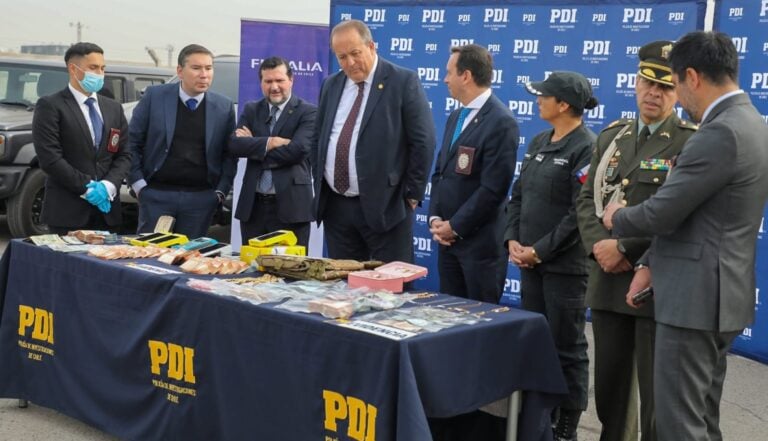
In one notable interdiction approximately 180 nautical miles off Ecuador’s coast, Ecuadorian forces seized three coordinated narcoterrorist vessels. The operation, led by the Ecuadorian Navy with critical support from U.S. forces, resulted in the seizure of 2,062 kilograms (over 4,500 pounds) of cocaine, demonstrating the effectiveness of combined operations.
The operation also highlighted Ecuador’s growing operational capabilities and leadership in maritime interdiction. Through close coordination and the integration of advanced technologies, both nations enhanced their ability to detect, track, and disrupt the narcoterrorist networks that threaten regional stability and security.
A senior Ecuadorian official, authorized to speak about the operation, stated that “the SSM enables Ecuadorian forces to project their operational impact more than 200 nautical miles from the coast.” The official noted this is particularly effective in combating narcoterrorism in the waters south of the Galapagos Islands as “this area serves as a major maritime narcotrafficking route to North and Central America, French Polynesia, and Australia, and is further complicated by illegal Chinese fishing operations.”

The SSM effort was strengthened by cutting-edge support from the Artificial Intelligence and Machine Learning (AI/ML) Joint Operations Center (JOC) at JIATF-S. The center processes large volumes of data to identify suspicious maritime activity, tipping off the SSM mothership to potential targets.
According to a JIATF-S spokesperson, “When paired with the forward-deployed interceptor teams, the [AI/ML JOC] capability significantly reduced response times, allowing Ecuadorian forces to act within minutes of detection and execute boardings under their own national authority.”
Operation Pulpo is a key component of the broader multinational Campaign MARTILLO (Hammer), through which JIATF-S coordinates a 21-nation partnership to deny narcoterrorist organizations the use of air and maritime trafficking routes. The effectiveness of this collaboration is reflected in record results: In fiscal year 2025, JIATF-S-supported operations led to the seizure or disruption of 455.8 metric tons of cocaine, a total expected to be surpassed in 2026, driven in part by innovative approaches such as those showcased during Operation Pulpo.
According to an Ecuadorian official, JIATF-S transcends international differences, allowing nations to align in the common fight against narcoterrorism. “The spirit of cooperation by the international and interagency team at JIATF-S allows decisions to be made in minutes that would otherwise take days,” the official stated, adding that “The success of Operation Pulpo is a testament to this fact.”
The success of Operation Pulpo underscores the strength of the Ecuador-U.S. security partnership and the importance of sustained multinational cooperation. By combining resources, intelligence, and expertise, partner nations are better positioned to counter narcoterrorist networks that threaten regional stability.
As traffickers continue to adapt, operations like Pulpo demonstrate that coordinated, forward-deployed capabilities can deny them freedom of movement — even across the vast expanses of the open ocean.