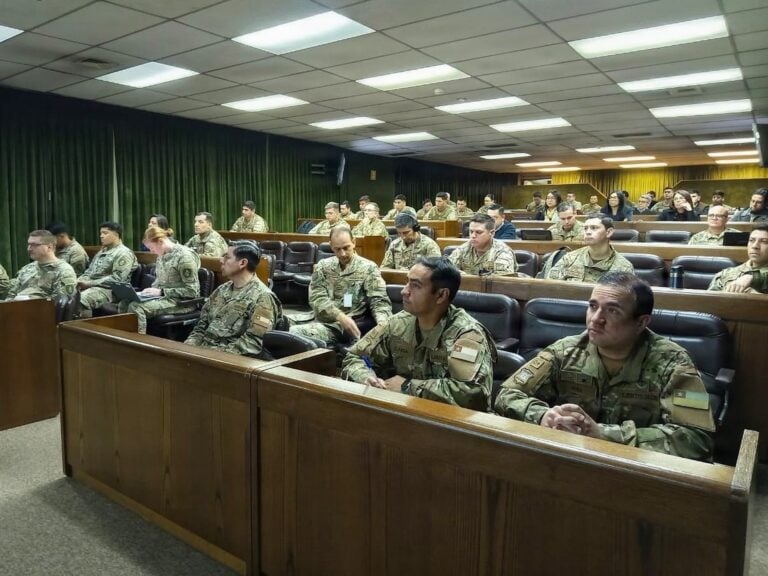


Ecuadorian Army, Navy, and Air Force personnel trained alongside members of the Kentucky Army National Guard during Exercise EL GATO in Salinas, Ecuador, May 10–19, marking the 30th anniversary of the partnership between Ecuador and Kentucky under the State Partnership Program (SPP).
The exercise brought together military police and security personnel from both partners to strengthen interoperability, exchange operational experiences, and deepen a relationship built through three decades of military cooperation. Kentucky’s partnership with Ecuador began in 1996 and has grown through recurring exchanges, training events, and leader engagements designed to strengthen professional ties and operational readiness.
For U.S. Army Captain Demitri Ray, commander of the Kentucky National Guard’s 940th Military Police Company, EL GATO represented an important step in the evolution of the partnership.
“With the outlook to strengthen that partnership, we do this because we want to bring not just 10 or 12 people down on an SPP mission,” Capt. Ray said. “We want to get to the point where it’s an Ecuadorian unit and a Kentucky National Guard unit training together.”
The training began with an opening ceremony before participants divided into platoon-level training groups. The 940th’s 1st Platoon partnered with the Ecuadorian Army, 2nd Platoon partnered with the Ecuadorian Air Force, and 3rd Platoon partnered with the Ecuadorian Navy.
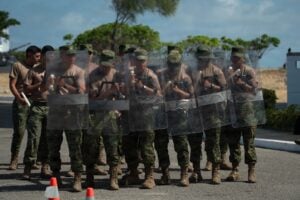
Training exchanges focused on military policing fundamentals before expanding into interpersonal communication, conflict de-escalation, search and apprehension procedures, and riot-control formations and movements.
Throughout the exercise, participants compared techniques and discussed how each force approaches similar missions. The exchanges allowed both partners to reinforce skills while building familiarity and trust through practical, side-by-side training.
The exercise culminated in a simulated scenario requiring Ecuadorian personnel and Kentucky soldiers to work together to defend a government facility from a riot. Combined teams applied the communication, de-escalation, movement, and crowd-control techniques practiced throughout the exercise.
Training in Ecuador also provided participants an opportunity to operate in a different environment and work through language and cultural differences while integrating with partner forces in real time.
“When you actually put boots on the ground in another country, it gives them confidence that we can actually deploy and conduct an operation,” Capt. Ray said.
For Sergeant Aide Figueroa, a clerk for the Kentucky National Guard’s Joint Force Headquarters G-3 (Operations) section, the exercise highlighted the importance of communication and cultural understanding. Having grown up speaking Spanish as her first language, she helped facilitate interaction between Kentucky soldiers and their Ecuadorian counterparts.
“When I say communicate, it’s not just words,” Sgt. Figueroa said. “It’s tone, facial expressions, body movements. All that helps understand what someone’s trying to say to the other person.”
One of the most memorable moments for Sgt. Figueroa came during riot-control training, when participants compared techniques and discussed how each force approaches similar challenges.
“They were trying to communicate, compare and contrast,” Sgt. Figueroa said. “All of us learned from each other the different techniques we used for riot control.”
Capt. Ray also emphasized the role bilingual soldiers played in strengthening cooperation throughout the exercise.
“When we first came, I was wondering if we were going to be able to do this without interpreters,” Capt. Ray said. “But our bilingual soldiers impressed me so much that it’s changed my outlook on it. I think it worked out better than having private professional interpreters because those soldiers are with us 24/7, and they understand the training.”
For Sgt, Figueroa, the shared language helped establish immediate connections between participants.
“When you speak the same language, it’s as if you already know them,” Sgt. Figueroa said. “It’s like distant family.”
Cpt. Ray noted the significance of sustaining a partnership that has endured for three decades.
“It’s hard to maintain relationships,” Cpt. Ray said. “Some marriages don’t last that long, but our partnership is still going strong, and we look forward to more training together to come.”
He added that bringing a full military police company to Ecuador opens opportunities for future training in different operational environments across the country, including the Amazon region and the highlands. The experience could also create opportunities for larger Ecuadorian units to train alongside Kentucky National Guard personnel in the United States.
“Bringing a large unit like this opens the door to so much more we can do,” Capt. Ray said.
Sergeant First Class Joshua Webb, readiness noncommissioned officer for the 940th, said one of the exercise’s most important outcomes was the relationships established among participants.
“I hope that they take away a little bit on the training side, but the bigger piece is the relationship building across the board,” Sgt. 1st Class Webb said. “Every one of our soldiers has made fast friends with their partners in the Ecuadorian branches. I like to think that we’ve laid a good foundation for that across all three of our platoons and theirs.”
As Ecuador and Kentucky celebrate 30 years of partnership, Exercise EL GATO demonstrated how sustained military-to-military cooperation can evolve from small exchanges into combined training involving operational units from multiple services. Leaders from both partners expressed interest in expanding future exercises and continuing to strengthen interoperability through practical, mission-focused collaboration.