

The controversy between Peru and Chinese state-owned shipping company Cosco Shipping over exclusive control of the mega-port of Chancay highlights the complex geopolitical and economic dynamics surrounding negotiations with China.
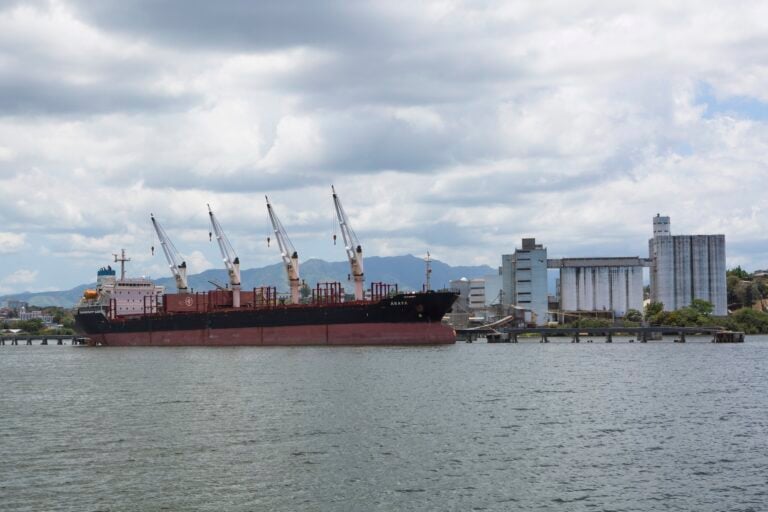
Chancay, located 75 kilometers from Lima, will be the first Chinese logistics center in the Pacific and the only Cosco-operated one in the region. After penetrating Europe through the Piraeus Port Authority in Greece, Cosco Shipping is set to access South America through Chancay, with a $3 billion investment.
“It’s disturbing that [the exclusivity] has come to light after 3 years. This highlights a series of flaws,” Sergio Cesarin, coordinator of the Center for Asia-Pacific and India Studies at the National University of Tres de Febrero in Argentina, told Diálogo on June 8. “During this time there was pressure that hindered the truth from being reveled and for solutions to be implemented.”
Administrative error
The conflict began in March, when Peru’s National Port Authority (APN) filed a lawsuit through the Ministry of Transport and Communications, requesting the annulment of a 2021 agreement that gave Cosco Shipping exclusivity to operate all port services, “due to an administrative error” made by Peruvian officials, Peruvian security magazine ProActivo reported.
In response, the Chinese consortium insisted on maintaining its 30-year exclusivity, even threatening to withdraw from the project and resort to international arbitration. The APN argued that it did not have the authority to grant exclusivity and proposed that the Peruvian Congress modify Ports Law to resolve the problem.
“Behind this is the Chinese government itself. All the Chinese weight is behind Cosco,” says Cesarin. “Our rulers and economic advisors make decisions based on the search for immediate profits, but when China invests or lends money it does so under leonine conditions.”
On May 30, Peru amended the Port System Law, giving automatic exclusivity to private ports. This legislative change allows privately managed ports, such as Chancay, to operate under a regime of exclusivity for a period of 30 years, extendable for an identical period, Chilean news site Portal Portuario reported.
“Evidently, in this case China was not going to break ties with Peru, especially considering that the construction of the port terminal is well advanced,” Cesarin said. “Although there was no total rupture, there was significant cross pressure, which led Peru to grant the 30-year concession.”
Chinese economic coercion
In the past 20 years, China has intensified economic coercion against various countries in response to different incidents. A prominent example is the economic pressure against Lithuania, motivated by its attempt to forge closer ties with Taiwan, says a study from Switzerland by the Asia Society Policy Institute.
China responded with a series of retaliatory measures, including a de facto trade embargo and a ban on European products containing Lithuanian components, thus threatening the European Union’s single market. These measures significantly impacted various sectors such as Lithuania’s high-tech laser industry, which is dependent on the Chinese market, the Asia Society Policy Institute indicated.
The study notes that many aspects of Beijing’s economic coercion campaign against Lithuania are similar to other episodes: The measures are informal and lack transparency, allowing China to plausibly deny its actions. Moreover, Beijing combines these measures with diplomatic pressure and tends to intensify its pressure campaign over time, the report says.
In a similar incident, Guatemala reported on May 25 that China had rejected Guatemalan containers of macadamia nuts. Guatemala is one of 12 countries that maintain diplomatic relations with Taiwan. Beijing has not responded to the Guatemalan government on the issue, Reuters reported.
“Economic and commercial coercion is a tool China uses. By establishing economic relations, especially with Latin American countries, it generates a dependency that gives it elements of pressure and penalization if a country tries to change the rules of the game,” Cesarin said. “It’s a strategy of force and pressure, which China employs with all the countries where it operates.”
“Chinese firms have acquired Peruvian companies in key sectors such as mining, energy, and telecommunications,” he added. “China is deeply integrated into the Peruvian economy. These factors influenced the port’s decision making.”
China is increasing its presence in Latin America by acquiring stakes in ports, building 5G mobile networks, major roads and bridges, and space monitoring stations, British daily Financial Times reported. Beijing hides its intentions under the discourse that mutual benefit is the basis of its infrastructure projects abroad.
The Asia Society Policy Institute offers solutions that governments in China’s crosshairs can adopt or adapt: “Be prepared for sustained pressure, identify clear and politically viable requests, use the World Trade Organization’s dispute settlement system, coordinate with industry, and control the narrative to refute Beijing.”