The landscape of organized crime in Trinidad and Tobago took a decisive turn in 2025, as the nation launched an aggressive, technology-driven offensive against transnational criminal organizations (TCOs). In this renewed effort, a high-stakes partnership with the United States was further consolidated as a fundamental pillar for achieving unprecedented results in maritime security and regional stability.
A partnership for regional peace and security
The year 2025 was defined by a surge in bilateral operational synergy. The arrival of the USS Gerald R. Ford Carrier Strike Group in November marked a peak in this cooperation. Prime Minister Kamla Persad-Bissessar openly expressed her satisfaction with the U.S. presence during these intensified anti-drug operations, noting that the collaboration has led to a “significant reduction in the trafficking of guns, drugs, and humans into our country.”
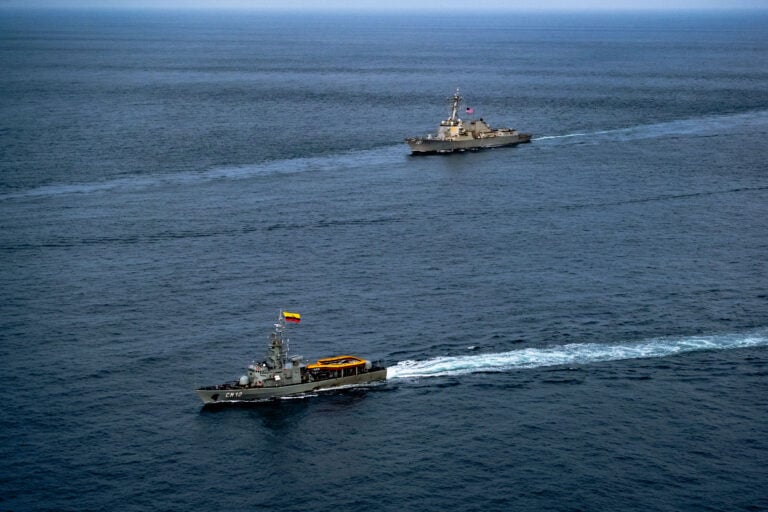
Central to this effort has been the U.S. strategy of countering narco-terrorism and enhancing maritime interdiction capabilities, as part of its commitment to Caribbean security. By deploying an array of naval assets and surveillance platforms, the partnership supported the Trinidad and Tobago Defence Force (TTDF) with intelligence and reach to intercept high-speed vessels in international waters.
Prime Minister Persad-Bissessar underscored the importance of this alliance in the face of evolving threats. “Our partnership with the U.S. has already achieved meaningful success, and together we will continue to press forward until we win the war on crime which has plagued TT and threatens stability across our region,” the Prime Minister stated via X in mid-November.
Specialized training
The collaboration in 2025 moved beyond routine drills to include specialized, high-intensity training in support of the TTDF and the Trinidad and Tobago Police Service (TTPS). In November, personnel from the 22nd Marine Expeditionary Unit (MEU) conducted high-level training exercises with local forces. These engagements focused on tactical maneuvers in both urban and rural environments and sought to simulate the complex conditions of counternarcotics operations.
In addition, Trinidad and Tobago co-hosted the 40th iteration of U.S. Southern Command- (SOUTHCOM) sponsored exercise Tradewinds in April and May. The multinational exercise brought together over 1,300 personnel from 24 nations to focus on countering transnational organized crime and enhancing maritime domain awareness, further solidifying the role of Trinidad and Tobago as a regional leader in security cooperation.
Tangible results: Technology and order
U.S. support also manifested in the deployment of advanced technology. A breakthrough occurred with the installation of a state of the art radar system on the island of Tobago, providing the local Coast Guard with a comprehensive view of illicit maritime routes. The efficacy of this system was proven in December 2025, when radar-led intelligence guided the TTPS to a stash of 1,560 kilograms of creepy marijuana in the Caroni Swamp, a haul valued at about $25 million.
Minister Sobers highlighted the significance of these results. “I think it is a partnership that has never come to this level of fruition that we have been seeing in recent times,” he told the press in mid-December. “The success of it in such a short period is a testament to how strong the relationship is, and the equipment that they have provided to Trinidad and Tobago is working quite well.”
This technological edge was bolstered by the arrival of mobile scanning technology at key ports, enabling the non-intrusive inspection of cargo, leading to record seizures of firearms and illegal substances.
“Our government promised in its manifesto to restore order in the country, and that is exactly what we are doing,” Trinidad and Tobago’s Minister of Foreign Affairs and CARICOM Affairs Sean Sobers emphasized.
Complementing these maritime successes, the government declared a nationwide State of Emergency in July 2025 after uncovering a criminal network operating within the prison system. This measure allowed for a surge in joint police-military operations that dismantled several major gang structures and resulted in record seizures of high-powered rifles, including AR-15 and AK-47 platforms, as well as several ghost guns lacking serial numbers. On the international front, the TTPS Vetted Unit worked alongside the DEA on Operation Vikings, which culminated in the seizure of a Trinidad-linked sailing vessel off the Azores carrying 1.6 tons of cocaine valued at $25 million.
Official data reflects the profound impact of these actions: By the end of 2025, the national homicide rate had plummeted to 25.5 per 100,000 inhabitants, marking a historic 42 percent year-on-year decline. For the first time in a decade, Trinidad and Tobago recorded a month with only 22 homicides, signaling a decisive shift in the country’s security trajectory.
“These life-saving results were achieved through unified action, border modernization, and the coordinated work of agencies as a focused force: Police, Customs, Defense, and Intelligence,” the Ministry of National Security indicated.
The path to 2026
Vanessa Cárdenas, an organized crime researcher at the Observatory of International Affairs at Finis Terrae University in Chile, analyzed this evolution as a significant victory over entrenched criminal trends. “Breaking the record of more than 600 murders that Trinidad and Tobago had in 2024 was complicated. However, by April and May 2025, there was a significant decline in the trend, in the order of 30 percent,” she told Diálogo.
Cárdenas also highlighted that the United States’ role in providing a shield against illicit vessels in the Caribbean was a game changer that hampered trafficking throughout the region.
As 2026 begins, the Ministry of National Security is preparing for an even more aggressive phase of its security strategy. This includes the expansion of ballistic tracking through the National Forensics Centre and the deployment of advanced sensors across the Gulf of Paria to maintain the momentum gained over the past year. The country remains determined to consolidate a modern, effective strategy backed by solid international cooperation to keep transnational threats at bay and ensure the long-term safety of its citizens.