

Submarine fiber-optic cables, which carry more than 95 percent of the world’s digital information, are essential to the economy. Without these some 600 cables, spanning 1.2 million kilometers, laying on the ocean floor worldwide, acting as data superhighways, today’s 5G networks, cloud computing, video streaming, financial transactions, as well as scientific and diplomatic communications and critical intelligence would not be possible, think tank Center for Strategic International Studies (CSIS) explains in a report.
However, China’s increasing influence as a cable provider and owner poses great risks of espionage, sabotage, and censorship, the report, published in August, indicates. With artificial intelligence growing rapidly, the importance of undersea cables will only increase exponentially.
Currently, the construction and maintenance of these cables is dominated by four companies: U.S.-based SubCom, France’s Alcatel Submarine Networks, Japan’s Nippon Electric Company, and China’s HMN Technologies. Amazon, Google, Meta, and Microsoft control about half of the global bandwidth in a structure that can be individually owned or in consortium, CSIS explains.
Through its ambitious Digital Silk Road initiative, launched in 2015, China seeks to control 60 percent of the global submarine cable market, CSIS says. In recent years, HMN Technologies has become among the leading subsea cable builders worldwide, building or repairing nearly 25 percent of existing cables and installing 18 percent of those that have been laid globally in the past four years.
“This is part of China’s global strategy to expand its influence in various areas,” Victor Ruiz, founder of the SILIKN cybersecurity center in Mexico, told Diálogo on September 2. “Chinese companies, according to their national intelligence law, are obliged to collect and report with the Chinese government sensitive information such as technology, science, military affairs, and politics of any country.”
Suspicious incidents
For years, Western governments have been expressing concerns about undersea cables security. However, the issue has been gaining prominence due to “a series of murky incidents,” which reaffirm the vulnerability of these infrastructures to subversion and sabotage, Argentine news site Infobae reported on July 13.
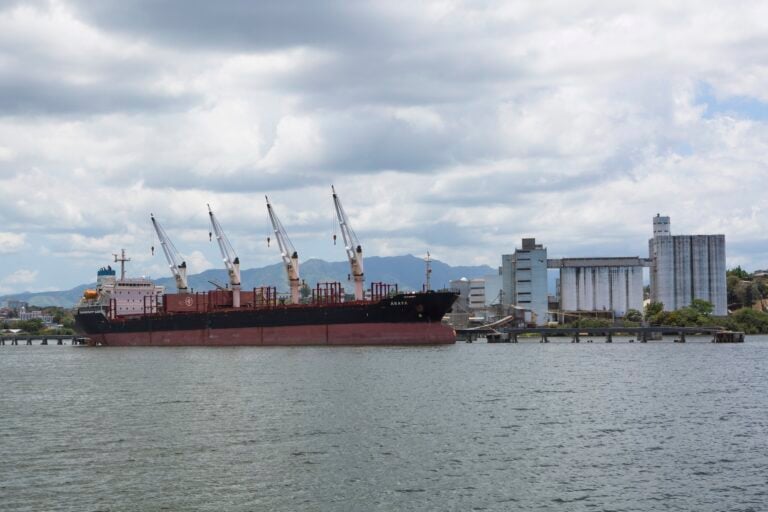
In October 2023, for example, the Balticconnector gas pipeline that travels from Estonia under the Baltic Sea and connects Finland to the European gas network was damaged along with two telecoms cables. Regional authorities suspected the involvement of the NewNew Polar Bear, a Chinese-owned container ship, which was in the area. Months later, China acknowledged that the NewNew Polar Bear was responsible for the damages, but European officials are not finding the explanations sufficient and suspect sabotage, Radio Free Europe/Radio Liberty reported.
In February 2023, a Chinese freighter and fishing vessels were suspected of cutting the two cables connecting to Taiwan’s Matsu Island, disrupting its connectivity for 50 days, Infobae reported. “Taiwan relies heavily on these cables for its international communications.”
“In the event of war,” Washington, D.C.-based think tank Center for a New American Security says, “the People’s Liberation Army would try to impose an information blockade on the island. Wire-cutting would most certainly be a component of that campaign.”
This is compounded by the behavior of Chinese companies such as state-controlled SB Submarine Systems, which conceals the location of its ships while repairing international cables.
“The lack of transparency in submarine cable repairs by Chinese companies increases distrust,” Ruiz said. “The fact that they can disable their radars and conduct opaque activities raises suspicions about the installation of spying devices, similar to those reported in Chinese-made cell phones.”
On the radar
For the Atlantic Council, Beijing’s growing influence in the submarine cable industry in the Middle East and North Africa is not accidental, but strategic. By controlling routes and infrastructure of these cables, China can shape the global flow of information, giving it a geostrategic advantage in influencing digital behavior worldwide, the U.S. think tank says in a report.
This potential control extends to the possibility of installing backdoors in undersea cable networks during their construction to siphon data that travel along these networks. While China denies such practices, statements by its leaders have made clear the interest in leveraging civilian technology for military purposes, Atlantic Council indicates.
According to the report, in 2016 Qin Ann, director of the China Institute of Cyberspace Strategy, said that “due to the highly monopolistic nature of information technology systems, it is unlikely that there will be two different systems for military and civilian use […]. It is particularly necessary [for China] to integrate military and civilian resources through a military-civil fusion system.”
“Despite efforts, protecting undersea cables is difficult. Fragmented maritime jurisdictions and the lack of international agreements complicate their defense. The proximity of these cables to countries like China and Russia makes them potential targets,” Ruiz said. “Beijing takes advantage of legal loopholes to expand its submarine network, creating an increasingly complex global security scenario.”
CSIS warns that while the focus has largely been on China, Russian threats to undersea cables are of significant concern as well. For instance, the Russian spy ship Yantar has been observed near undersea cable routes with equipment capable of cutting or tapping into these cables, “signaling a clear intent to exploit those vulnerabilities in a potential conflict scenario,” CSIS said.
Latin American response
Since 2019, Beijing has expressed interest in building a submarine cable to connect South America and China. In January 2024, Chile announced a partner project with Google, the Cable Humboldt project, a submarine fiber optic cable that will connect South America to the Asia-Pacific region, with estimated completion by 2026.
In addition to this development, the region is preparing for the installation of four new cables that will connect Central America and the Caribbean with the United States and Mexico. These include Trans-American Fiber’s TAM-1; Telconet’s CSN-1; Gold Data and Liberty Networks’ GD-LN1; and America Movil and Telxius’ Tikal-AMX3, reported on May 22 Mexico-based news site DLP News.
Ruiz warns however, that in parallel to these developments, the imminent inauguration of the Chancay Port in Peru, developed under Chinese control, “could spur the construction of a submarine cable connecting South America to China, which would allow Beijing to consolidate its presence in the region, expanding its monitoring and surveillance capabilities, giving it significant geopolitical oversight by occupying strategic territory.”
For CSIS, it is critical that partner nations work together to improve international regulatory frameworks, strengthen cable repair capacity, provide technical assistance to developing countries, and establish an international body to standardize regulatory processes to improve the security of cable networks and ensure that this critical infrastructure remains under the control of trusted entities.