

As 2026 begins, Panama and the United States have reached a historic high point in their security and defense alliance. Throughout 2025, the two nations deeply integrated their operational partnership. This joint effort has significantly increased the region’s readiness to face criminal networks and emerging threats through a framework of shared responsibility.
“The cooperation between Panama and the United States reflects a renewed approach that places shared security at the center of the relationship,” Carlos Sánchez Berzaín, director of the Inter-American Institute for Democracy, told Diálogo. “This orientation, which extends to other partners in the region, responds to a hemispheric vision based on closer coordination with strategic allies.”
2025: A year of strategic milestones
The past year was defined by several high-profile engagements that redefined regional security. In April 2025, Panama and U.S. Southern Command (SOUTHCOM) co-hosted the Central American Security Conference (CENTSEC), focusing on combined maritime operations and cybersecurity. This was followed by the execution of PANAMAX Alpha 2025, the annual bilateral exercise that serves as the foundation for the larger biennial multilateral PANAMAX.
PANAMAX Alpha 2025 was notably broad in scope. It began in March with Phase 0, a humanitarian mission led by Joint Task Force-Bravo (JTF-Bravo). Using HH-60 Black Hawks and CH-47 Chinooks, U.S. and Panamanian teams delivered construction materials and tons of food to remote communities such as La Esmeralda and Playón Chico. This humanitarian effort built the trust necessary for Phase I and II later in the summer, which shifted focus to high-end security. During these phases, Panamanian security forces worked alongside U.S. Navy SEALs and Special Operations Command South (SOCSOUTH) to sharpen maritime interdiction skills, including Visit, Board, Search, and Seizure (VBSS) tactics and underwater hull inspections.
Forging a new legacy: The inauguration of CJOTC
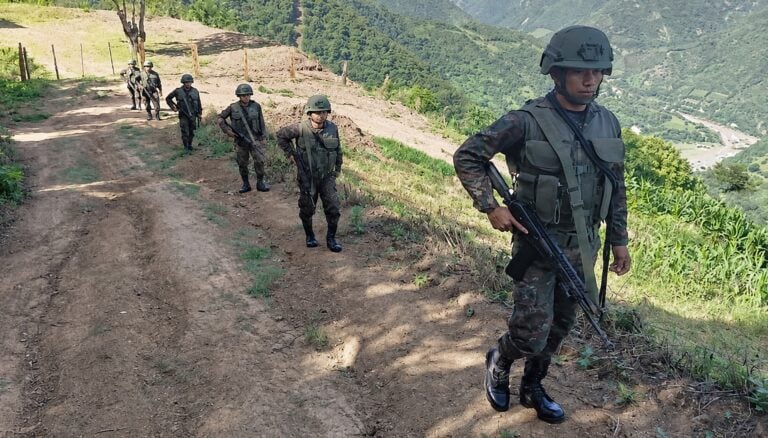
Perhaps, among the most enduring legacies of 2025 was the rebirth of jungle excellence. In August 2025, the two nations inaugurated the first Combined Jungle Orientation Course as a successful pilot. Its success led to the formal launch of the Combined Jungle Operations Training Course (CJOTC) in October at the Admiral Cristóbal Colón Air and Naval Base. The program is focused on survival, tactical maneuvers, and leadership.
The CJOTC is built on true reciprocity, as U.S. Army First Sergeant Kevin Rouse explained. “We made sure that the squads were made up of 50 percent U.S. military personnel and 50 percent Panamanians,” he said. “In addition, we rotated leadership so that each member assumed command responsibilities during missions.” This model ensures that Panamanian instructors lead alongside U.S. experts, strengthening the operational capacity of both nations.
A multi-domain partnership
The scope of 2025’s cooperation extended far beyond large-scale exercises. In June, the USNS Comfort hospital ship visited Colón as part of mission Continuing Promise 2025, providing free medical services to thousands and conducting search and rescue training with Panama’s National Civil Protection System (SINAPROC). Simultaneously, members of the U.S. 7th Special Forces Group (Airborne) engaged in specialized tactical talks and medical training with the Panamanian National Police and Air and Naval Service (SENAN).
Operational synergy was also visible in the air and on the ground. In August, the 822d Base Defense Squadron from Moody Air Force Base conducted combined tactics training at the Cerro Tigre range, focusing on high-risk vehicle interdictions with the National Border Service (SENAFRONT) and the National Police. This was capped off in December with a complex Crisis Response Exercise at the U.S. Embassy in Panama City, where Navy SEALs and Panamanian special units validated their ability to synchronize communications and neutralize threats in a diplomatic environment.
Panama: A pillar of regional stability
“Panama has a special relationship with the United States, closely linked to the Panama Canal, one of the country’s main strategic and economic assets,” Sánchez Berzaín said. “This relationship has sustained ongoing cooperation, in which the security of the Canal and its impact on global trade are central to the agenda.”
This collaboration yielded concrete results on the ground throughout 2025. By integrating U.S.-provided boats and tactical mobility assets, Panamanian security forces significantly increased their patrol frequency in high-traffic illicit corridors. SENAFRONT Commissioner Raymond Cáceres Cedeño, emphasized the importance of this deepening bond.
“Cooperation with the United States has been essential to strengthening our operational capabilities. Thanks to this assistance, we have been able to improve our reach, training, equipment, and responses to common threats, such as narcotrafficking and irregular migration […]. This not only reinforces regional security but also deepens the strategic relationship between both countries.”
“The country quickly integrated into this dynamic of cooperation, along with other nations in the region that have strengthened their alignment in security and foreign policy, consolidating a regional architecture based on collaboration and shared responsibility,” Sánchez Berzaín added.
Formal instruments
This operational integration is supported by a robust legal framework that respects Panamanian sovereignty. A major milestone occurred on April 9, 2025, when Panama’s Ministry of Public Security and the U.S. Department of War signed a Memorandum of Understanding. This agreement formalized the use of designated facilities for joint rotational training and the protection of the Canal against malign influence.
Over the past five years, the United States has provided more than $230 million in security assistance to Panama. In 2025, a portion of this funding was directed toward high-tech modernization, including specialized equipment to strengthen the National Immigration Service, such as biometric systems and satellite technology to improve surveillance and intelligence-gathering in the Darién jungle. As the 2026 calendar unfolds, the Panama-U.S. alliance stands as a model for security cooperation in the Western Hemisphere.
“This cooperation has allowed the country to strengthen its security and development, provided it maintains a clear and firm policy against organized crime, drug trafficking, and illicit structures,” Sánchez Berzaín concluded.