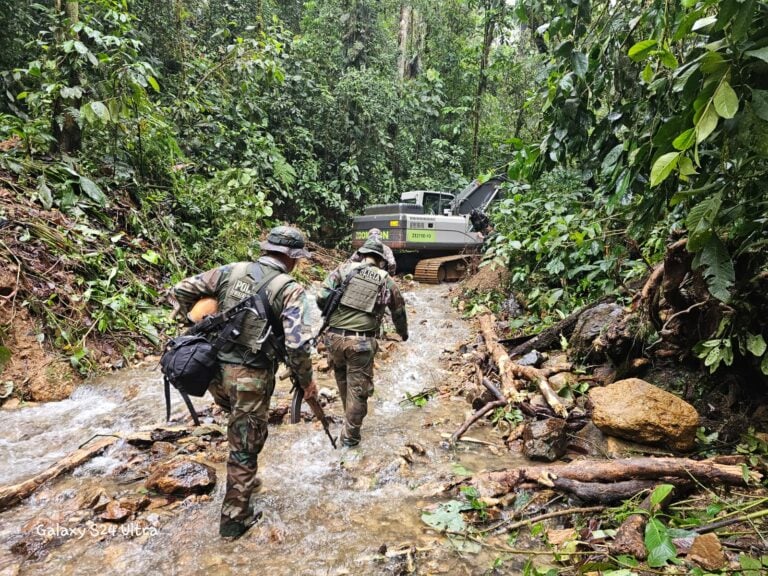


In southern Venezuela, strategic minerals known as “black sands”— including coltan, niobium, and tin — are being plundered to feed supply chains destined for China. This process is orchestrated through a sophisticated scheme of illicit extraction and cross-border laundering that effectively weaponizes Venezuela’s resource wealth for China’s strategic gain.
According to an investigation by digital media outlet Armando.info, these minerals are moved via river and land routes into Colombia. Once across the border, the material is “legalized” through documentation fraud, reclassification, and marketing operations, allowing it to enter the formal global trade as legitimate Colombian exports.
China’s support of armed groups
The predation of these resources relies on a symbiotic relationship between Chinese interests and transnational criminal organizations (TCOs). Miners in the municipality of Cedeño, located in the heart of Bolívar State’s extraction zones, have provided testimonies to media outlet Amazon Underworld describing a seamless integration between buyers and irregular armed groups. These miners have observed how buyers linked to Chinese companies interact closely with the National Liberation Army (ELN).
These traffickers do not merely negotiate purchases; they function as operational partners with the ELN, collaborating on logistics and transportation. Reports indicate that Chinese buyers and guerilla commanders have been seen coordinating mineral collection from the air, using helicopters to navigate the dense Venezuelan interior. This partnership provides TCOs with the financial capital and technical demand necessary to expand their territorial control, while granting China access to sanctioned minerals that would otherwise be unreachable through formal channels.
The expanding geopolitical footprint
Dr. Evan Ellis, research professor of Latin American studies at the U.S. Army War College Institute for Strategic Studies, emphasizes that this shadow economy is a deliberate component of China’s regional footprint. “It is very possible that materials extracted informally from the country — under schemes of harassment or supervision by military commanders of the Comprehensive Defense Operational Zones or the Comprehensive Defense Strategic Regions […] — are transferred to Colombia to officially leave as if they came from formal mines, as a form of laundering.” This dynamic illustrates how China’s demand fuels a “kleptocratic” ecosystem that undermines the sovereignty of the region’s nations.
In addition, China’s interest in these minerals is a calculated move to reinforce its global processing monopoly. Spanish television network RTVE reported that China accounts for up to 90 percent of the world’s refining capacity for these strategic inputs. By securing a steady flow of illicit minerals from South America, Beijing ensures that even the illegal economies of the region are tethered to its industrial machine, creating a geopolitical dependency that reduces margins of control and traceability of critical technology components.
The strategic value
The importance of these minerals lies in their status as critical raw materials for modern defense and technology. Coltan is the primary source of tantalum, a metal indispensable for the manufacture of high-performance capacitors used in smartphones, medical implants like pacemakers, and guidance systems for missiles.
Niobium is equally vital as an alloying agent in “superalloys” required for aircraft turbine engines and rocket nozzles, as it maintains its strength at extreme temperatures where most metals would fail. Tin remains a cornerstone of the electronics industry, serving as the primary soldering agent that binds every microchip to its circuit board. By controlling the supply of these materials, China effectively holds the keys to the future of the aerospace, telecommunications, and defense industries.
High-profile seizures and the Orinoco Mining Arc
The scale of this predation was recently underscored by significant enforcement actions in Colombia. In April 2025, Colombian authorities executed Operation Uranium, a massive strike against mineral trafficking that resulted in the seizure of 54 tons of tin and coltan in Villavicencio. This shipment, valued at over $1.2 million, was traced back to illegal mines operated by ELN and dissidents of the Revolutionary Armed Forces of Colombia (FARC) near the Venezuelan border and was explicitly documented as being destined for the port of Cartagena for final shipment to China. Such high-profile seizures highlight the sheer volume of material being siphoned out of the Amazonian basin to satisfy Chinese industrial quotas.
The Orinoco Mining Arc has become the epicenter of this looting. Since its establishment in 2016 as a National Strategic Development Zone, its designated area encompasses more than 111,000 square kilometers, about 12 percent of Venezuela’s territory. Dr. Ellis warns that China’s regional strategy is designed for longevity, noting that “China, as in many other parts of the world, will continue to operate not only illegally, but also through formal government-to-government schemes.” This persistent presence ensures that China will seek to maintain its influence regardless of the political climate in Caracas.
Legitimization and blurry line
Bram Ebus, a consultant for the International Crisis Group, points out in a publication by InfoAmazonía that the replacement of tradition mining corporations by Colombian armed groups has fundamentally altered the commercial landscape of southern Venezuela. Buyers now appear directly at mining sites, working within an integrated system that uses specific legal decrees to centralize the reception of minerals, providing an appearance of legitimacy. Public agencies and state-owned companies serve as the primary conduits in this process; they register and mix illicitly sourced materials into formal circuits, masking their criminal origins before they reach international markets.
While many of the buyers in these regions appear as “private” entities, the distinction between private and state-owned companies in China is virtually non-existent. In the Chinese economic model, the state often maintains “golden shares,” direct equity ties, and Communist Party committees within nominally private firms, particularly those operating in strategic sectors like mineral extraction, to ensure absolute alignment with government policy. Under China’s 15th Five-Year Plan (2026–2030), corporate strategies are systematically synchronized with national objectives. Consequently, any Chinese entity acting in Bolívar or Amazonas effectively serves as an agent of Beijing’s broader resource diplomacy.
Ecological impact
This strategy of resource seizure carries a devastating ecological and social price. According to Deutsche Welle, the extraction of these “black sands” often involves radioactive elements that contaminate the soil and groundwater.
“What is worrisome,” Dr. Ellis concludes, “is that as corruption increases, so does the illicit market.” The toxic extraction processes and the fueling of an illegal economy based on corruption and informality represent a permanent scar on the region. Ultimately, these environmental and human costs are the byproduct of a deliberate geopolitical strategy by China that prioritizes its own mineral security over the preservation of life or the stability of South America.