

As transnational criminal organizations grow more adaptive, technologically sophisticated, and interconnected, countries across Latin America and the Caribbean face a common challenge: how to respond in a coordinated and effective way. Increasingly, that response depends not only on national capabilities, but also on the ability to work across borders, share intelligence, and apply common investigative approaches.
At the center of that effort is the International Law Enforcement Academy in El Salvador (ILEA San Salvador), a U.S.-supported training institution that shapes how regional security and justice professionals confront organized crime in practice. U.S. and Salvadoran directors jointly manage ILEA, which receives funding through the U.S. State Department Bureau of International Narcotics and Law Enforcement Affairs.
Specialized training with regional impact
ILEA San Salvador’s value lies in the courses it delivers, and how they translate into real-world coordination. Its programs bring together police officers, prosecutors, and investigators from across the region to train on shared threats — while building the professional networks needed to act on them.
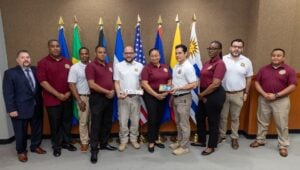
Training areas reflect the operational priorities facing partner nations today: human, arms, and drug trafficking; the illicit use of cryptocurrencies, asset recovery, protection operations, combating gangs, and dismantling clandestine laboratories.
Officials from different countries work alongside U.S. agencies, including the DEA, FBI, U.S. Customs and Border Protection (CBP), the Bureau of Alcohol, Tobacco, Firearms and Explosives (ATF), Diplomatic Security, and Secret Service.
“ILEA not only strengthens technical capabilities but also fosters a common foundation of knowledge and procedures, in addition to creating key connections for tracking cross-border cases,” said Evan Ellis, a research professor of Latin American studies at the U.S. Army War College Strategic Studies Institute.
An example of this cooperation is the recent Anti-Gang Course, which brought together law enforcement officials from the Bahamas, Barbados, Haiti, Jamaica, St. Kitts and Nevis, St. Vincent and the Grenadines, Trinidad and Tobago, and El Salvador. The program, taught by El Salvador’s National Civilian Police and Attorney General’s Office, addresses the transnational dynamics of gang activity through prevention, investigation, and enforcement strategies.
A strategic response adapted to evolving threats
In February 2026, ILEA San Salvador trained 35 law enforcement officers in a two-week antinarcotics investigations course, supported by DEA specialists. Participants strengthened investigative techniques, intelligence integration, and case development capabilities against drug trafficking networks.
In a separate course, participants received instruction in tactical safety and planning, including tactical medical response and operational risk management — skills designed to improve performance and survivability during high-risk operations.
During the opening of the Course on the Investigation and Prosecution of Violent Transnational Criminal Organizations on March 9, ILEA San Salvador Director General Juan Henríquez emphasized the broader impact of these efforts: “What is strengthened here will have a direct impact on the security and stability of our countries.”
Ellis highlighted the importance of these initiatives. “Through its courses, not only is knowledge strengthened, but essential personal interactions are also created for the fight against transnational crime.”
Infrastructure and bilateral cooperation
In 2025, ILEA took a significant step toward institutional consolidation with the inauguration of a new applied skills annex, funded by a $1.1 million investment from the United States. This project increased the academy’s operational capacity by 30 percent and added specialized, practical skills training areas.
The expansion reflects growing demand and reinforces cooperation between El Salvador and the United States to address transnational threats more effectively.
More than training
ILEA San Salvador fosters coordination among security and justice agencies from different countries, helping build the professional networks required to confront increasingly interconnected criminal organizations.
With the support of the United States and a strategic approach that transcends borders, ILEA San Salvador continues to play a key role in strengthening regional security and cooperation.