

In its recent report, The Kremlin’s Playbook in Latin America, European think tank Center for the Study of Democracy (CSD) highlights Russia’s use of oil to expand its influence in the region. The strategy, the CSD indicates, also provides Moscow with a means to circumvent economic sanctions imposed following the start of the war in Ukraine in 2022.
“By establishing and deepening economic relationships, particularly in key sectors such as energy […], Russia seeks to create dependencies that can be exploited for political leverage. This economic strategy not only provides immediate financial benefits to Russia, but also helps to secure long-term influence in the region,” the CSD report states.
Russian oil deals in Latin America are often reinforced by long-term contracts, joint ventures, and the provision of financing and technical assistance. This makes it very difficult for countries in the region to disengage from Moscow, even if they want to.
According to the CSD report, “economic leverage is a key element of Russia’s pursuit of wider influence over the domestic and foreign policy of countries in Latin America, with the aim of countering the Western dominance in the region.”
Russian oil exports
Russian oil exports to Latin America have increased since the start of the war in Ukraine in February 2022 and, according to the CSD report, currently reach some 300,000 barrels per day. For instance, in February 2024, the Russian supertanker Ligera transported more than 1.7 million barrels of crude oil to Venezuela, the first delivery to the South American country in five years, Bloomberg reported.
“This dependence entails risks for the region. Countries like Brazil and Venezuela could experience political coercion aligned with Russian geopolitical objectives,” Martin Vladimirov, director of geoeconomics at the CSD and one of the authors of the report, told Diálogo.
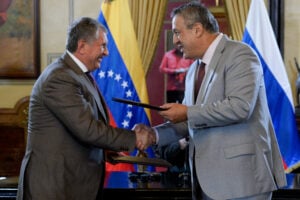
Moscow’s interest in Venezuela is not recent. According to the CSD report, some 23 percent of the bilateral agreements between Caracas and Moscow from 2004 to 2023 relate to oil. They include joint ventures, acquisitions, investments, loans, debt rescheduling, oil field allocations, crude oil trade, and even cooperation agreements. According to the CSD, in Venezuela, Russian state-owned Rosneft has been a key commercial intermediary in the oil sector, facilitating through its subsidiaries the export of crude oil from Venezuelan state-owned oil company PDVSA, as such helping the company to circumvent international sanctions and sell its oil to China and India. Rosneft also exploits five oilfields in Venezuela through joint ventures with PDVSA that produce around 100,000 bpd.
“This not only allows Venezuela to join forces with Russia to evade U.S. sanctions, but also supports the Maduro regime. Russian state oil company Rosneft has played a key role in this, through financial assistance and infrastructure investment, effectively positioning Moscow as a guarantor of the Chavista government,” says Vladimirov.
Investments in Latin America

In Latin America, in addition to Rosneft, other Russian oil companies such as Gazprom and LUKOIL have also increased their investments. In 2022, LUKOIL announced that it had bought a 50 percent stake in the offshore oil company Area 4 in the Gulf of Mexico’s Bay of Campeche.
In April 2023, oil and gas company Wintershall Dea, linked to Russian oligarch Mikhail Fridman, said it had discovered oil in the Gulf of Mexico, with estimates ranging around 200 million barrels of potential oil. According to Vladimirov, this discovery “underlines Russia’s continued attempt to position itself as a major player in the oil and gas sector in Latin America.”
In April 2024, Russian Foreign Minister Sergey Lavrov, in the presence of his Bolivian counterpart Celinda Sosa, highlighted Bolivia as one of Russia’s priorities in Latin America, Bolivian news site Opinión reported. “There are important opportunities to increase mutually beneficial activity” in different fields, such as energy, Lavrov said, referring to the exploitation of Gazprom’s deposits. In 2018, Gazprom and state oil company Yacimientos Petrolíferos Fiscales Bolivianos (YPFB) signed an agreement in which the Russian energy corporation committed to invest some $1.2 billion in exploration and production at the Vitiacua onshore field, in southern Bolivia.
“In addition to oil, investments by, for example, Russia’s Rosatom, in the $300 million Center for Research and Development in Nuclear Technology in the city of El Alto, reveal Moscow’s intention to insert itself into several critical energy infrastructures in Latin America, potentially influencing Bolivia’s political decisions,” Vladimirov says.
According to the expert, since the start of the war in Ukraine, Russian companies have mainly resorted to low-cost, high-impact investments in Latin America, offering long-term contracts at low prices, using cost reduction as a geopolitical tool.
Hidden fleets
To circumvent Western sanctions, Moscow uses various techniques. For example, according to Bolivian nongovernmental organization Fundación Tierra, Russian capital in Bolivia often operates through third parties. “Russian oil companies LUKOIL and Gazprom appear in the Bolivian registers as Dutch investments that are part of the hydrocarbon exploration and exploitation business,” Fundación Tierra indicated.
In addition, Moscow has developed a fleet of “shadow” tankers, many of which are registered in Latin American offshore centers and can therefore change flag. These ships help Russian companies move the sanctioned oil by disguising the export origin and ownership.

“For Latin America, this shadow fleet carries substantial risks. Participation in these sanctions evasion networks exposes Latin American countries to legal liabilities and reinforces corruption in the maritime and financial sectors, creating vulnerabilities that authoritarian states like Russia could exploit to gain more economic and political influence,” Vladimirov says.
Corruption
To expand its economic influence, Russia has used various strategies in Latin America, including involving influential power brokers through bribes. This is evident in the case of Venezuela, where Russian state-owned companies have secured numerous contracts in the oil sectors through opaque deals that often circumvent standard regulatory procedures.
“In Venezuela, Russian companies such as Rosneft have secured lucrative oil contracts by establishing personal and financial ties with local elites. Thanks to opaque deals and lobbying, Russian companies linked to the state have taken large portions of the Venezuelan oil sector, often circumventing public procurement procedures,” Vladimirov says.
According to the expert, this relationship also includes military support, as evidenced by the presence in Venezuela of Wagner Group agents, which Russia uses to safeguard its economic investments.
In Bolivia, according to the CSD report, Russian influence over the government of Evo Morales allowed Rosatom to obtain contracts under minimal transparency, incorporating Russia into the country’s energy sector. This erosion of governance not only poses a danger to the economic sovereignty of the region, but risks turning Latin American resources into footholds for Russian geopolitical maneuvering, Vladimirov concludes.