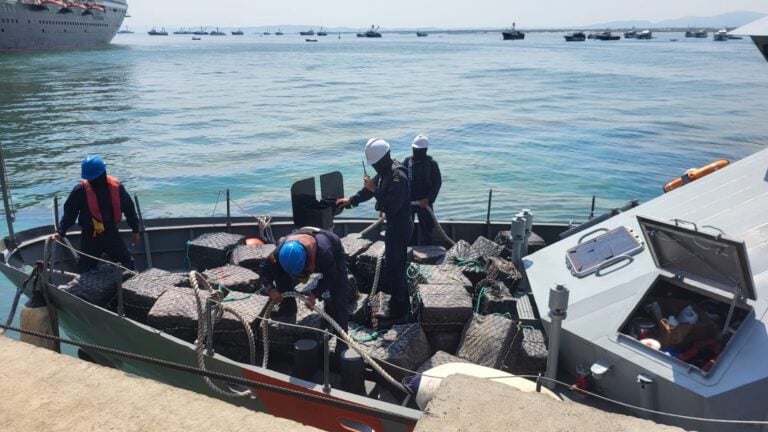


According to a recent report from nongovernmental organization International Crisis Group (ICG), the Brazilian criminal organization Red Command (CV) has been advancing in the triple border Amazon region between Brazil, Colombia, and Peru, in its quest to control cocaine trafficking routes.
The criminal organization that originated in Rio de Janeiro in the 1970s, created a network of alliances involving Colombian guerrilla group Frente Carolina Ramírez and Peruvian drug traffickers. The group’s advance is reflected in other crimes, such as illegal gold and timber extraction and illegal fishing, further threatening the forest and the lives of indigenous peoples and riverside dwellers.
According to the ICG report, the CV launched the Amazonas Red Command nearly five years ago, undoing an old alliance with the Família do Norte, which was the main criminal organization in the Amazon for almost a decade. As such, the CV overcame enemies such as the First Capital Command and the Crias, a faction made up mostly of young criminals. The CV also created a criminal council made up of 13 members from Manaus, which coordinates actions and answers to the original leadership in Rio de Janeiro.

The group’s course of action includes looking for cheap labor in local communities, mainly targeting teenagers. In a region marked by extreme poverty and a lack of job opportunities, they continue to provide financial aid, medicine, and food to needy families in the areas under their control, with the aim of dominating local markets and populations. Indigenous people, mainly young men, are also co-opted, sometimes paid in cocaine base paste, which has led to an increase in consumption, including among children.
Competition among criminal groups is already having an impact on violence rates. According to the Brazilian Public Security Forum, Brazil’s rate of intentional violent deaths in 2022 was 23.3 per 100,000 inhabitants. In the Legal Amazon, which includes all seven states in the northern region, as well as Mato Grosso and part of Maranhão, it was 33.8 per 100,000 inhabitants. In 2022, Leticia, a Colombian city in the triple border area, emerged as the second most violent in the country.
For ICG, the best way to combat this advance is for the three countries to join forces. “Cooperation is key. Criminals often operate across the dividing line, transporting weapons, drugs, funds, and people internationally. By crossing these borders, they can avoid arrest and prosecution, especially since they often have more financial resources than the budgets of the states dedicated to fighting them,” says Bram Ebus, ICG environment and crime consultant.
The Belem Declaration signed during the Amazon Summit in August 2023, which brought together the eight Amazonian countries that make up the Amazon Cooperation Treaty Organization, follows this path of cooperation. The Declaration vows to “promote the exchange of information and improve police and intelligence cooperation to combat illegal activities and environmental crimes affecting the Amazon Region.” It also provides for the installation of a regional police cooperation center in Manaus.
“Law enforcement agencies should focus on strengthening confidence-building exercises, including the implementation of anti-corruption measures. Improving information sharing and communication channels regarding cross-border movements of wanted individuals, as well as drug and arms shipments, could significantly increase the agility and efficiency of state responses,” Ebus said.

The ICG report indicates that criminals reinvest narcotrafficking profits into other criminal activities that degrade the environment, such as illegal logging and gold mining, as well as illegal fishing. These activities allow them to launder money, find a lucrative and more secure source of income, and even use them to hide and transport the drugs in timber, fish shipments, etc.
Cocaine itself is already the main cause of deforestation in this triple border region, largely because it is also in the forest that laboratories are set up to process the drugs, leaking chemical residues into the soil and water. Illegal gold mining pollutes Amazon rivers with toxic mercury, while criminal incursions into indigenous lands put these communities at risk.
According to Ebus, the border countries already have good initiatives in place to combat criminals. Colombia’s Financial Information and Analysis Unit, for instance, receives good financial support and has the necessary tools to investigate money trails related to environmental crimes. In Brazil, the Brazilian Institute of Environment and Renewable Natural Resources can crack down on environmental offenders and violent intruders in protected ecosystems.
In a statement to Diálogo, the Brazilian Ministry of Defense said that it participates in inter-ministerial actions that carry out operations with public security agencies to combat crimes in border areas. Some of these operations are carried out jointly with the armed forces of countries bordering Brazil. The Ministry cites the Brazilian Armed Forces Operation Agatha, which has been carrying out security actions since 2011 throughout the 17,000 kilometers of land borders with 10 South American countries.
“Collaboration with counterparts across borders is crucial to understanding the international supply chains of illicitly obtained Amazonian products and the associated money flows. The standardization of legislation on environmental crimes in all countries would facilitate this effort,” Ebus said.
On July 27, U.S. Treasury Secretary Janet Yellen announced the launch of a new effort with the governments of the Amazon basin to disrupt illicit finance that fuel nature crimes. The Amazon Region Initiative Against Illicit Finance aims to increase cooperation between finance ministries, security agencies, and other entities in Brazil, Colombia, Ecuador, Guyana, Peru, Suriname, and the United States, with the aim of improving training to detect illicit financial networks operating in the region.