

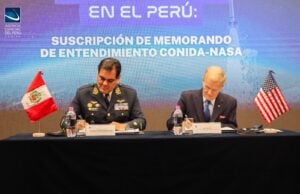
The Peruvian Space Agency – CONIDA, of the Ministry of Defense, and NASA laid the groundwork for the potential launch of sounding rockets from the South American country. The historic agreement seeks to promote scientific research and the development of advanced technologies and is a key step in the scientific and technological collaboration between both countries.
“This alliance reinforces the historic relationship between Peru and the United States, characterized by years of continuous collaboration. Although it is now channeled through NASA, this link is not recent,” Marco Milla, director of the Institute of Radio Astronomy of the Pontifical Catholic University of Peru, told Diálogo. “The objective is to expand existing cooperation and strengthen scientific ties between both countries.”
The agreement, signed on November 14, 2024, includes safety training, a joint feasibility study for a sounding rocket campaign with launches starting in 2028, dubbed the Cielo project, and technical assistance for sounding rocket launches. This project will not only strengthen Peru’s space capabilities but will also promote its participation in international scientific missions, the Peruvian government said in a statement.
Project Cielo envisions the launch of 10 to 14 rockets from Peru’s Punta Lobos Rocket Range, with scientific instruments to investigate phenomena in the ionosphere, part of Earth’s upper atmosphere, to understand and reduce errors in satellite technologies such as GPS. The campaign will also boost the development of cutting-edge technology in the country, the Ministry of Defense indicated.
“Peru was chosen for this campaign because of its privileged location on the magnetic equator and the Jicamarca Radar or Radio Observatory, recognized as the world’s largest instrument for studying this region of the atmosphere,” Milla said. “Much of the current knowledge about ionospheric phenomena is due to research conducted with this radar.”
The Peru-NASA cooperation is not new. In 1975 and 1983 NASA conducted joint sounding rocket campaigns from CONIDA’s Punta Lobos base to study interactions between the Earth’s atmosphere and the Sun. These investigations are essential for the safety of critical resources, such as electrical grids and navigation systems.
Space station
Cooperation between Peru and NASA goes beyond rocket launches, as the Andean country prepares for an ambitious project: Its first space station in Talara, Piura, to launch its first space vehicles, General Carlos Chávez Cateriano, commander of the Peruvian Air Force (FAP), told TV Perú. The facility will also include a scientific research center.
“The FAP is leading the development of the first spaceport on the South American Pacific coast, in collaboration with U.S. Space Command (SPACECOM). The initial study phase has already concluded, and the project has a development prospect of three to five years,” Gen. Chávez said. According to Argentine news site Infobae, the project will require an estimated $268 million investment.
The collaboration with NASA and the construction of the spaceport “will position Peru as a scientific pole in the region, allowing it to expand its impact on training, research, and scientific discoveries, with local and global benefits,” Eduardo Ismodes, vice provost for Research at the Pontifical Catholic University of Peru, told Diálogo.
Strategic horizons
In April 2024, representatives from Peru and other South American countries met with SPACECOM leaders at the 39th Space Symposium in Colorado Springs, to strengthen cooperation in the Western Hemisphere.
In May 2024, Peru became the 41st member of the Artemis Accords, committing to safe, transparent, and responsible space exploration. The Accords, a set of principles designed to guide civil space exploration, which were launched in 2020 by the United States and seven other nations in 2020, seek to ensure that space is used in a manner that benefits all of humanity.
Operation Harpy South, part of Exercise Resolute Sentinel 2023, also spurred international collaboration from Peru’s Satellite Imagery Operations Center. Led by U.S. Southern Command (SOUTHCOM), SPACECOM, CONIDA, and FAP, the exercise strengthened emerging space programs in the region through space domain awareness training and the use of the Joint Commercial Operations mission system.
For Ismodes, these alliances promote innovative solutions to regional and global challenges. “Peru reaffirms its commitment with the success of these joint initiatives,” he said. In this line, Milla highlighted that the FAP and CONIDA are developing a strategic plan to consolidate the country’s progress in the space field.
Hand in hand cooperation
The schedule established for the rocket launch reflects the commitment of both nations: The international agreements is set to be formalized in 2025, and the necessary instrumentation will be developed between 2026 and 2027. Finally, in 2028, the Cielo Launch Campaign will be carried out, Milla said.
“Peru is participating as an equal partner, with scientific capabilities on par with the United States, which motivates them to take part in international collaboration,” Milla concluded. “This joint effort not only strengthens scientific collaboration but also broadens the participation of Peruvian researchers in global initiatives.”