

Transnational criminal organizations (TCOs) are waging a silent war on Latin America’s ecosystems, turning biodiversity and natural resources into a multibillion-dollar illicit economy. Crimes like illegal gold mining, deforestation, and wildlife trafficking are rapidly eroding the Amazon and other critical environments, financing criminal groups, and fueling human rights abuses across the continent.
The scale of this threat demands a coordinated, regional response. To meet this challenge, several countries of the region have been increasingly conducting joint regional law enforcement and military operations. These range from specialized national task forces, like Colombia’s Operation Artemisa, which deployed thousands of troops to combat deforestation, to international efforts like Operation Green Shield, which involved forces from Brazil, Colombia, Ecuador, and Peru, targeting crimes in the Amazon Basin.
Among the significant efforts in 2025 was the two-month-long INTERPOL-led international crackdown: Operation Mother Earth VII (Operación Madre Tierra VII).
Operation Madre Tierra VII
In May and June 2025, authorities from nine Latin American countries joined forces for this massive operation coordinated by INTERPOL’s Regional Bureau for Central America. The operation, which served as a reminder of the global scale and complexity of environmental crime, saw the participation of Colombia, Costa Rica, Dominican Republic, El Salvador, Guatemala, Honduras, Mexico, Nicaragua, and Panama.
The results, announced in late October, confirmed the urgency of the operation’s focus. The effort led to 225 arrests and launched hundreds of new investigations into organized crime networks.
“The results highlight how organized crime networks are transforming protected species and forests into transcontinental commodity chains, with profound consequences for ecosystems and climate resilience,” AP reported following INTERPOL’s announcement.
The preliminary results revealed a staggering breadth of criminal activity: 203 violations related to illegal logging; 138 violations linked to wildlife trafficking; 23 cases of illegal mining; 26 illegal fishing and 16 pollution crimes.
Madre Tierra VII resulted in significant seizures of contraband, exposing the global reach of these crimes. Authorities confiscated live protected species — including birds, reptiles, primates, and big cats — as well as 2.4 tons of shark and ray fins, and high-value, protected timber such as rosewood. The investigation exposed transnational routes connecting Latin America to markets as far as Europe and Asia.
The dominance of illegal mining and deforestation
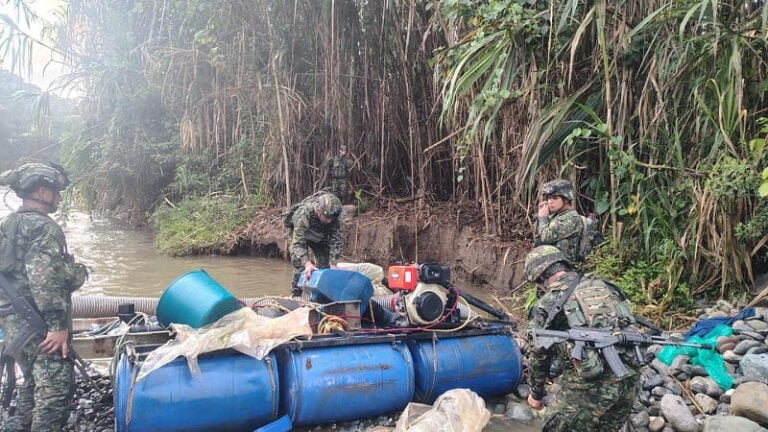
While environmental crimes are diverse, illegal gold mining has become one of the most destructive and profitable ventures for TCOs. Fueled by rising gold prices (reaching highs of over $3,500 per ounce in 2025), it often generates more revenue for criminal groups in countries like Peru and Colombia than traditional drug trafficking.
This convergence of crimes is deeply alarming. The United Nations Office on Drugs and Crime (UNODC) notes that drug trafficking factions have diversified into illegal gold mining, leveraging established smuggling routes and infrastructure.
“Organized crime groups have increasingly infiltrated gold supply chains, attracted by the rising value of the metal and the high profitability of the sector,” UNODC states.
The environmental cost is staggering. Illegal mining encroaches on forests, employing dangerous chemicals like mercury — an estimated 30 tons of which are dumped into Amazonian waterways annually — and driving significant deforestation. According to UNODC data, there has been a 625 percent increase in illegal mining areas on indigenous lands across the Amazon region in the last decade alone, devastating indigenous communities in countries like Brazil, Venezuela, Colombia, Ecuador, Peru, and Bolivia.
“Illegal gold mining has become one of the main drivers of deforestation, soil degradation, and pollution,” notes the Due Process of Law Foundation (DPLF). “Its expansion even reaches protected natural areas and indigenous reserves, with profound impacts on the health, social cohesion, and culture of local communities.”
A structural, coordinated response
Operations like Madre Tierra VII demonstrate that coordinated, intelligence-led action can disrupt these complex criminal structures. However, experts stress that arrests alone are not enough.
Oscar Soria, chief executive of environmental think tank The Common Initiative, told AP that the operation shows how environmental crime in Latin America “has become deeply integrated with traditional organized crime networks.” He urges for a structural response that goes beyond arrests to include stronger governance, better regional coordination, and efforts to reclaim territories where criminal networks thrive in the absence of the state.
Addressing this ongoing crisis requires governments to treat environmental crime as a core security and financial problem, integrating environmental intelligence into customs, anti-money laundering efforts, and cross-border cooperation to dismantle the entire illicit value chain.