
The threat from Iran continues to grow in Latin America. In recent weeks, as Argentina’s security forces stepped up vigilance due to an anti-terrorism alert, experts warned of the growing influence of the Iranian regime and its proxy, terrorist group Hezbollah, in the Triple Frontier, along the junction of Argentina, Brazil, and Paraguay.
“According to different investigations, Hezbollah’s ties in the region include important gangs such as the First Capital Command in Brazil and the Los Zetas and Sinaloa cartels in Mexico,” reported Argentine daily La Nación on April 21. “The central activity of the Shiite group in the region, experts agree, is financial, by facilitating mechanisms to launder money for narcotrafficking and organized crime organizations, mainly to sustain their operations in the Middle East.”
Amid heightened tensions between Iran and Israel, experts do not rule out a new attack in Buenos Aires like those Iran and Hezbollah carried out in the past. In fact, Argentina’s Federal Chamber of Criminal Cassation ruled that Iran and Hezbollah were behind the 1994 bombing of the Argentine Israelite Mutual Association (AMIA), which left 85 people dead and injured some 300.
In their April 12 ruling, the judges of the Chamber of Cassation described the attack as a “crime against humanity” and called for legal reforms to be able to hold a “trial in absentia” of the Iranian fugitives. “The Chamber of Cassation confirmed that the evidence in relation to the attack constitute serious human rights violations and, therefore, are not subject to any statute of limitations,” La Nación reported.
The judges also found that Iran and Hezbollah were responsible for the 1992 bombing of the Israeli embassy in Buenos Aires, which killed 29 people and injured more than 200.
Sebastián Basso, federal prosecutor in charge of the AMIA case, highlighted the importance of the decision of the Cassation Chamber. “As we find ourselves before the highest instance of the Argentine federal criminal justice system (the only thing left is that the Supreme Court of Justice could eventually intervene, which would be exceptional), the density of the decisions of this Court is important for all the judges in the country,” Basso told Diálogo. However, for the purposes of resolving the AMIA bombing case, the ruling did not make any novel contribution, the prosecutor added.
“What the judges contend is neither more nor less than what the prosecutors in the case, from the late prosecutor [Alberto] Nisman to the present, have said. Since 2006, the Prosecutor’s Office has maintained that the decision to attack the AMIA headquarters was taken by the highest authorities of the regime that governs the Islamic Republic of Iran from 1979 to date,” Basso said. “Also, since that date, it has been held that the AMIA bombing is a crime against humanity and because of its transcendence it cannot be subject to the statute of limitations. The criminal action remains in force as long as the defendants are alive,” the prosecutor said.
The Prosecutor’s Office has also argued that “those who carried out the attack are members of the Hezbollah group, specifically its armed and clandestine arm that operates abroad and whose base of operations, at that time, was what is called the Triple Border,” Basso said. “Thus, it can be said that the Cassation ruling constitutes a strong support to the activity of the Public Prosecutor’s Office and a confirmation by the Judiciary of the correct hypothesis. It rules out all other conjectures as to who carried out the attack,” Basso said.
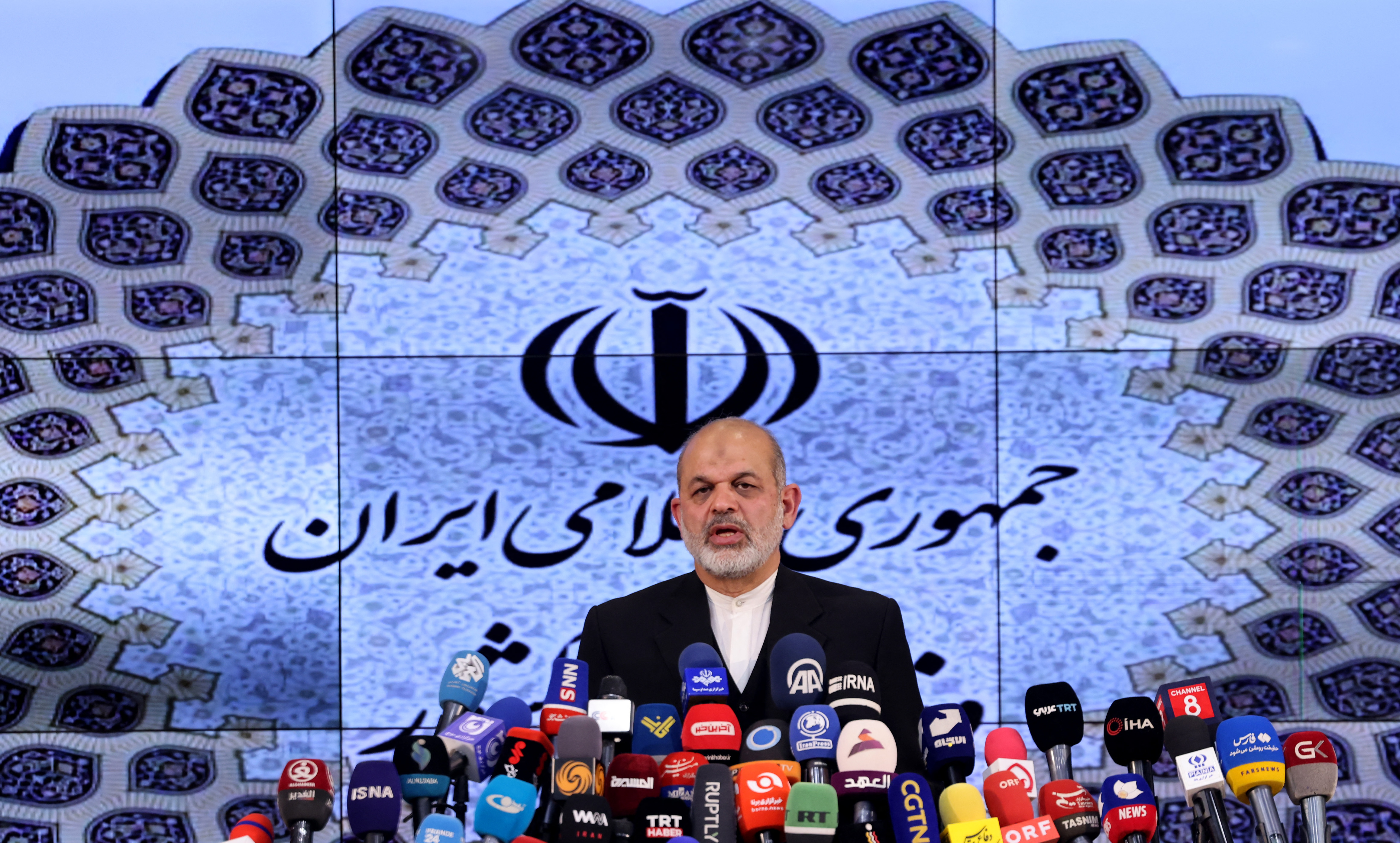
Ahmad Vahidi
Argentina continues to call for the international arrest of those responsible for the AMIA bombing, “who maintain their positions of power with total impunity,” the Argentine Foreign Ministry said in an April 23 statement.
One of them is Ahmad Vahidi, who was the commander of a special unit of Iran’s Revolutionary Guards when the attack occurred. “This individual is currently Minister of the Interior of the Islamic Republic of Iran and is part of a governmental entourage that is in Pakistan and Sri Lanka these days,” the Foreign Ministry said in the statement.
At the request of the Argentine authorities, Interpol issued a red notice for Vahidi’s arrest. In addition, Argentina has asked the governments of Pakistan and Sri Lanka for his arrest according to the mechanisms provided by Interpol, the Foreign Ministry said.
Continuous threat
As the 30th anniversary of the AMIA bombing approaches (July 18), threats from Iran and Hezbollah continue in the region. In Brazil, authorities discovered that Eray Uç, a Turkish drug trafficker under investigation by the United States for alleged links to Hezbollah, was living under a false identity in a Brazilian prison.
Uç had escaped in 2017 from a prison in Paraguay, where he was convicted of drug trafficking. The São Paulo Civil Police had him in custody since June 2023, also for drug trafficking, but he was using his brother’s name, Garip, something authorities discovered in February.
“After his arrest, the unit’s team confirmed that his fingerprints were not included in the Civil Police database and, after exchanges between intelligence agencies, his true identity was discovered,” the São Paulo Civil Police told the Organized Crime and Corruption Reporting Project (OCCRP), a global network of journalists who investigate transnational crimes. Brazilian authorities are now paving the way to extradite Eray Uç to Paraguay, where he faces cocaine trafficking charges, OCCRP reported.
“Hezbollah’s network in Brazil continues to grow along with Brazil’s increasing importance as a transit point for global illicit trafficking and the expansion of the illicit economy,” Emanuele Ottolenghi, senior fellow at the Washington-based think tank Foundation for Defense of Democracies, told Argentine daily Infobae on April 1.
Ottolenghi identified the presence in Brazil of two Lebanese brothers who are members of the terrorist group: Haj Wissam Rizk, owner of a cell phone store in São Paulo, and Khalil Rizk, former head of Hezbollah’s Foreign Relations Department. “This Department acts as a liaison between Tehran and the Shiite communities of the world,” Infobae reported.
“One of the Department’s main functions is to assist Hezbollah operatives abroad, including members of Unit 910. Unit 910, which operates under the auspices of the Jihad Council/Izz al-Din al-Qassam Brigades, is responsible for foreign operations, which leads terrorist attacks worldwide,” Infobae reported.