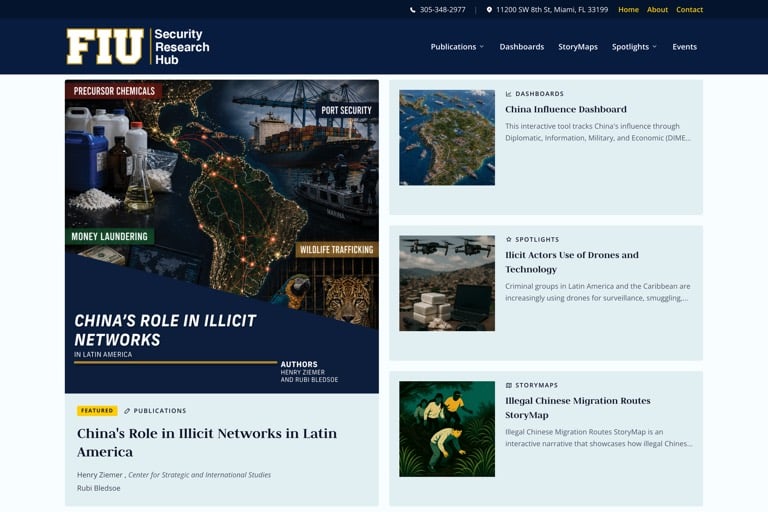


China’s infiltration through universities, Confucius institutes, collaborations with the academic world, scholarships, and international forums is growing in Latin America. The purposes are manifold, from consensus building to industrial and military espionage, but the impact on the region is devastating. In addition to compromising countries’ national and economic security, China undermines the region democracy through propaganda and disinformation.
“This penetration is a tool that facilitates Beijing’s process of ‘colonization’ of the region. Infiltration in universities and also through Confucius cultural centers facilitates propaganda, since China can quickly spread its ideology and worldview and allows for easy dissemination of an alternative truth,” Ogbobode Abidde, professor of Political Science at Alabama State University, told Diálogo.
China and Taiwan in Latin America and the Caribbean, a volume edited by Abidde and published in early 2024, highlights how since the COVID-19 pandemic and also due to political tensions with Taiwan, China has adopted an increasingly authoritarian cultural communication in Latin America. This language “has gone from expressing so-called soft power to sharp power, that is, from being persuasive to monopolistic, suppressing alternative narratives and exploiting the institutions with which China has established cultural exchanges,” the book indicates.
Confucius institutes

This ideological agenda is quite evident in the educational programs of Confucius institutes, centers where Chinese language and culture are taught. The Beijing government has total control over them, from funding to teacher selection and teaching content, through the Hanban, an office of the Ministry of Education of the People’s Republic of China responsible for Chinese language teaching abroad.
“Ideas considered dangerous due to Western influence, such as freedom of speech; civil rights, historical mistakes made by the Chinese Communist Party; and political issues concerning Taiwan, Tibet, and Falun Gong, are also banned in Latin America,” Abidde’s edited volume says. In the region, these centers have been able to expand thanks to the financial support provided to their host universities, which are often underfunded.
This strategy has enabled Beijing to create more than 45 Confucius institutes in Latin America and the Caribbean in about 15 years. Each year, more than 100,000 students enroll, and more than 1 million people participate in their cultural activities and workshops.
“Confucius institutes offer linguistic and cultural programs aimed at spreading the ideologies of the Chinese Communist Party and controlling the thinking and lifestyle of the population. These centers do not allow the liberalization of ideas or teachings that promote Western ideas and ideals, such as civil liberty, free markets, and political liberalization,” Abidde tells Diálogo.
The Brazil case
Brazil is home to 12 Confucius institutes, the largest number in the region. Some of these centers are strategically located in poor states but have advantageous locations for China, such as ports. In these remote regions, the Confucius institutes promote conferences to which local politicians are also invited to facilitate business deals favorable to Beijing.
For example, in November 2022, the seminar, Combating Poverty in the Digital Economy, organized by the Federal University of Pernambuco and the Confucius Institute hosted by the university, was publicized as a precursor to a larger meeting, the China-Northeast Brazil Forum: Studies on the Economic and Social Development of Northeast Brazil, chaired by the president of the same Confucius Institute, Peng Xiantang. The event was held in the neighboring state of Maranhão, which China is interested in including in its Belt and Road Initiative due to its strategic location on the Atlantic coast, close to the Panama Canal and African and European markets.
China is also investing in Brazil in scientific cooperation, including space. The two countries signed a series of agreements in 2023 that also established a greater exchange of information and technology. In the state of Paraíba, the Brazilian Institute for Space Research (INPE) is building the BINGO radio telescope together with Chinese state-owned China Electronics Technology Group Corporation (CETC), one of the leading manufacturers of military electronics for the Chinese government. In 2020, the U.S. Department of Commerce blacklisted four CETC entities for helping China’s People’s Liberation Army (PLA) build and militarize artificial islands in the South China Sea. Following the Chinese balloon incident that entered U.S. airspace in 2023, the Commerce Department sanctioned CETC’s 48th Research Institute, accusing it of supporting “China’s military modernization efforts, specifically the PLA aerospace programs, including blimps and balloons […]. The PLA is utilizing high altitude balloons for intelligence and reconnaissance activities.”

In its research, Navigating Challenges and Risks in Sino-European Academic Collaborations, Netherland-based center for the analysis of intelligence data on China, Datenna, warns of the risks of collaborating with Chinese scientific or academic institutions due to “the transfer of sensitive technologies and inadvertent support provided to Chinese military actors,” given “the general opacity of many institutions in China and the difficulty of ascertaining their potential military connections and defense-related work.” According to the investigation, of the thousands of Chinese academic institutions, more than 2,000 were found to be involved in defense-related activities.
Interest in Latin American academia
According to the Latin American Faculty of Social Sciences (FLACSO) 2024 report, China and Latin America and the Caribbean: Multidimensional and Multilevel Relations, Argentina is among the countries with the largest academic collaborations with China. In 2017, the country’s most important research organization, the National Council for Scientific and Technical Research (CONICET) and Shanghai University (SHU) created a Joint International Research Center (CIMI) with sites in both Buenos Aires and Shanghai to produce joint academic research on social issues such as food and labor in rural areas. According to Abidde, this type of cooperation allows Beijing to interfere in public policies in the region.
“It would be a mistake to think that China is altruistically benevolent with its increasing aid in academic cooperation, foreign investment, soft loans, and other forms of economic and political support in Latin America. No, it is not. Beijing has a strategic approach to global affairs and has many instruments at its disposal to achieve its foreign policy objectives. This kind of penetration is simply one of China’s ever-expanding arsenals in its age-old desire for global hegemony,” Abidde tells Diálogo.
China’s interest in Latin American academia does not stop. In August, for example, Shenzhen Polytechnic University announced its intention to collaborate with Peru’s National Engineering University in the field of automotive research. In April, a delegation from the University of Chile traveled to China to sign scientific cooperation agreements between both countries, including the creation of a joint academic forum on topics of interest to Beijing, including renewable energy. In Ecuador, the Chinese embassy organized meetings this year with more than 50 representatives of the country’s academic world to seek new possibilities for cooperation.
The diplomacy of research centers and cultural exchanges

Beijing’s cultural strategy also includes the penetration of research centers in the region. In particular, the China-Community of Latin American and Caribbean States (CELAC) Forum brings together researchers, geopolitical analysts, former Latin American political leaders, ambassadors, diplomats, journalists, and business executives. In the China-CELAC Joint Action Plan for Cooperation 2022-24, China stated that it will “promote think tanks to carry out cooperative research activities for poverty eradication and provide specific recommendations to strengthen the design and implementation of public policies.”
According to Abidde, one of the most effective ways to colonize a society is to co-opt or collaborate, directly and indirectly, with academics, public intellectuals, journalists, elites, and the ruling class, to make them feel important. “There is nothing cooperative about the China-CELAC forum. Like other such forums in developing countries, it is nothing more than a tool through which China materializes its goals and aspirations. In both the short and long term, the China-CELAC forum mainly benefits Beijing,” explains Abidde.
In 2022, the Chinese government also announced new investments in educational exchanges with Latin America. The initiative has so far provided scholarships, training opportunities, and talent programs for young Latin Americans to study or acquire job skills in China. Beijing has so far offered Latin Americans 5,000 scholarships and 3,000 training courses. In addition, since 2014 China has had a program called Bridge to the Future Training Camp with the aim of training 1,000 “young leaders from Latin American and Caribbean countries” in China, on topics such as the digital economy, as stated on the initiative’s official website.
For Abidde, “if Latin America continues to embrace and tango with Beijing, it will always depend on China.” And this he says, goes for the academic and cultural world, which should be vigilant in the face of Beijing’s predatory ambitions.