
From the quiet erosion of democratic norms to shifting diplomatic allegiances and the rise of transnational criminal networks, Beijing’s expanding influence is reshaping Latin America’s political and strategic landscape. In the second part of this interview with Diálogo, Ryan C. Berg, director of the Americas Program at the Center for Strategic and International Studies (CSIS), unpacks how China’s economic power translates into political leverage, why some nations are rethinking their ties with Beijing, and how Chinese criminal organizations are becoming favored partners of regional cartels.
What emerges is a nuanced portrait of a region at a crossroads, learning from past dependencies, confronting new security challenges, and seeking a more coherent strategy toward an increasingly assertive China.
Diálogo: A less discussed aspect of China’s growing influence in Latin America is its potential impact on democracy. In 2024 you published a report suggesting that China’s rise correlates with the erosion of democratic values in the region. What mechanisms drive this connection? Is there empirical evidence supporting this conclusion?
Ryan C. Berg, director of the Americas Program at the Center for Strategic and International Studies (CSIS): We analyzed a number of democracy indicators and indices, including well known ones from Freedom House and the Economist Intelligence Unit, and found a clear trend. Over the past 20 years, as China became the top or second trading partner for most of the region, the quality of democracy declined.
The mechanisms vary. One is the trap dependency, where Chinese funding becomes the primary source of capital, creating a political and economic dependence that makes local systems vulnerable to Beijing’s influence. This influence often manifests as sharp power, the ability to coerce or manipulate without overt coercion. For instance, in Brazil, agricultural lobbies backed Huawei’s 5G bid out of fear of losing access to Chinese markets. These groups had little to do with telecommunications, but they understood that failure to align with China could led to market restrictions or stricter phytosanitary controls on Brazilian exports.
In other cases, we found that democratic backsliding began organically within a country, but China acted as a regime protector, stepping in to prevent reversals of authoritarian tendencies. We’ve seen this dynamic clearly in Venezuela, Nicaragua, and Cuba, where Beijing has become a key external guarantor helping sustain these regimes.
Diálogo: Seven of the 12 countries that still recognize Taiwan are in Latin America and the Caribbean. Beijing has sought to shift these allegiances through promises of investment and expanded trade. Yet, nations such as Panama, El Salvador, the Dominican Republic, Honduras, and Nicaragua, which cut ties with Taiwan in favor of Beijing, are now facing growing disillusionment, as many of China’s pledges have failed to materialize. What lessons should regional democracies take from these experiences to avoid repeating the same mistakes, especially in the Caribbean, where China’s presence has become increasingly assertive over the past decade?
Berg: There’s a lot of promises and a lot of rhetoric, but much less delivery. And when there is delivery, it’s often of substandard quality. Across the region, we’ve seen multiple examples of Chinese-built infrastructure that simply doesn’t meet expectations. There are cost overruns, environmental concerns, and a lack of proper feasibility studies. Chinese companies also tend to rely on imported labor rather than hiring locally, which further undermines the projects’ development impact.
For the five Caribbean countries that still recognize Taiwan, St. Lucia, St. Kitts and Nevis, Haiti, St. Vincent and the Grenadines, and Belize, sticking with Taipei provides a degree of focused attention that they wouldn’t receive from Beijing. This gives them unique diplomatic leverage and the opportunity to engage closely with an economically dynamic and technologically advanced partner; qualities that many of these Caribbean nations aspire to emulate. Moreover, Taiwan’s development assistance, though modest in scale, tends to fit the needs of small island states. In contrast, the projects many larger Latin American countries seek, after switching recognition to Beijing, are simply too costly for Taiwan to fund. But for smaller economies, Taipei’s support can go a long way.
So, in many ways, the “bang for your buck” is greater if these Caribbean nations stick with Taiwan. They get more attention, more tailored cooperation, and more visibility. If they align with China, they become just one among more than 130 countries recognizing Beijing, far less significant in its global calculus.
Diálogo: Overall, how would you describe China’s influence in Latin America today?
Berg: I think China is on the back foot. Domestically, it faces serious economic, demographic, and political challenges. They are not in good shape. Xi Jinping’s increasing centralization is stifling innovation and flexibility. That doesn’t bode well for its global ambitions and sustaining influence abroad. As these domestic problems deepen, China won’t have the same tools or leverage it once had to project power internationally. When Beijing does try to push back, it may find that its influence isn’t what it used to be a few years ago, when the economy was stronger.
At the same time, Latin American countries have learned from experience. They’re now more cautious and are diversifying, looking toward Tokyo, Brussels, Seoul, Canberra, and the Gulf states. We’re entering an era of multi-alignment, where countries engage with multiple partners rather than depending on a single one.
Diálogo: For a long time, analysts argued that Latin America lacked a coherent strategy toward China, that the region neither fully understood the implications of deepening ties with an authoritarian regime nor grasped Beijing’s broader geopolitical ambitions. Are we now seeing a more coherent and strategic approach emerging?
Berg: It’s not yet at the level I’d like to see, but it’s progress. The failures of past projects have taught valuable lessons. There’s growing skepticism about overreliance on China, and that caution didn’t exist years ago. The world today is far more complex and assertive. Countries now recognize the need for clear, forward-looking strategies. Those who define their role in this new global order, as strategic partners rather than passive recipients, will thrive. Those who don’t risk being left behind.
Diálogo: As violence and organized crime surge across the region, we’ve also seen the rise of Chinese criminal networks. Has China’s growing influence facilitated their expansion?
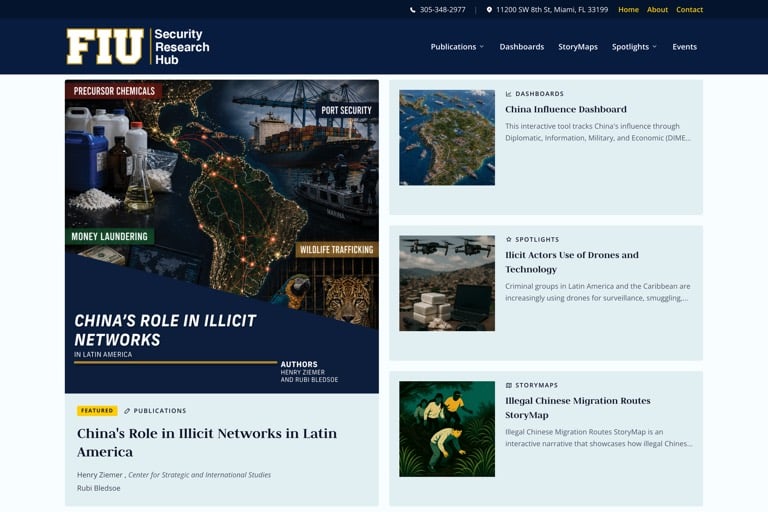
Berg: One hundred percent. There are Chinese diaspora communities across the region, some of them established for hundreds of years, like in Panama, but in recent years, we’ve seen a notable increase in Chinese criminal activity. These groups are involved in similar illicit activities as Latin American organizations such as human trafficking, wildlife trafficking, illegal gold mining, deforestation, and timber operations.
What makes them particularly effective is their expertise in money laundering through diaspora networks. Often, money doesn’t even move through banks or across borders, it relies on trust systems within kinship networks. Because of this, Chinese criminal organizations have become preferred partners for Mexican, Colombian, and other Latin American criminal groups. Their methods are cheaper, faster, and more secure than traditional money laundering operations.
Diálogo: Investigations suggest that the expansion of these criminal networks may also serve Beijing’s strategic interests. To what extent could Chinese criminal groups be operating as informal instruments of the Chinese state?
Berg: That’s the ultimate question. How much control China has over these groups, how much contact exists between them and the party-state, and to what extend these groups answer to Beijing? These are the key issues. I would argue we want to know the answer, but in some ways, we do not want to know, because if we do, and a direct nexus exists, it could effectively implicate China as a criminal regime.