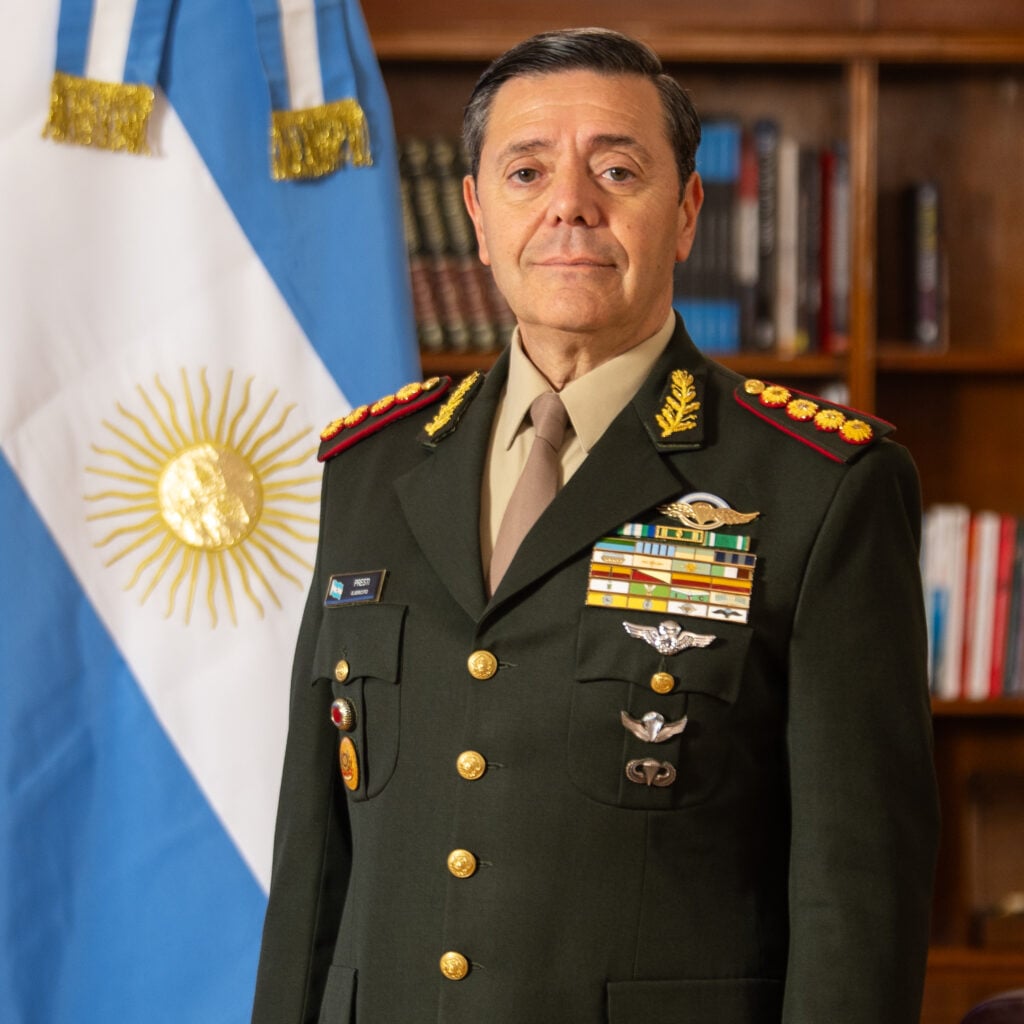

Argentina is undertaking one of its most significant defense transformations in decades, reshaping a doctrine historically centered on conventional conflicts to address transnational threats, critical infrastructure protection, cyber defense, and maritime surveillance. In this exclusive interview with Diálogo, Argentine Defense Minister Lieutenant General Carlos Alberto Presti outlines how the country is modernizing its Armed Forces to respond to an increasingly complex regional security environment.
Central to this effort is an expanding defense partnership with the United States. From the acquisition of F-16 fighter aircraft, Stryker vehicles, and P-3C Orion maritime patrol aircraft to combined exercises, professional military education, cyber cooperation, and interoperability initiatives, Presti describes a broad modernization strategy aimed at strengthening Argentina’s operational capabilities across multiple domains.
The minister also discusses Argentina’s efforts to strengthen border and maritime control, improve intelligence coordination, expand regional cooperation, and reinforce its presence in the South Atlantic. Looking ahead, Presti says Argentina seeks to consolidate itself as “the most reliable South American strategic partner” of the United States while building modern, agile, and technologically advanced Armed Forces.
Diálogo: Latin America today faces an increasingly dynamic security environment, marked by transnational organized crime, illicit trafficking, and growing pressure on borders and critical infrastructure. How does Argentina assess these evolving threats, and how are they influencing its national defense priorities and posture?
Argentina’s Defense Minister Lieutenant General Carlos Alberto Presti: It is a very interesting and very timely question given the geopolitical times we are living in today. Argentina has historically been heavily focused on conventional conflicts. For many years, all our legislation was oriented toward this type of conflict, centered on external state threats. Today, particularly since 2024 under President Milei’s government, the doctrine has been modified through various decrees, incorporating high-value or strategic-value objectives — meaning critical infrastructure — as part of this new doctrine. Likewise, another decree issued that same year incorporated transnational threats, including terrorist actions and those threats that directly affect the interests of our countries.
Diálogo: As these transnational criminal organizations expand their reach and adopt more sophisticated methods, including the use of emerging technologies such as drones, how is Argentina positioning itself to contribute to regional efforts to counter these threats? And what role do international partnerships with countries such as the United States play in strengthening that response?
Minister Presti: Argentina has already taken a step forward and has been conducting an analysis of the different domains, such as the cognitive domain and the electromagnetic space domain, where new threats are also part of everyday actions. In this regard, Argentina seeks to position itself within South America as a partner with technological capabilities that allow it to become a leader in the Western Hemisphere. We have acquired equipment from the United States, specifically F-16 aircraft, as well as cyber defense and cybersecurity capabilities aimed at ensuring we are prepared to confront these threats.
Diálogo: For that response to be effective externally, it is essential to first have strong internal coordination among defense, security, and law enforcement institutions. How is Argentina strengthening interagency integration to improve situational awareness, intelligence sharing, and operational effectiveness?
Minister Presti: There has been significant progress in the Argentine Republic since 2024, with a change in the intelligence system. Previously, it was governed by the Federal Intelligence Agency; today it has been replaced by a new organization called SIDE, the State Intelligence Secretariat.
Likewise, last year the National Intelligence Policy was approved, a document that governs all intelligence activities. Specifically, within the Ministry of Defense and the Armed Forces, including the Joint Chiefs of Staff, structures have been created to develop military strategic intelligence, providing all the necessary inputs for the leadership of both the Ministry and the Joint Chiefs of Staff.
Within this framework, there is a General Intelligence Directorate under the Joint Chiefs of Staff responsible for providing all the necessary information to these two levels of coordination.
Diálogo: Securing national borders requires sustained presence and greater situational awareness across land, air, and maritime environments. What specific measures is Argentina adopting to strengthen its surveillance, control, and rapid response capabilities in key border areas?
Minister Presti: First of all, as you pointed out, interagency work is fundamental. Argentina maintains very strong integration between the Ministry of Defense, the Ministry of National Security, and the State Intelligence Secretariat. We work in a coordinated, permanent, and articulated manner.
Regarding control of the different domains, and particularly in airspace, Argentina has acquired 24 F-16 aircraft. It’s not just about the aircraft themselves, but also all the training, weapons, systems, and software that allow us to reach any point in the country to conduct interception operations. This is complemented by the national radar network, which we are also strengthening with Argentine-made radars.
On the maritime side, the Argentine Navy has incorporated P-3C Orion reconnaissance aircraft, which allow us to effectively monitor our extensive sea and maritime platform, as well as obtain updated information on vessels that turn off their electronic systems or operate in the so-called mile 201, very close to our exclusive economic zone.
Likewise, the Army has acquired Stryker vehicles and is also advancing in the search for new UH-60 Black Hawk helicopters with the objective of modernizing effective border control.
Diálogo: Among those critical areas, the Paraná River stands out as a strategic corridor for commerce, but also one vulnerable to illicit activities. How is Argentina working with its regional partners to strengthen river security, and how does this cooperation contribute to regional stability?
Minister Presti: Argentina maintains very strong ties with all its neighbors, particularly Paraguay. We have signed agreements in both defense and security matters. Specifically in defense, we have agreements in Clorinda [a border city] through which we share information and data to ensure effective control of the riverway.
The Argentine Navy also has river naval bases along the river routes capable of projecting forces when necessary. Likewise, in our country, due to legislation, river control is also the responsibility of the Naval Prefecture, which is part of the Ministry of National Security. They carry out a control plan that guarantees an effective state presence along this strategically important waterway.
Diálogo: Turning to the maritime domain, the South Atlantic remains key to protecting Argentina’s national resources, particularly given the presence of hundreds of Chinese fishing vessels operating near its maritime boundaries. With the incorporation of P-3C Orion aircraft in patrol missions, how has this capability strengthened maritime domain awareness and deterrence against illicit activities?
Minister Presti: The Argentine Navy exercises effective control over the South Atlantic. We have now acquired four P-3C Orion reconnaissance aircraft, which allow us to conduct operations lasting more than 12 hours and maintain constant surveillance over Argentina’s vast maritime space.
All of this is coordinated through the Joint Chiefs of Staff, which has a joint surveillance command to which all information is transmitted to maintain an updated operational picture. There are vessels from other nations operating in mile 201 that, in some cases, turn off their automatic identification systems (AIS) to avoid detection.
Faced with this situation, the Navy has also deployed its fleet, ships, and offshore patrol vessels to maintain an effective presence and reinforce control over the limits of our maritime territory.
Diálogo: Cooperation with the United States has been a recurring theme throughout this conversation. How is Argentina expanding its defense partnership with Washington, and which activities, exercises, or agreements do you consider most relevant for strengthening interoperability and joint readiness?
Minister Presti: The Argentine Republic is currently experiencing a moment in which the country’s highest political authority, President Javier Milei, maintains a high degree of affinity with the United States and with President Donald Trump. As a result, the relationship between the Ministry of Defense and U.S. authorities has also strengthened to a level of closeness not seen in decades, particularly with the Pentagon and the Secretary of War.
This rapprochement is reflected in different areas. As I mentioned earlier, it includes the incorporation of equipment such as Stryker vehicles, naval aircraft, and F-16 aircraft with all associated weapons and software, in addition to projects linked to helicopters. Added to this is increased exchange in the training of officers and noncommissioned officers, as well as combined exercises with troops.
We also place great importance on all activities that allow our personnel to operate jointly and conduct exercises and training alongside U.S. troops. Just a few days ago [April 30], for example, the president was aboard the aircraft carrier Nimitz together with members of his cabinet. Likewise, the Argentine Navy has conducted activities with destroyers, P-3 aircraft, helicopters, and other systems, including communications exercises, cyber defense, and logistical support involving U.S. equipment. I believe those are some of the most significant aspects of this cooperation.
Diálogo: In a broader context, Argentina has long been recognized as a key actor in peacekeeping operations, multinational exercises, and professional military education in the region. How does Argentina plan to leverage this experience to strengthen leadership in promoting interoperability, trust, and cooperation among the region’s armed forces?
Minister Presti: Argentina has extensive experience in peacekeeping operations. Since the 1950s, the country has deployed individual observers and contingents in various missions, both in Europe and currently in Cyprus and Haiti.
Today, task forces of between 230 and 250 personnel — men and women of different ranks — are deployed. Under Argentina’s leadership, we also invite neighboring countries to integrate into these task forces, including Chile, Ecuador, Paraguay, and Brazil. And within this peacekeeping structure in Cyprus, Argentina has historically maintained leadership and command of the force.
Diálogo: Looking toward the future, how do you envision the role of Argentina’s Armed Forces in supporting national defense, contributing to regional stability, and responding to evolving security challenges in the Western Hemisphere?
Minister Presti: I envision our country first and foremost as a stable nation with a growing and dynamic economy. Within that framework, our Armed Forces must be capable of supporting that economic growth.
I envision modern, agile, and strong Armed Forces capable of protecting our borders, our strategic-value objectives, and the lives and way of life of our citizens. I see them with the capability to effectively control our airspace, our sea, and our land, and to project an important presence from Ushuaia as the main gateway to Antarctica, with a relevant role for Argentina in the South Atlantic.
Projecting ahead 20 or 30 years, I envision Armed Forces with a leading role, significant international integration, and the objective of consolidating themselves as the most reliable South American strategic partner for the United States.