


Environmental crimes are destroying the Bolivian Amazon. In 2023, the loss of primary forests in Bolivia increased by 27 percent and reached its highest number on record for the third consecutive year: nearly 500,000 hectares, according to the Global Forest Watch platform.
“Behind this destruction there are out-of-control forest fires, the expansion of the agricultural frontier, rampant gold mining, and the construction of airports and drug laboratories in the middle of natural parks and protected areas,” indicated the recent report The Plundered Amazon: The Roots of Environmental Crime in Bolivia, jointly published by InSight Crime and the Brazilian think tank Instituto Igarapé.
The report highlights the transnational and cross-border dynamics of environmental crime in Bolivia, including wildlife trafficking, illegal mercury trafficking for gold mining, and timber trafficking. “The increase in illicit activities not only degrades the environment, but also strengthens transnational criminal networks that benefit from lack of oversight and corruption,” Melina Risso, director of Research at the Igarapé Institute, told Diálogo.
“It is imperative that there be more effective regional cooperation and a strengthening of public institutions to combat these threats and protect biodiversity and local communities in the Bolivian Amazon and other countries in the region,” Risso added.
Seventy-nine percent of deforestation has occurred in the department of Santa Cruz. There, forest cover fell from 31.9 million hectares in 1985 to 25.7 million hectares in 2022, according to environmental journalism platform Mongabay.
Rise in drug trafficking

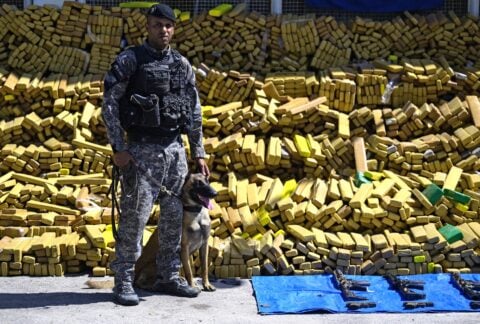
The rise of drug trafficking in the Bolivian Amazon is evidenced by increasing drug seizures. In January 2024, for example, Bolivian authorities seized a truck with more than 8.5 tons of cocaine impregnated on wooden planks as varnish that were to be sent first to Chile and then to Belgium. Authorities arrested three Bolivians and one Colombian, according to Bolivia’s Public Prosecutor’s Office.
“This seizure shows the boom in drug trafficking in the region, which now has the Amazon territory as its main focus of dispute,” reported Peruvian investigative website OjoPúblico in a June 10 report. Coca cultivation is spreading in Bolivia, Ecuador, and Peru driven by criminal groups that capture or invade the territories of indigenous communities to force them to plant coca, the document said.
“In Peru, Colombia, and Bolivia, according to information provided by the authorities, there is penetration of coca crops in protected areas, and alongside these plantations cocaine processing laboratories and clandestine airstrips used for drug transport are built,” OjoPúblico reported.
Mercury from Russia
Most of the deforestation in the Bolivian Amazon is due to gold mining and widespread land clearing for agribusiness, according to the report The Plundered Amazon. “In some cases, cooperatives, which began as simple unions but have become more powerful entities, serve as cover for Chinese, Colombian, and other foreigners who illegally subsidize mining activities,” the report says.
The document notes that imports of mercury, a highly polluting metal used to separate gold from sediments, have also increased. “The country [Bolivia] is by far the largest importer of mercury in the Americas. Until recently, Bolivia’s first supplier was Mexico, but now it’s Russia, which has not ratified the Minamata treaty [a United Nations treaty through which more than 100 countries pledged to reduce their mercury pollution],” the report states.
Timber and fauna
Trafficking networks that steal timber and ship it to countries such as Brazil and Peru also negatively impact the Bolivian Amazon. In May, more than 10 officials from the Authority of Social Control and Inspection of Forests and Land (ABT) seized 320 logs of illegal timber in the Santa Cruz department. “We are complying with the mandate to combat all illegal acts, to keep a firm hand against illegal logging and the sanctions will be in accordance with the infraction,” Luis Roberto Flores Orellana, ABT national executive director, said in a statement following the seizure.
Meanwhile, Bolivia’s wildlife is being pillaged. One of the most affected species is the jaguar, whose parts are highly sought after in China. “Chinese companies’ road construction through the Bolivian Amazon has opened the way for new jaguar traders’ incursions. Environmental groups have documented seizures of hundreds of the felines’ fangs and claws in shipments bound for China, through networks run from Chinese-owned restaurants and stores,” the report The Plundered Amazon indicated.