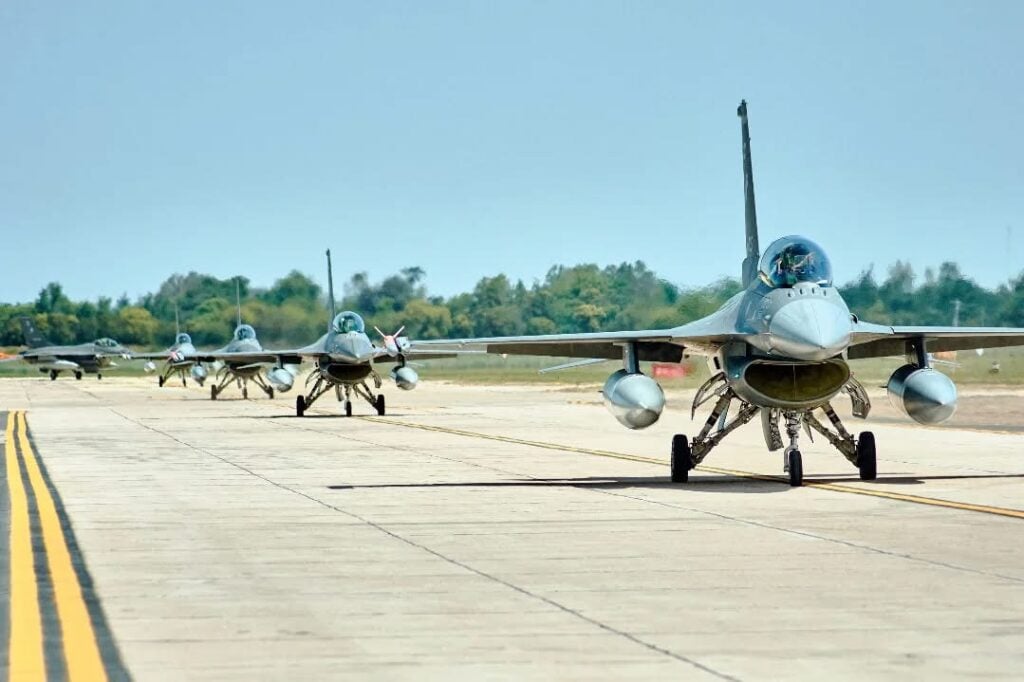

December 2025 will be remembered as a pivotal moment in the modernization of the Argentine Armed Forces. In the span of just 48 hours, the country simultaneously restored its supersonic air capabilities and introduced a new generation of armored vehicles to its ground forces, signaling a decisive shift toward NATO-standard interoperability and modern operational doctrines.
The week of milestones kicked off on December 3 at the military garrison in Boulogne, Buenos Aires, where the Argentine Army officially took delivery of its first Stryker 8×8 Armored Wheeled Combat Vehicles (VCBR). This momentum continued December 5 with the touchdown of the first six F-16 Fighting Falcon fighter jets at the Río IV Material Area in Córdoba, followed by a historic presentation ceremony the next day, ending nearly a decade-long gap in Argentina’s supersonic interceptor capabilities.
These acquisitions, part of a comprehensive process to modernize equipment and training, represent an unprecedented milestone in the nation’s military history.
The support and financing provided by the United States were essential to the incorporation of these advanced land and air systems. “The importance of these acquisitions for Argentina is a significant step toward restoring the capabilities of the Armed Forces,” said Santiago Rivas, director of digital magazine Pucará Defensa.
The F-16: symbol of a changing Argentina
The arrival of the first batch of F-16s — part of a total of 24 aircraft deal with the Royal Danish Air Force — was facilitated by a strategic partnership with the United States. To support the acquisition, Washington provided $40 million in Foreign Military Financing (FMF), a program designed to bolster regional security and cooperation.
“These aircraft are a symbol of the Argentina we are building: a nation that takes itself seriously and seeks to regain its rightful place among the nations of the world,” Argentina’s President Javier Milei stated during the presentation ceremony.
The logistical feat of bringing the jets to South America was a masterclass in international cooperation. Supported by U.S. Air Force KC-135 Stratotankers, the jets completed a transcontinental journey with in-flight refueling, a maneuver unprecedented in Argentina’s history. Beyond the airframes, the F-16 package includes a comprehensive suite of sensors, advanced weaponry, and long-term maintenance support.
“These new multi-role fighter aircraft represent a qualitative leap in deterrence and operational capability,” the Argentine Air Force noted. Rivas added that the F-16 not only restores supersonic flight but also integrates Argentina into a global network of more than 20 countries, operating this platform, aligning the nation with international technical standards.

Stryker 8×8: versatility and protection for the Army
While the skies were the focus on December 5, the ground forces saw their own revolution two days earlier. The incorporation of the Stryker 8×8 represents a massive leap in troop protection and tactical agility.
Valued at $20 million for the initial phase, the Stryker package includes vehicles, spare parts, training, and a robust technical support program. The United States is providing ongoing technical assistance, while General Dynamics Land Systems, the Stryker manufacturer, is overseeing the specialized training.
For Rivas, the Stryker’s arrival “marks a key step in the transformation of the land military instrument, providing the force with more agile, versatile means adapted to operations with armored protection and fire capabilities.”
These vehicles not only strengthen Argentina’s ability to participate in international peacekeeping operations, humanitarian assistance, and disaster response, but also improve interoperability with U.S. and allied systems, strengthening strategic bilateral ties.
Future projects and international cooperation
As part of the ongoing modernization, the Army is currently evaluating the incorporation of Black Hawk helicopters. This follows the cancellation of a tender in January 2025 due to budget constraints; however, by early 2026, new financing alternatives are being studied to reactivate the project, El Cronista Comercial reported.
To deepen this cooperation, Brigadier General Sergio Di Clemente, director of the Argentine Army Aviation, recently visited the Georgia National Guard Center as part of the U.S. State Partnership Program, Zona Militar reported.
U.S. Ambassador to Argentina Peter Lamelas told Infobae that “Argentina’s military modernization is very important to the United States, which is willing to analyze Argentina’s requirements to determine howe we can best assist.”
“The goal is to cooperate with regional partners to maintain security and stability in the Americas, and also to counter the advance of China and Russia, which in recent years have pursued a policy of selling or donating military equipment in the region,” Rivas concluded. “This demonstrates that the military ties between the United States and Argentina are strong and reliable.”