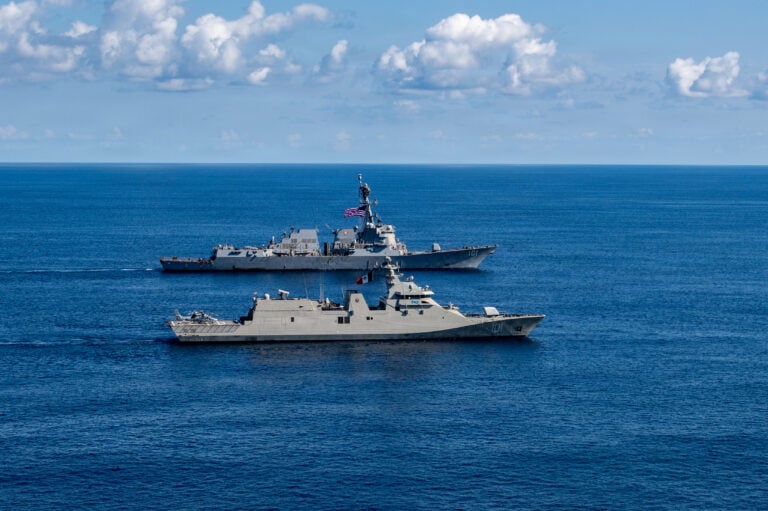
Long-standing U.S. Southern Command- (SOUTHCOM) led multinational exercise Tradewinds remains a key component for regional security in the Caribbean, focused on strengthening interagency cooperation to face a wide spectrum of threats, including natural disasters and transnational organized crime.
In its 2024 edition, held in Barbados, Tradewinds brought together representatives from more than 25 countries to conduct joint operations in the naval, air, land, and cyber domains. The event promoted new strategies in humanitarian assistance and maritime interdiction operations to neutralize threats on the high seas.
Each year, Tradewinds serves as a strategic forum that promotes exchanges among military and security leaders from the Caribbean, Latin America, and North America, together with SOUTHCOM. Through joint training, multinational maneuvers, equipment donations, and technical assistance, participants strengthen regional preparedness for common challenges.
During the planning conference for the 2025 edition of the exercise, which just kicked off in Trinidad and Tobago, Captain Anil Gosine, chief of Staff of the Trinidad and Tobago Defence Force, highlighted the high level of collaboration among participating countries.
“This dedication exemplifies the teamwork and commitment that exercise Tradewinds strives for,” Capt. Gosine said. “Let us remember that the things which unite us are enhancing security, regional resilience, and cooperation. The diversity of expertise and perspectives in this room is all free to strengthen together.”
For Yadira Gálvez, a security expert and academic at the National Autonomous University of Mexico, “Tradewinds is key to security for three reasons: First, it fosters trust and the exchange of knowledge among military forces in the face of transnational threats and natural disasters. Second, it improves interoperability to respond to recurrent catastrophes in the Caribbean, integrating lessons learned. And third, in the face of threats such as narcotrafficking, human trafficking, or violent extremism, it strengthens the capacity for deterrence and response,” she told Diálogo.
The 2025 edition of Tradewinds will focus on the fight against transnational organized crime and violent extremist organizations, and the optimization of natural disaster management.
Expanding alliance
On January 1, a new provisional the Status of Forces Agreement (SOFA) between Trinidad and Tobago and the United States came into effect. The new agreement, signed on December 10, 2024, aligns the SOFA in place since 2007 with current U.S. and Trinidad and Tobago laws and facilitates interoperability between the countries’ armed forces. In November 2024, Trinidad and Tobago signed the San José Treaty, demonstrating their commitment to collaboration in combating illegal trafficking in the maritime domain.

In December, Trinidad and Tobago also formalized its adherence to SOUTHCOM’s Human Rights Initiative, committing to implementing human rights programs in their defense and security institutions. That same month, Trinidad and Tobago signed the Caribbean Basin Security Initiative (CBSI) Technical Assistance Field Team (TAFT) Memorandum of Understanding (MOU) with the U.S. State Department, increasing maritime maintenance capability and interoperability with like-minded partners in the region.
Seeking to strengthen interoperability and maintain stability in the Caribbean, the Jamaica Defence Force, in collaboration with the Canadian Special Operations Forces Command and U.S. Special Operations Command South (SOCSOUTH) carried out Exercise Tropical Dagger 2025. The exercise, which concluded in late March, saw the participation of Special Forces from Barbados, the Bahamas, Belize, Guyana, and Trinidad and Tobago.
Cooperation in the region also extends to the civilian sphere. In September, SOUTHCOM donated mobile medical units and trauma relief equipment valued at more than $490,000 to Trinidad and Tobago. This donation strengthens the local health system, providing essential medical services to vulnerable communities and reinforcing the humanitarian aspect of regional cooperation, the U.S. Embassy in Trinidad and Tobago indicated.
In December 2024, the Unite States also donated disaster relief equipment and supplies valued $100,000 to several partners across Trinidad and Tobago. Funded through SOUTHCOM’s Humanitarian Assistance Program, the donations included a high-water truck, electric generators, and personal protective equipment that will enhance Trinidad and Tobago’s natural disaster response capabilities, the Embassy said.
Persistent challenges
“The Caribbean represents a key geostrategic area for the movement of drugs, the illicit trafficking of people, and even the operation of cells linked to violent extremism,” said Gálvez. “Documented cases show how terrorist organizations such as ISIS have established connections with people based in the region, who have been recruited and radicalized through digital platforms.”
Faced with these threats, exercises such as Tradewinds improve the deterrence and response capability of regional armed and security forces, reinforcing their preparedness for complex and transnational scenarios, Gálvez said.
To threats such as organized crime with increasingly decentralized and adaptable structures, are added narcotrafficking, extortion, fraud, human trafficking, and the illegal exploitation of natural resources.
There are also persistent risks associated with natural disasters such as hurricanes, earthquakes, and floods. According to the United Nations’ Regional Assessment Report on Disaster Risk for Latin America and the Caribbean, every year at least one high-intensity hurricane impacts an area of the Caribbean with cascading effects that affect multiple countries simultaneously.

“With that in mind, it’s key to take advantage of the logistical and operational capacities of the armed forces to respond in an efficient and timely manner,” Gálvez said. “This function is already recognized within the framework of the Conference of Defense Ministers of the Americas, which promotes their participation in humanitarian support and emergency management.”
The 2010 catastrophic earthquake in Haiti demonstrated the need for logistical, operational, and immediate support capabilities on the part of the military forces, to facilitate the response of civilian organizations in humanitarian aid. “This type of exercise must be conceived in an integral manner, where the military component is part of a broader response that includes civilian actors,” Gálvez added.
Multinational response
Beyond Tradewinds, initiatives such as the recent U.S. Air Forces Southern-led Lesser Antilles Medical Assistance Team (LAMAT) 2025 also foster goodwill and strengthen partnership, all while showcasing the United States’ commitment to the region.
Added to this are engagements such as PANAMAX Alpha Phase 0, in which SOUTHCOM’s Joint Task Force Bravo (JTF-Bravo) teamed up with their Panamanian counterparts in support of Panamanian communities, and the yearly mission Continuing Promise in which medical military personnel, embarked on a U.S. Navy ship, provide health and veterinary care, share expertise, and bolster disaster relief collaboration.
“For the armed forces, these exercises promote learning, collaboration, and the consolidation of long-term ties. They reaffirm cooperation, respecting national sovereignties and state interests,” concluded Gálvez. “They also make it possible to identify improvements in the processes of modernization and institutional transformation, as well as doctrinal, strategic, and operational evolution that the entire hemisphere is undergoing.”