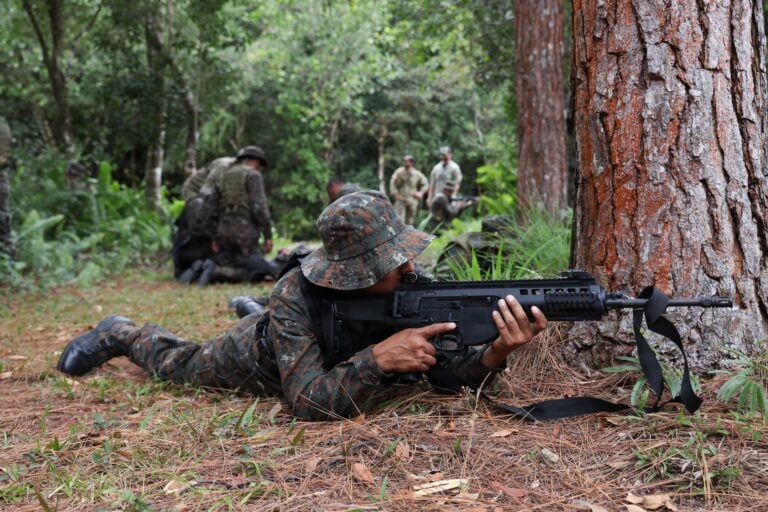


For the past 40 years, Caribbean nations and the United States have come together yearly to strengthen cooperation and improve operational readiness to respond to threats, from natural disasters to terrorist organizations. Under the aegis of U.S. Southern Command (SOUTHCOM), exercise Tradewinds has served as a platform for productive dialogue and collaboration, symbolizing the collective resolve of nations to enhance interoperability and bolster capabilities to mitigate, plan for, and face challenges for peace and security.

Far beyond a strategic engagement to optimize the skills of participating forces, Tradewinds has, since its inception in the 1980s, focused on the wellbeing of the region’s inhabitants, carrying out construction and repair projects, as well as medical assistance missions, as part of its humanitarian and disaster relief training. Collaborating with security and service members of the host nation, Tradewinds participants have routinely rolled up their sleeves to renovate schools, pave roads, repair critical infrastructures, contribute to groundskeeping efforts, and even take on environmental initiatives, such as clearing debris and rehabilitating coral reefs.
“There is more to military than just fighting wars,” U.S. Marine Captain Brian Pierson rightfully said back in 2017, as he and service members from Jamaica, Canada, Mexico, the host country, and other partner nations picked weeds and repaired walls side by side at Trinidad and Tobago’s Carenage Boys Government Primary School, as part of Tradewinds. “It’s about understanding the community, culture, and showing the kids that there are good people out there.”
And goodness abounds. In 2022, for instance, the Barbados Defence Force and the Queen Elizabeth Hospital in Barbados received a $2 million medical supply donation. That same year, during a medical outreach in Belize, the Tradewinds medical team provided preventative care, pediatrics, dental, and for the first time optometry services to thousands of residents in Belize’s Orange Walk district.
“Tradewinds organizers reach out to rural areas with limited medical services to let them know of the services that we will provide as part of the exercise,” Chief Petty Officer Kerstin Dickerson, former Chief Operations coordinator at the U.S. Embassy in Belize, then said.
Throughout the years, Tradewinds’ multinational trainings in ground security, maritime interdiction, aerial support, and cybersecurity, among many others, have been welcomed not only by participating forces but by the community at large. In a 2002 opinion piece, Caribbean daily Sun Weekend described Tradewinds as a worthy exercise tailor-made for the region and praised its benefits year after year.
“The people of the region should feel as confident as the A&BDF [Antigua and Barbuda Defence Force] that all is well in this area of the region’s development and does, in fact, seem to be getting better each year with Tradewinds,” the Sun Weekend said.

This year’s iteration of Tradewinds, slated for late April, will be hosted by Trinidad and Tobago for the sixth time. The long-lived exercise has evolved to included Latin American nations in combined operations drills, thus strengthening cooperation beyond the Caribbean.
“Tradewinds 2025 [TW25] represents the true essence of multinational cooperation. By working hand-in-hand with the Trinidad and Tobago Defence Force [TTDF], our Caribbean partners, and allied nations, we are not only building readiness but also reinforcing the bonds of trust and shared commitment to regional security and stability,” Colonel Christopher Johnes, director of training and exercise for U.S. Army South (ARSOUTH) and TW25 exercise co-lead, said. “This exercise exemplifies our collective ability to adapt, collaborate, and excel in an increasingly complex global environment.”
This year’s exercise includes participants from across roughly 30 partner nations in the Western Hemisphere, as well as France, Canada, and the Netherlands. The diverse participation of partner nations further underscores the emphasis on global interoperability and dynamic partnerships.
“Working side by side with forces from other nations, joint and combined training generates significant benefits, such as the creation of mutual trust and solidarity, and a deep understanding of each country’s procedures and capabilities,” José Javier Díaz, a defense, security, and aerospace consultant, told Diálogo. “This allows nations to effectively complement each other’s capabilities, resulting in a more agile and coordinated response to emerging challenges.”
As for the host country, it awaits launch day with enthusiasm. “Our soldiers, sailors, and airmen are excited to interact with regional and international partners,” Lieutenant Colonel Dwayne Edwards, TTDF exercise director, said during a planning conference for the event. “And for many, it will be their first opportunity to serve alongside such diverse allies.”