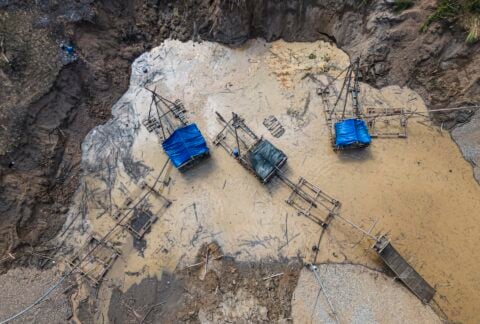



The Pampa de Pongo mining megaproject in Peru’s Caravelí province, led by the Chinese company Jinzhao Mining, is shaping up to become one of the largest iron projects. Yet concerns are mounting over the corporation’s clouded history of non-compliance and controversy, raising alarms about doing business with a company linked to the Chinese Communist Party (CCP).
With an estimated investment of $1.78 billion, the project is expected to consolidate Peru as a major player in iron ore production, with an annual output of 22.5 million tons. Construction is slated to begin before the end of 2025, and operations are scheduled to start in 2028.
Social and environmental challenges
Experts agree that Peruvian communities are cautious concerning “social authorization” for mining projects. Being very aware of their environment, these communities have seen in the past how companies have negatively affected their ecosystem, often depriving families of their daily livelihood.
“Peruvian communities and the towns where mining projects are developed are particularly sensitive to these projects because of the threat they pose to agricultural areas in the highlands,” Sergio Paredes, a Chilean mining consultant, told Diálogo. “These are mostly communities that depend on small family farms.”
“In this context, any extractive activity requires much more rigorous care than in mining areas such as those in Chile, where projects are usually located in desert regions or isolated mountain ranges, with no surrounding population, and where the impacts are of a different nature,” Paredes added. “In Peru, on the other hand, the effects of mining directly impact access to water, roads, and agriculture, immediately affecting nearby communities.”
Peruvian international analyst Pedro Yaranga stressed that Jingzhao Mining must strive to obtain social authorization for the mine from at least “70 or 80 percent of the population of Caravelí.”
“Otherwise, I believe that this project will encounter more than one problem over time,” he added.
Controversies and questions
The Pampa de Pongo project has been surrounded by a series of controversies and allegations. While the project originally included a port on Sombrerillo Beach, it was later announced that the district of Marcona would be the “epicenter of the mining revival.” In March 2024, Jinzhao Mining won the tender for the design, financing, construction, operation, and maintenance of a new port in Marcona — the San Juan de Marcona Port Terminal —for 30 years, with an estimated investment of $405 million.
However, the concession was granted amid allegations of corruption and alleged political favors, in which the general director of the company’s Peruvian subsidiary, as well as high-ranking government officials and state officials, were believed to be involved.
In a video statement, Edison Poma, project manager of the Jinzhao Mining port terminal, attributed the issue to “a lack of communication between state entities.”
According to Yaranga, there are several issues with the project. These include: The Chinese company changing the port’s environmental impact study without consultation; the work, which should have started in 2018, being postponed until now; and the port’s location being moved to Marcona, in the Ica region, from its original site near the Arequipa mine.
Julia Cuadros, a researcher with nongovernmental organization CooperAcción, told global news agency IPS Noticias that “China is appearing in corruption cases, not only in mining. A lobby of this kind would be very shady […], and the problem is that when it’s such a huge investment, the impact is also huge.”
Controversy over local employment
Jinzhao Mining’s track record of alleged breaches and broken promises has generated discontent among the local population. The company initially promised that 40 percent of the workers hired for the port project would be from Caravelí, but this figure has since been reduced to just 15 precent, daily Diario El Pueblo reported.
Yaranga warned of the negative track record of companies linked to the CCP in Peru, pointing out that during a previous administration, many of these companies received advance payments for projects that were never carried out.
“The amounts amounted to almost 50 percent of the cost of the work itself,” Yaranga said. “They made a little progress, but then they all abandoned the project. In other words, it was a complete scam.”