
Following a model pioneered by European mafias — most notably the Italian ‘Ndrangheta — major Latin American criminal organizations have begun a systemic infiltration of the legal economy. Moving beyond traditional shadow operations, these groups acquire companies, investing in heavy industry, and seizing control of entire agricultural and production chains. Their primary objective represents a departure from classic money laundering; it is no longer just about concealing illicit capital, but about acquiring a veneer of legitimacy to expand their power and influence.
“The business facade allows them to infiltrate trade associations and finance politics, presenting themselves as job creators to hinder criminal prosecution and obtain social protection,” Nicolas Zevallos Trigoso, director of Public Affairs at Peru’s Institute of Criminology, told Diálogo.
According to Zevallos, the legal economy serves as a dual space for protection and expansion, designed to ensure the long-term sustainability of illicit enterprises. The impact on the general population is considerable. In this burgeoning gray area, where criminals become “white-collars,” many legitimate entrepreneurs are forced to operate under the draconian rules of organized crime or, find themselves squeezed out of the market entirely.
Brazil’s Operation Hidden Carbon
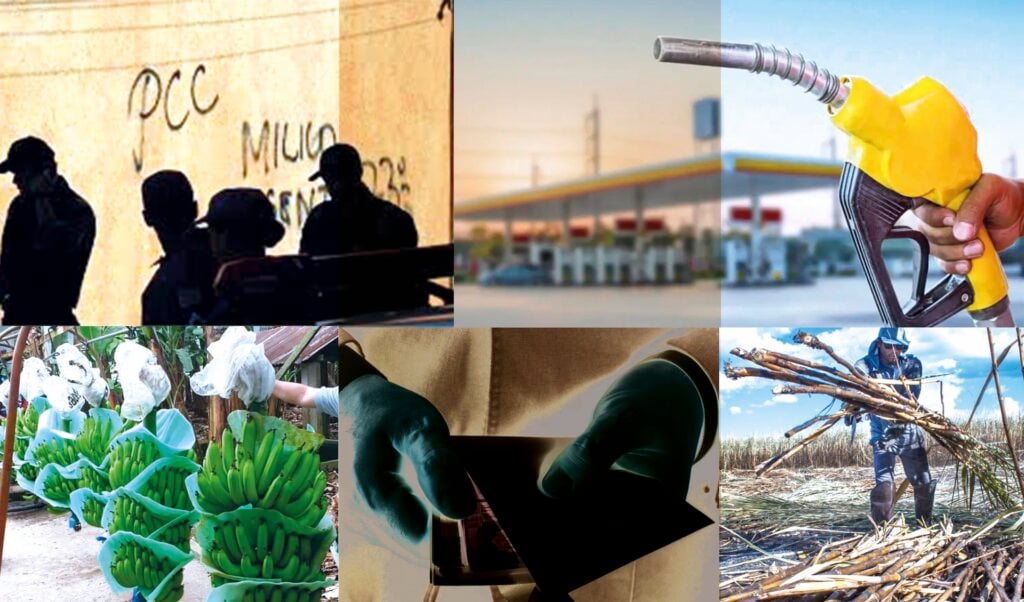
The scale of this threat was laid bare in 2025 by a landmark investigation led by the Public Prosecutor’s Office of the State of São Paulo. What began as a legal complaint against the First Capital Command (PCC) evolved into the massive Operation Hidden Carbon (Operação Carbono Oculto), exposing the group’s unprecedented vertical integration of the energy sector. Prosecutors revealed that the group allegedly coerced farmers, sugar mill owners, and fuel distributors into selling their businesses through targeted intimidation — including the strategic torching of sugarcane fields to devalue assets before a forced takeover.
The results of the crackdown were staggering. Authorities dismantled a network that included four ethanol plants and over 1,000 gas stations, uncovering a financial apparatus that moved about $9.6 billion through clandestine fintechs and investment funds.
“Criminals generate an unfair competitive advantage: By owning capital at zero cost and using coercion, they can bankrupt honest competitors and monopolize local markets,” says Trigoso.
The cases of Peru and Ecuador
In Ecuador, local criminal groups have begun to emulate the Balkan mafias that have operated within the country for years, seizing control of banana production and export firms to conceal cocaine shipments. The most harrowing example is the Hacienda La Clementina — a massive banana plantation spanning over 10,000 hectares in the Los Ríos province.
In a brazen escalation throughout 2025, the plantation was taken over by the Los Choneros AK-47 faction. The group blocked the legal sale of the property, imposed their own private security force, and continues to extort the families who live and work on the plantation.
In Peru, within regions dominated by illegal mining or drug trafficking, the local economy often revolves around illicit capital. Sectors such as hospitality, automotive repair, and general commerce have become heavily dependent on this cash flow, which serves as the primary engine for regional consumption.
“In Peru, rather than infiltration, we see a deep symbiosis between the legal and the illegal. Markets such as illegal mining, drug trafficking, and logging demand services from a network of 1.4 million people who provide logistics, transportation, supplies, and food in a formal or informal manner,” says Trigoso.
This phenomenon of organic integration is mirrored across the continent. In Mexico, cartels exert a stranglehold on the avocado and lemon value chains. In Colombia, the legal cattle trade and gold market have become intertwined with criminal capital and operations.
“It is not an external intrusion, but rather a structure in which criminal capital mobilizes entire legal sectors, turning the formal economy into a cog in its business model and creating a social base dependent on its success,” says Trigoso.
Vulnerabilities
According to Zevallos, two critical factors facilitate the penetration of the legal economy by Latin American criminal groups: the prevalence of informality — an expansive sector of unregistered, cash-based commerce that operates outside of government oversight and taxation — which averages 50 percent across the region, and the institutional fragility of formal systems.
“Informality acts as a massive communicating vessel; it allows illicit money to circulate freely, without traceability or a digital trail. It’s an ecosystem where cash rules, making it easy for illegal capital to be atomized and integrated without resistance into daily consumption,” says Trigoso.
As a sector of the economy that escapes official taxation and monitoring, the informal market accounts for roughly 33 percent of Latin America’s GDP. According to the 2025 Regional Human Development Report, Under Pressure: Recalibrating the Future of Development, published by the United Nations Development Program (UNDP), organized crime thrives in these high-informality environments by positioning itself as an essential source of income and employment.
Even the formal economy offers little resistance. “Current controls are mostly performative and administrative. They are based on compliance with procedures and declarations that function as a ‘paper shield,’ but the state lacks real capacity for strategic surveillance and financial intelligence on the ground,” Trigoso notes.
Confronting this reality requires a shift in strategy. “States must focus their intelligence and criminal prosecution on the most relevant criminal structures and move from a model of administrative controls to one of predictive economic intelligence,” the expert concludes.