
The earthquake that struck northern Venezuela on June 24 triggered a broad mobilization of hemispheric humanitarian assistance and disaster response (HADR) capabilities, with urban search and rescue teams, medical personnel, aircraft, search dogs, emergency supplies, communications specialists, and logistical support deployed from countries across the Americas.
More than a collection of bilateral aid efforts, the operation demonstrated how advance preparation, shared standards, and civil-military coordination enable countries to rapidly integrate specialized capabilities when a disaster overwhelms a nation’s response capacity.
“An earthquake of magnitude 5 or greater may already require international assistance. When it reaches magnitude 7.5, as it did in Venezuela, international cooperation is no longer optional — it becomes an immediate necessity to save lives during the first critical hours,” Luis Carlos Villegas, former minister of Defense of Colombia and former chairman of the Board of Directors of the Coffee Region Reconstruction and Social Development Fund (FOREC), the agency created to coordinate reconstruction after Colombia’s devastating 1999 earthquake, told Diálogo.
Urban search and rescue
Urban search and rescue (USAR) was among the first capabilities deployed, playing a critical role in locating survivors trapped beneath collapsed structures. Several countries across the region dispatched specialized teams to reinforce Venezuelan rescue operations.
Colombia deployed its USAR COL-1 team, consisting of 63 specialists, four search dogs, and nearly 12 tons of technical equipment. Coordinated by Colombia’s National Unit for Disaster Risk Management (UNGRD), the mission brought together personnel from multiple institutions trained to operate under international standards in complex urban disasters.
Ecuador deployed 46 specialists from the Quito Fire Department’s USAR ECU-01 team, two search dogs, and 6 tons of emergency equipment. Panama activated a humanitarian search and rescue mission in support of Venezuela, while the Dominican Republic deployed specialized Armed Forces units as part of Operation Quisqueya Solidaria 2026.
Mexico also contributed search and rescue capabilities. In addition to deploying military rescue personnel, search dogs, and aircraft, members of the International Rescue Brigade Topos Azteca — renowned for responding to earthquakes both within and beyond the region — traveled to Venezuela to support rescue operations in the hardest-hit areas.
Coordinating teams from multiple countries requires more than goodwill. Many of these units operate under the methodologies and standards of the International Search and Rescue Advisory Group (INSARAG), a United Nations initiative that establishes common procedures for sector management, operational safety, communications, structural assessment, and medical care during urban collapse operations.
“When everyone works under the same protocols, the operation becomes much more efficient. Every team knows what to do, where to operate, and how to coordinate with the others,” Captain Luis Bernardo Moreno Llano, commander of the Envigado Volunteer Fire Department in Colombia, whose rescuers are part of USAR COL-1, told Diálogo.
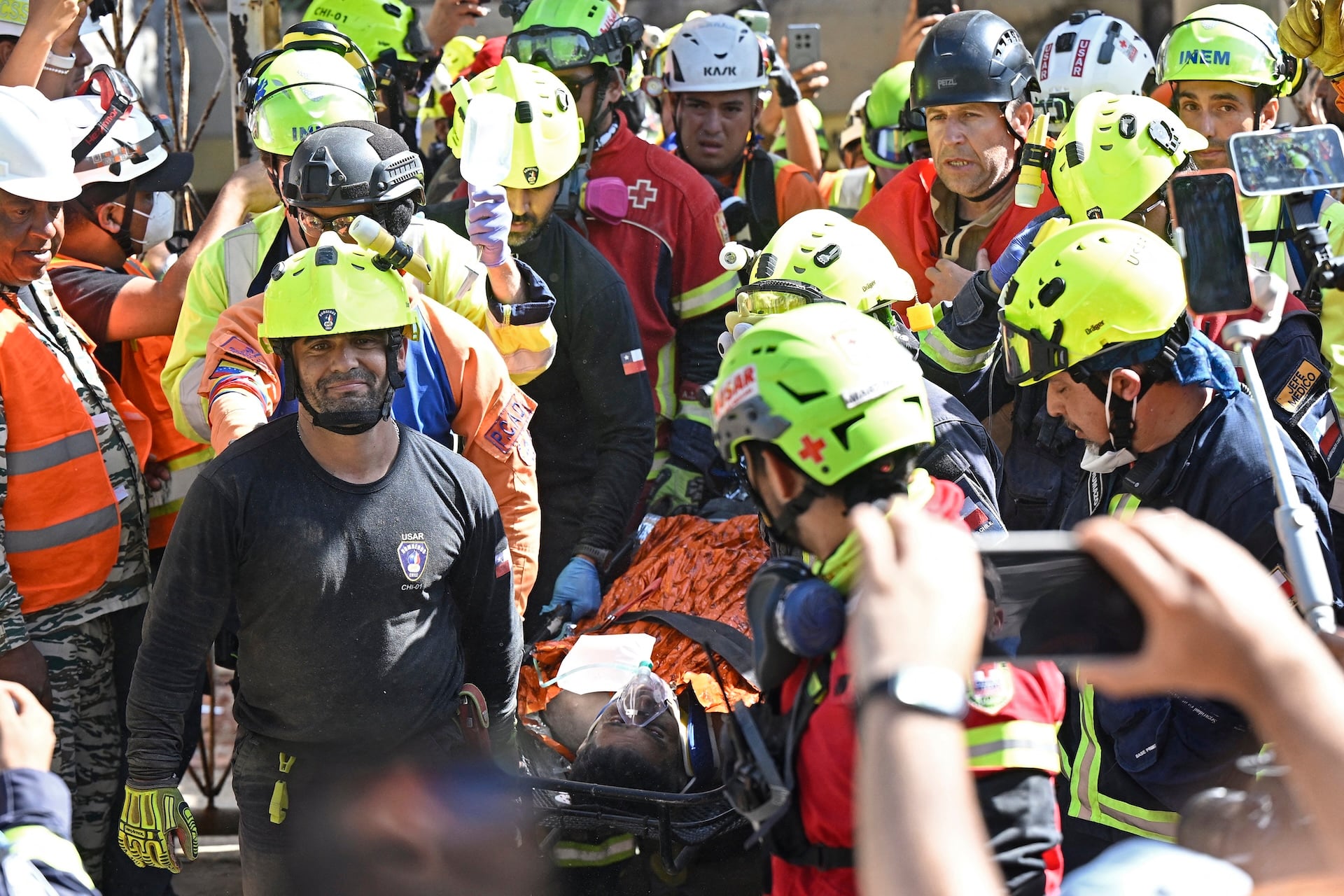
That interoperability was reflected in coordinated rescues on the ground. In La Guaira, Colombian rescuers worked alongside Venezuelan authorities and other international teams to rescue Moisés, an 11-year-old boy who had remained trapped beneath the rubble for approximately 72 hours. Days later, teams from Chile, Costa Rica, El Salvador, and the United States helped rescue Hernán Gil, a worker who was found alive after spending more than a week beneath the debris.
Medical capabilities and humanitarian support
The hemispheric response also included medical capabilities, essential supplies, and humanitarian assistance for communities that had lost homes, access to services, or healthcare.
El Salvador deployed 300 rescuers and paramedics, along with 50 tons of equipment, medicines, and essential supplies. The mission represented one of the largest operational contributions made by a Central American country during the initial phase of the emergency.
Brazil mobilized a humanitarian mission that included military firefighters, personnel from the National Civil Defense, specialists from the National Telecommunications Agency (Anatel), search dogs, and a KC-390 transport aircraft. The mission also included a field hospital, medicines, water purification systems, and other essential supplies. The deployment of telecommunications specialists strengthened a critical capability for coordinating rescue operations, medical care, and humanitarian assistance in areas where communications had been disrupted.
From Panama, the International Federation of Red Cross and Red Crescent Societies mobilized humanitarian supplies from its regional logistics hub, including hygiene kits, kitchen sets, mosquito nets, and other essential relief items. The regional logistics hub helped sustain relief operations and support displaced communities and others with limited access to basic services.
Strategic mobility
In large-scale disasters, one of the greatest challenges is turning international assistance into effective support on the ground. Moving personnel, equipment, and relief supplies depends on a complex logistical network that must continue functioning even when critical infrastructure has been damaged.
“In a disaster of this magnitude, the first obstacles are usually logistical: overwhelmed airports, blocked roads, damaged ports, and disrupted communications. Unless those bottlenecks are resolved, even the best-trained rescue teams can become immobilized,” Villegas said.
In that context, the United States contributed transportation, logistics, search and rescue, coordination, and operational support capabilities. Led by the U.S. Department of State, U.S. Southern Command (SOUTHCOM) deployed personnel, aircraft, rescue teams, and damage assessment capabilities to facilitate the flow of humanitarian assistance.
More than 900 U.S. personnel were deployed inside Venezuela, while another 800 were positioned in Puerto Rico and Curaçao to support the regional operation. According to U.S. Marine Corps General Francis Donovan, SOUTHCOM commander, U.S. forces supported search and rescue operations, helped restore airport operations, and continue to provide transportation and logistical capabilities to facilitate the delivery of humanitarian assistance to affected areas.
The operation also included damage assessment and operational intelligence. According to Gen. Donovan, MQ-9 unmanned aircraft and a fusion cell in Miami helped identify damaged buildings and passable routes, providing information that guided the movement of personnel and relief supplies.
“Military forces do not replace humanitarian agencies; they provide strategic mobility, engineering, communications, and logistical capabilities that few civilian organizations can deliver during the first hours of a major emergency,” Villegas said.
Preparing before disaster strikes
The response to the earthquake in Venezuela demonstrated that HADR capabilities cannot be improvised. Certified USAR teams, search dogs, field hospitals, transport aircraft, telecommunications specialists, engineers, medical personnel, and regional logistics hubs are the product of years of preparation, joint training, and interagency coordination.
For Moreno, that preparation is decisive. “That level of speed is only possible when countries maintain trained teams, established procedures, and permanent readiness,” he said.
Across the hemisphere, natural disasters are not only humanitarian emergencies. They also test institutional resilience, logistical capacity, and coordination among military forces, civil protection agencies, fire departments, health authorities, and humanitarian organizations.
“Latin America, the United States, Canada, and Europe remain deeply committed to helping when tragedies of this magnitude occur. Today, the international community’s ability to mobilize assistance is even greater than it was two decades ago. That spirit of solidarity is still very much alive,” Villegas said.
The response to the earthquake in Venezuela demonstrated that a country’s ability to confront a large-scale disaster depends not only on its own resources, but also on how quickly it can integrate into a regional network of specialized capabilities. Certified USAR teams, strategic mobility, field hospitals, telecommunications systems, and established coordination mechanisms enabled assistance to reach affected communities more quickly and effectively during the critical early stages of the emergency.
The response highlighted the value of years of joint training, interoperability, and institutional relationships developed before disaster strikes. When an emergency overwhelms national capabilities, those partnerships enable countries to integrate specialized resources more rapidly, coordinate operations more effectively, and save lives during the most critical hours.