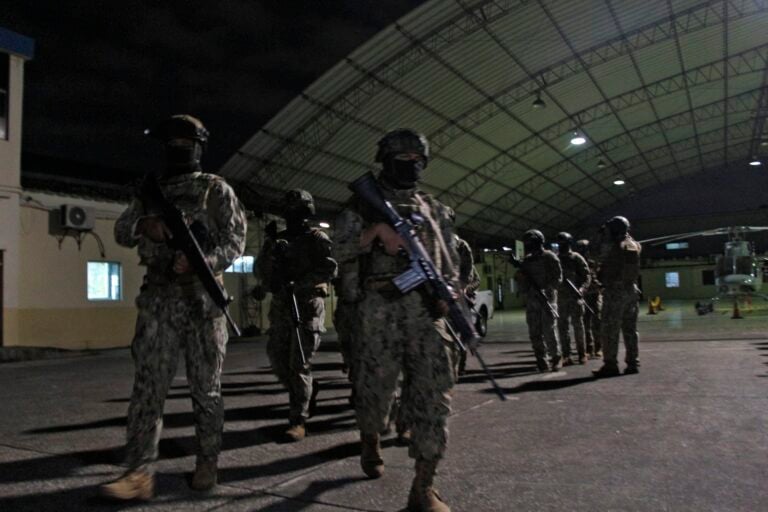
Controversial state-owned company China Road and Bridge Corporation (CRBC), which has one of the largest projects counts worldwide under China’s Belt and Road Initiative, is behind the construction of the maximum-security mega prison in Ecuador’s province of Santa Elena, Ecuadorian investigative news site La Fuente reported.
Puentes y Calzadas Infraestructuras S.L., a subsidiary of CRBC, signed a $52.2 million contract with the Ecuadorian government in mid-June to deliver the mega prison within 300 days.
Accused of misconduct; delivering shoddy work; construction delays, which then led to lost revenue; illegally winning tenders; human rights violations; and environmental damage, among many other issues in its projects worldwide, CRBC and its infamous sister company, China Harbour Engineering Company Ltd. (CHEC), have a questionable track record. Their parent company, China Communications Construction Company (CCCC), including all subsidiaries, was blacklisted by the World Bank in 2009 for eight years, for fraudulent practices in the Philippines.
CCCC, and its subsidiaries including CHEC and CRBC, are some of “the Chinese business giants that the Communist Party uses for everything,” Douglas Farah, international analyst and president of IBI Consultants, a U.S.-based national security consulting services company specializing in Latin America, told Diálogo in a previous report. “It’s a company that receives many complaints, mainly because it lacks transparency and because normally its contracts are not open to the public. That translates into them committing to do things and then there is no way to hold them to it.”
While construction of the mega prison in Santa Elena has barely begun, red flags have already started to come up. According to La Fuente, the Chinese company is clearing a large part of an extensive forest, home to several ancestral communities. In addition, little is known about the award process. It did not go through a bidding for the contract with local companies. The government invited the Chinese subsidiary directly and signed the agreement for the project soon after, Spanish daily El País reported.
On August 19, the Permanent Committee for the Defense of Human Rights of Ecuador (CDH) and the Coordinator of Social Organizations of Guayas, denounced that the construction affects the primary forest, puts wild flora and fauna at risk, threatens territories rich in pre-Hispanic archaeological artefacts, as well as the economy and livelihood of the communities Bajada de Chanduy and Juntas del Pacífico.
“The inhabitants of Bajada de Chanduy […] watched in fear as the tractor destroyed the trees, which have been there forever. Their faces twitched at the sound of the giant shovel as it tore out the roots of the destroyed trees. It took only a few minutes for the green landscape to change. The tractor destroyed everything around the giant ceibo trees, which must be around 100 years old to be that size,” El País reported. “In a little while they are changing our lives,” said Bernardo Cabrera, one of the community members, seeing for the last time the forest they had protected for decades, El País added.
The communities announced legal action to stop the construction, local media Expreso reported, fearing that more problems would arise in what they consider their territories.
The construction of the prison dubbed by the State Cárcel del Encuentro (the Meeting Prison), because that is where the corrupt, murderers, and drug traffickers will meet, began on June 21 and is among the government’s strategic plans to neutralize and eradicate narco-crime. The hope is that it will be a symbol of justice and the beginning of a new era of peace for Ecuadorians, the Presidency of the Republic said in a statement.
The Ministry of Environment, Water, and Ecological Transition said for its part that the area where the Chinese company is building the prison, the La Envidia forest, is not part of the National System of Protected Areas nor is it part of the National Forest Heritage. “However, the Prefecture of Santa Elena did declare the forest as a conservation and sustainable use area in January 2023,” Ecuadorian media Ecuavisa reported.
For experts, the issue lies in that the company chosen to do the works is among China’s state-owned firms, which all have poor performance records worldwide and raise concern about the potential negative, long lasting, and irreversible impacts.
“Ecuador opened its doors to Chinese companies to build mega-construction projects. Several of them, built more than a decade ago, continue to present serious structural problems,” Voz de América reported. “Among these works, the Coca Codo Sinclair hydroelectric dam stands out, which keeps the country on edge due to its extensive environmental impact and difficulties in generating energy.”