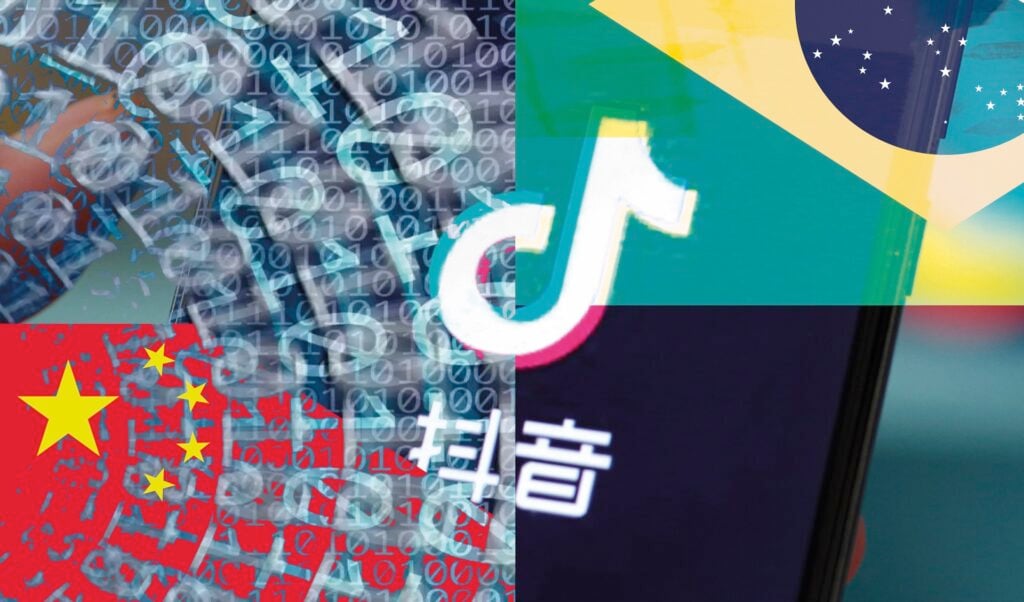

Chinese technology company ByteDance, TikTok’s parent company, plans to build its first data center in Latin America in Brazil — a project drawing increasing scrutiny from security experts concerned about China’s expanding influence over strategic digital infrastructure in the region.
The facility is planned for the Pecém port complex in the metropolitan region of Fortaleza, capital of the northeastern state of Ceará and is expected to begin operating in 2027.
The project, whose total investment could reach up to $38 billion over the next decade, according to Brazilian officials, is poised to become one of the largest technology ventures ever developed in the region. If completed at its planned scale, it would also rank among the largest single-client data centers in Brazil.
The initiative reflects Brazil’s growing ambition to attract investment linked to artificial intelligence, cloud computing and large-scale data storage. Yet as construction plans advance, security experts warn that the project also raises difficult questions about data governance, strategic infrastructure, and geopolitical influence — including risks related to intelligence gathering, data access, and broader national security concerns.
“The other day, at a dinner with business friends, someone mentioned TikTok’s data center in Pecém. The general reaction was excitement: ‘A billion-dollar investment in Brazil! Great for the country!’ I paused a moment before saying anything,” said Thiago Guedes, CEO of Deserv, a company specializing in information security and data privacy. “Because the question no one was asking was the most important one: Who will ultimately own the data that passes through there?”
The stated purpose of the facility is to process and store data from TikTok users across Latin America. On paper, that aligns with global trends toward regional data storage. But its location has drawn particular attention from experts.
Fortaleza is one of the largest submarine-cable landing hubs in the Americas, serving as a major gateway for Brazil’s international internet traffic and connecting the country to North America, Europe, and Africa.
For security analysts, the combination of a major Chinese data center located near one of Brazil’s primary international internet gateways raises broader questions about long-term strategic vulnerability.
“Do you understand what that means in practice?” Guedes said. “We are placing a major technology company ultimately controlled by a foreign country at the heart of Brazil’s digital infrastructure. This is not paranoia. It’s geopolitics.”
The security expert notes that TikTok does not simply collect basic personal information. “It processes deep behavioral data — who you interact with, what you watch, what you ignore, where you are, what excites you, what irritates you. At the scale of millions of users, that data makes it possible to model the behavior of an entire society,” he said.
Guedes compares this behavioral data to oil, a strategic resource, but one that is effectively being given away.
In the United States and Europe, TikTok has faced increasing scrutiny over data security. The app has been banned from many government devices, and regulators have pushed the company to adopt safeguards designed to limit potential access to user data by Chinese authorities.
After mounting scrutiny from regulators and lawmakers, TikTok introduced Project Texas in the United States and Project Clover in Europe, initiatives intended to separate user data from potential access by its Chinese parent company.
“I’m not saying the investment itself is wrong,” Guedes said. “What I’m saying is that we need to ask the right questions.”
For him, those questions include: What safeguards will Brazil require? What independent auditing will monitor how data is handled? And is there a coordinated national strategy to protect strategic digital infrastructure?
“These questions are not obstacles to investment. They are the minimum condition for the investment to be legitimate. As an entrepreneur who has been working in information security and data protection for over a decade, I’ve learned one thing: The most expensive threat is the one you don’t see because you didn’t want to look. Technology alone doesn’t solve this and neither does regulation. What makes a difference is culture, strategy, and the courage to ask uncomfortable questions before it’s too late,” the expert added.
Although widely referred to as the TikTok data center, the project is being developed by Casa dos Ventos, a Ceará-based renewable energy company, and Brazilian company Omnia, the data center arm of the Pátria investment fund.
Together, the two companies are expected to invest around $ 2.3 billion in the physical infrastructure of the facility, which will later be leased and equipped by ByteDance. The project also includes the construction of a wind farm and a high-voltage transmission network to power the complex.
Traditional data centers typically operate with power capacities between 10 and 30 megawatts. The Pecém facility is expected to operate at a dramatic larger scale.
Plans call for two main buildings with about 200 megawatts of IT processing capacity, with total energy demand reaching around 300 MW once cooling systems and other infrastructure are included. That level of consumption is comparable to the electricity demand of a mid-sized city.
The project has also sparked controversy beyond the security concerns.
Leaders of the Anacé Indigenous communities say that parts of the complex would be located on land traditionally inhabited by their people. Community representatives say they were not adequately consulted before the project advanced.
Chief Roberto Itaiçaba Anacé said the community learned about the project only indirectly.
“It came to our attention through third parties, practically,” he said. “What we want is regulation, clarity, and respect for conventions and for the population — especially for communities that often do not understand their rights.”
Environmental groups have also raised concerns about the impact of large-scale data centers, particularly the substantial electricity demand and the large volumes of water often required for cooling systems.
Critics also point to the project’s preliminary environmental license, issued by Ceará’s State Environmental Superintendence (Semace), which accepted a simplified environmental study typically used for smaller developments.
As China’s technology companies expand their presence in strategic digital infrastructure across Latin America, experts warn that the issue goes far beyond economic investment. In the digital era, control over data infrastructure is increasingly seen as a pillar of national power, shaping who ultimately holds influence over the networks that underpin modern societies.