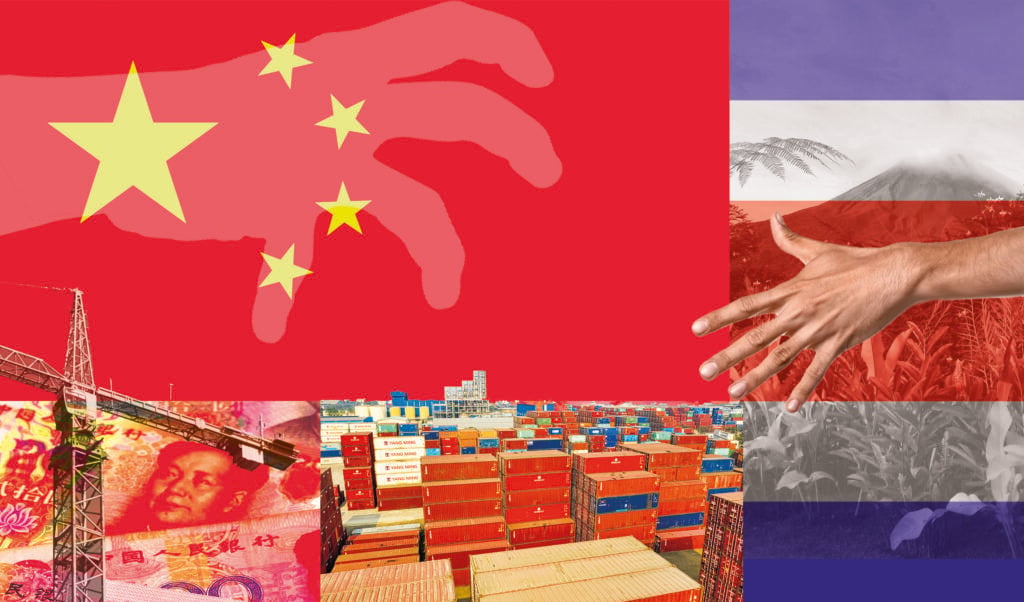

Since Costa Rica established relations with the People’s Republic of China (PRC), it has suffered a nearly 90 percent bilateral trade deficit. This “asymmetrical relationship” also allows Chinese companies to carry out infrastructure projects in the country, engaging in poor practices and violating legislation, Honduras-based think tank Expediente Abierto indicated in a report.
According to the report, China implements a similar strategy in each Central American country: It offers cooperation in exchange for breaking relations with Taiwan, and promises investment and infrastructure projects that, in some cases, are never fulfilled or are developed with poor practices, corruption, and inefficiency; mainly benefiting the commercial and security interests of the PRC.
“Relations between the two countries oscillate between great closeness and moments of estrangement,” Carlos Murillo, an academic at the University of Costa Rica, told Diálogo on July 22. “China did not find in Costa Rica the partner it was hoping for, as it was looking for an easy platform to make large investments and access the U.S. market, evading the sanctions imposed by Washington.”
Agreements
San José and Beijing have signed several agreements since 2007, including the Investment Promotion and Protection Agreement. While this agreement seeks to encourage Chinese investment, Expediente Abierto stresses that it is unfair to Costa Rica with agreement granting too many advantages to Chinese investors, without guaranteeing reciprocal treatment to Costa Rican companies.
Another agreement is the Joint Action Plan for China-Costa Rica Cooperation, which establishes Costa Rican support for Beijing’s multilateral initiatives in Latin America and the Caribbean, through the forum of China and the Community of Latin American and Caribbean States (CELAC) and the advancement of the Latin America and the Caribbean-China Comprehensive Cooperation Association.
According to Murillo, CELAC has generated controversy for its positions on human rights and democracy in countries such as Cuba, Nicaragua, and Venezuela. “In the CELAC forum there is no effective coordination among Latin American leaders. Although China holds annual meetings, no concrete results are achieved,” Murillo added.
In 2018, Costa Rica joined the Belt and Road Initiative, a Chinese global infrastructure project. China’s presence in Central America responds to geostrategic interests, as the region is a crossing point between the Atlantic and Pacific oceans, key to the expansion of Chinese global influence. This initiative, framed within the strategy of the Chinese Communist Party, has not had many benefits for Costa Rica, Expediente Abierto contends.
“Costa Rica’s exports to China increased from $37.8 million in 2011 to $307.6 million in 2021. However, in the same period, imports of Chinese products to Costa Rica increased from $1.2 billion to $2.9 billion,” the report indicates. This disparity shows an unfavorable tendency for Costa Rica in its trade balance with the PRC, especially since the signing of the Free Trade Agreement.
China’s high tariff protection scheme, along with volume and distance, prevented Costa Rica from sending products to China for several years. “None of the agreements established have been beneficial for Costa Rica,” Murillo said. “Let’s not forget that some agreements were negotiated in secret with Beijing, so it’s likely that the trade deficit will continue to increase.”
Soresco and Route 32
One of the projects arising from diplomatic relations between the two nations was the China-Costa Rica Reconstruction Company (Sociedad Reconstructora Chino Costarricense – Soresco) refinery in Limón, launched in 2008. The initiative was halted in 2013 when the Comptroller General’s Office rejected the financial feasibility study another Chinese company had carried out, preventing it from fulfilling the contract and taking the case to international arbitration, Costa Rica University of Costa Rica’s magazine Semanario reported.
In 2019, the London Court of International Arbitration ordered the dissolution of the company, Costa Rican newspaper Observador reported. The arbitration award determined that each firm would bear 50 percent of the cost of the arbitration and China’s request for compensation, reported Argentine daily La Nación.
For Murillo, “the Soresco oil refinery was China’s strategic project in Costa Rica. Beijing considered the project to be an incredible business, since it would allow refining oil from Venezuela, but did not anticipate that Costa Rica’s environmental regulations for clean fuels make many projects impossible.”
Another project is the 107-kilometer expansion of Route 32 to four lanes, between Río Frío and Limón, started in 2018 with an estimated three-year completion date. From the beginning, the work faced drawbacks. The lack of sufficient overpasses and other safety works put passersby and nearby residents at high risk, reported Costa Rican newspaper La República.
Expediente Abierto points out that the delays and cost overruns in the widening of Route 32 are due to China Harbour Engineering Company, which did not deliver the required information on time and presented a preliminary project that was not considered in the final project. This increased costs and created unforeseen expenses that the Costa Rican government had to assume. The company has requested several extensions, and it is estimated that the project will be completed in 2025.
Huawei
In late 2023, Huawei, as well as any other Chinese tech companies, were excluded from Costa Rica’s 5G networks contracts. Costa Rica indirectly banned China by approving cybersecurity regulation that prohibits companies from countries that are not signatories to the 2001 Budapest cybercrime agreement from taking part in 5G bidding processes.
In recent years the United States has banned the sale and import of communications equipment from five Chinese companies, including Huawei and ZTE, amid concerns over national security. Japan, Australia, New Zealand, and Canada, including some European allies, such as Britain and Sweden, have taken similar actions due to fears of espionage or sabotage of critical communications infrastructure.
“Although China gives preferential treatment to Costa Rica, it does not mean that its approach is different from the rest of the Americas,” Murillo said. Beijing exerts a lot of pressure. It has individuals in the ministries, who report directly to the Chinese Embassy on the progress of relations. In addition, there are Costa Ricans invited by the Beijing government to visit China on a weekly basis, sometimes just to go for a walk, he added.
Faced with rising crime and violence in Costa Rica, Beijing donated Huawei cameras and other surveillance equipment to the Costa Rican Institute of Aqueducts and Sewers and local governments. This initiative, while seeking to strengthen relations with the municipalities, also deepened the danger of the presence of Chinese technology in the region, according to the Peruvian Army’s Center for Strategic Studies.
In 2023, U.S. Southern Command and the Costa Rican government announced a $9.8 million initiative to establish a Cybersecurity Operations Center. The infrastructure will be equipped with state-of-the-art equipment, specialized training and logistical assistance, the U.S. Embassy in San José said in a statement.
“Costa Rica needs to regain its voice in the international arena. Since the establishment of relations with China, the country has had to remain silent on China’s human rights policy, due to a commitment not formalized in the bilateral agreement, which prevents Costa Rica from criticizing China’s policy in this regard,” Murillo concluded.