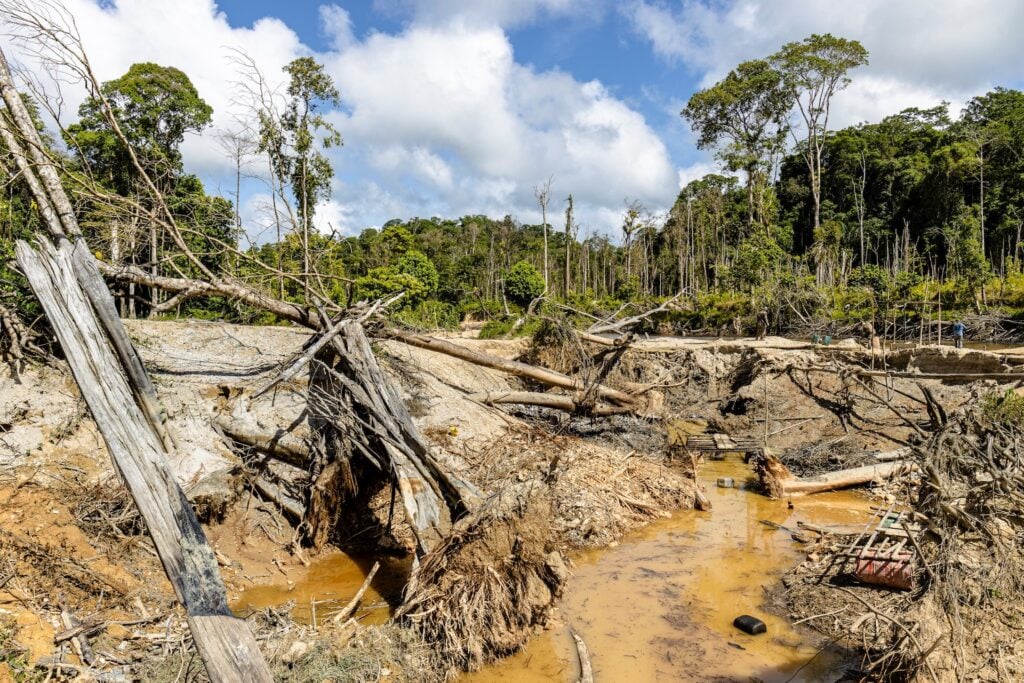

The illicit extraction of gold in the Amazon has found a formidable catalyst in surging global demand, increasingly orchestrated by Chinese interests through an elusive medium: gold-bearing sands. According to investigative media alliance Amazon Underworld, Chinese trading syndicates have woven a sophisticated web that allows clandestinely mined gold across South America to be laundered into the formal economy. This process effectively “legalizes” the precious metal, scrubbing its traceability and masking its illicit origin.
Reporting from Brazilian media outlet InfoAmazonía details a rigorous mechanism: Gold is funneled through transnational intermediaries, blended with legitimate materials, and propelled into international markets, with a final destination often linked to China.
In this geopolitical landscape, French Guiana has emerged as the frontline of a new, industrialized form of resource predation. Once a territory plagued by illicit, small-scale prospectors, the region has been annexed by a professionalized criminal hierarchy. Today’s garimpeiros — clandestine operators who flout national borders — are the foot soldiers for Brazil’s most violent criminal organizations. These factions have transformed mining into a state-level threat, providing the armed enforcement and logistical routes that allow Chinese-backed syndicates to extract and export the Amazon’s wealth with impunity.

Investigative reports from the French Foundation for Strategic Research (FRS) confirm that these Chinese actors have transitioned from being indirect suppliers to direct operators, financing the heavy excavators and industrial-grade crushers deep within French territory. By pushing these “gold sands” across the borders of the Guiana Shield, they attempt to “wash” the material through European regulated supply chains, using French Guiana’s status as a European enclave to bypass international scrutiny.
In that region of the Guianas, “there are operators from China working in territories where there is a strong presence of illegal mining,” Bram Ebus, founder of Amazon Underworld, told Diálogo. “It is the Chinese who buy the sand already treated with mercury, which captures between 25 percent and 30 percent of the gold, and then process it in their country in cyanidation plants, where the remaining gold is recovered in much higher percentages.”
The surge in clandestine extraction is inextricably linked to China’s strategy of securing strategic resources across the region. According to Brazilian think tank Igarapé Institute, Guyana, French Guiana, and Suriname have become pivotal nodes in this scheme, with state-linked Chinese enterprises operating within these extraction zones. This expansion reflects more than private greed; it signals the tacit endorsement of the Chinese state, which views gold acquisition as a pillar of national security.
The exploitation of regulatory gaps in these nations allows large quantities of gold concentrate to be exported — often under customs declarations and tariffs that drastically underrepresent the material’s true value. “This sand business, which is growing uncontrollably, indicates that Latin American countries have lost sight of what is being extracted or what is being exported,” Ebus added.
Market volatility and the illicit incentive
The price of gold is currently navigating an unprecedented bull cycle. On January 29, 2026, the price hit a historic, albeit volatile, high of $5,500 per ounce, according to Bloomberg Línea. This phenomenon, a lingering effect of post-pandemic instability, has intensified the pressure on the Amazon, empowering criminal syndicates and widening the discrepancy in official trade audits.
Unlike traditional ingots, these gold-bearing sands are transported in one-ton industrial bags aboard cargo vessels. Their mundane appearance — often indistinguishable from common dirt — allows them to bypass scrutiny.
“A primary characteristic [of this trade] is that it can be overvalued, undervalued, or even registered as a different product,” says Peruvian investigative platform Ojo Público. “An entire shipment of gold concentrate in these sands can be declared as copper concentrate, allowing large sums of money to be moved [without declaring it].” This logistical flexibility is precisely what makes the trade so seductive to organized crime.
China not only dominates global processing capacities for strategic minerals but has reportedly amassed gold reserves nearing 5,000 tons — far exceeding its official figures, as noted by Spanish daily El País. This appetite, coupled with the global energy transition, has significantly heightened the risk of criminal infiltration into legitimate supply chains.
In many jurisdictions, illegal gold mining has eclipsed drug trafficking as a more lucrative and less risky alternative for criminal groups. CNN en Español highlighted that, in 2025, Peru’s then Foreign Minister Elmer Schialer noted that the illegal gold economy in Peru was roughly seven times larger than the cocaine trade.
This lucrative shift has precipitated the violent occupation of indigenous territories across the Amazon. Clandestine airstrips and illegal camps continue to destroy primary forests and poison river systems with mercury, violating the fundamental rights of ancestral communities. Investigations by environmental news site Mongabay further corroborate this, revealing at least 128 clandestine airstrips facilitating illicit logistics across six Peruvian regions alone.

Chinese predation and TCO logistics
While regional transnational criminal organizations (TCOs) provide the violence and territorial control, China provides the essential destination and financial machinery. Across the Amazon basin, various non-state armed actors have pivoted to illegal mining as a primary revenue stream. This includes Brazil’s Red Command (CV) and the First Capital Command (PCC), as well as Colombia’s National Liberation Army (ELN) and dissidents of the Revolutionary Armed Forces of Colombia (FARC).
However, these groups don’t operate in a vacuum; they have become operational facilitators for Chinese resource predation. By providing a market for mercury-treated sands and unregulated concentrates, Chinese traders offer TCOs a level of financial stability that drug trafficking — subject to higher international interdiction — cannot always guarantee. This synergy creates a dangerous feedback loop: Chinese demand finances the territorial expansion of TCOs, which in turn secure more indigenous land for extraction to satisfy that very demand.
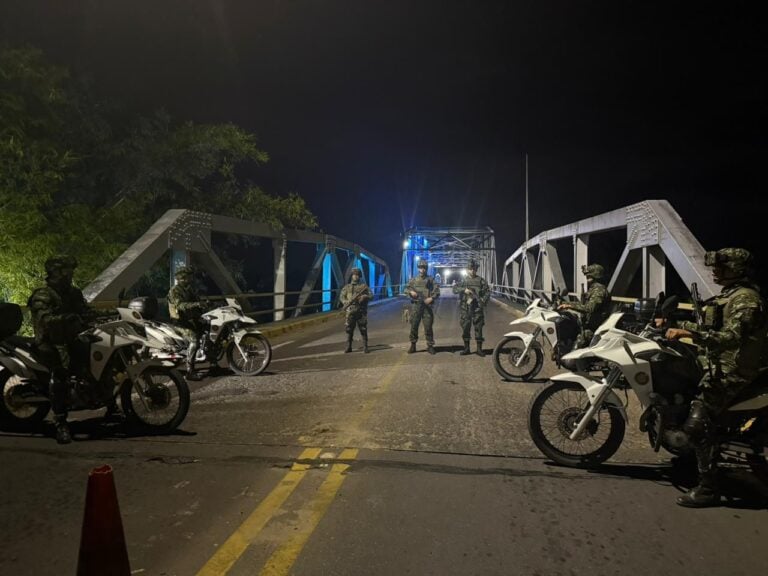
Governments have recently stepped up their efforts to combat this scourge. In January 2026, the Colombian Air Force and National Police carried out a joint operation to dismantle illegal mining infrastructure linked to transnational groups. Simultaneously, a cross-border operation involving Brazil, Guyana, French Guiana, and Suriname resulted in the arrest of some 200 people, with support from Interpol and the European Union.
However, experts warn that these actions, while necessary, do not attack the financial roots of the problem. “We often see strategies that consist of entering the areas, destroying mining machinery, and retreating. This involves the destruction of equipment or the arrest of individuals caught in the act, but it fails to affect the illicit financial flows behind the gold or the people at the highest levels of these criminal organizations,” Ebus said. These structures, he added, tend to quickly replace destroyed equipment or hire new miners.
Transparency: Dismantling the predatory framework
The fight against illegal gold mining depends not only on military or police operations, but also on greater transparency and regulation in international markets. The fight is not just against the criminal groups mining in the jungle, but against the global supply chain that turns a blind eye to China’s role in laundering these assets. According to Infobae, tracing capital flows and enforcing “beneficial ownership” transparency are essential to dismantle the predatory framework Beijing has established in South America.
The bilateral agreement signed between Peru and Ecuador in December 2025 to curb illegal mining and arms trafficking represents an important step toward cohesion. However, the scale remains daunting: Peru continues to facilitate roughly 44 percent of the region’s illicit gold trade, followed by Colombia at 25 percent and Bolivia at 12 percent.
The convergence of record-breaking prices and China’s strategic hunger for gold has created a perfect storm. It is a scenario that not only threatens the Amazonian ecosystem but allows a foreign power to subsidize organized crime, ultimately challenging the sovereignty of Latin American states.
“Combating this problem requires a comprehensive approach that combines local action with international cooperation and greater control over global supply chains,” Ebus concluded.