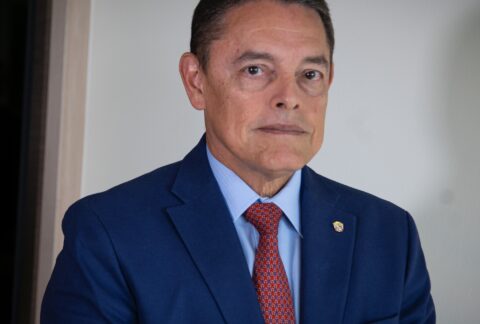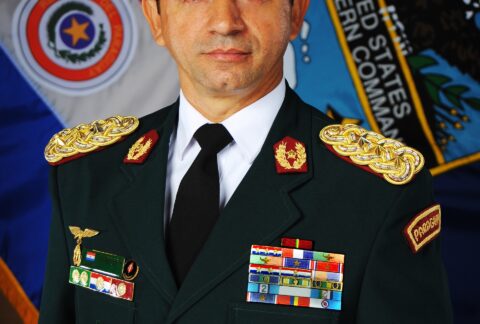


With over four decades of distinguished service, General Xavier Julián Isaac is a central figure in Argentina’s defense landscape and currently serves as the Chairman of the Joint Chiefs of Staff of the Argentine Armed Forces. A career officer and a seasoned combat pilot, his expertise extends from the cockpit to the highest levels of strategic planning. His extensive service has been recognized with honors from military commands across the globe, and he plays a crucial role in modernizing Argentina’s forces.
Diálogo had the opportunity to speak with Gen. Isaac during the South American Defense Conference (SOUTHDEC) in Argentina, where he discussed his vision for fortifying Argentina’s military capabilities and strengthening regional security. Gen. Isaac also provided insight into the historic acquisitions of F-16 fighter jets and Stryker 8×8 combat vehicles and detailed Argentina’s deepening security cooperation with partner nations.
Diálogo: What did organizing an event like the South American Defense Conference (SOUTHDEC) mean for Argentina, its Armed Forces, and you personally?
General Xavier Julián Isaac, chairman of the Joint Chiefs of Staff of the Argentine Armed Forces: My goal has always been to reposition Argentina and its Armed Forces as a regional leader, as it has always been. This involves many activities, including re-equipping our forces and hosting events like this conference. These activities strengthen our relationships and project our commitment. The 16th [SOUTHDEC conference] was a success not only in its organization, logistics, and attention to detail, but also in the quality of the topics discussed and the commitment of all participants to take concrete action, which is the main purpose of these gatherings.
Diálogo: Argentina’s participation in exercise Tradewinds 2025, carried out in Trinidad and Tobago with some 26 partners and allied nations, yielded great results with the use of a C-130 from the Air Force, which led to the crew’s recognition for their contribution to strengthening regional interoperability. What impact did this have on the Armed Forces?
General Isaac: That’s a great question. When you’re invited to participate in exercises, you can send personnel, which for the General Staff is simple and doesn’t require much effort. Sending resources, especially from a country that isn’t swimming in abundance, is a significant challenge. However, my premise is that this was an excellent opportunity. It allowed us, particularly the Air Force, to showcase our capabilities and give our personnel experience operating in different environments. We are geographically isolated in the Southern Cone, so deploying and flying a long distance presents unique challenges. The feedback was very positive. I don’t recall us sending resources to Central America in this way in many years. It was an important signal from our side.
Diálogo: Argentina has taken significant steps toward military modernization, particularly with the acquisition of F-16 fighter jets and plans to purchase Stryker 8×8 armored combat vehicles. How were these assets chosen, and what impact will they have on the Armed Forces?
Gen. Isaac: The impact is tremendous. The F-16 selection was based on a thorough operational analysis. The military made a proposal to the political leadership after concluding that the F-16 was the platform that best suited Argentina’s needs. Many people don’t realize that the quality and level of maintenance, as well as the improvements made to an aircraft throughout its life, are what matter, not just its age. This was a long process with many applicants — Russian, Chinese, Indian, and Korean aircraft were considered. Ultimately, we proposed the F-16, and the current government finalized the deal.
Similarly, the acquisition of the Stryker 8x8s is essential for Army operations. This not only enhances our capabilities but also boosts morale. When soldiers see that their leaders are providing them with necessary resources, it fosters a stronger sense of commitment. We are very happy with this development.
Diálogo: In April 2025, Operation Roca was launched to support security forces in the fight against narcotrafficking and organized crime on the northern border area. What are the strategic reasons for this operation, and what are the expected results?
Gen. Isaac: The SOUTHDEC conference highlighted the issue of hybrid transnational threats. Our extensive and complex borders are difficult to control, and there’s a significant amount of illegal traffic. The Armed Forces are operating in what we call strategic gaps — the areas between legal crossing points that are handled by the Gendarmerie. We are there to deter illegal trafficking. This ensures that internal security and defense roles remain distinct. We act as a containment barrier outside urban areas to prevent confusion with police powers. Our mission is to defend the territory, which also includes prevention. These areas in northern Argentina are geographically very difficult to control. We are preparing, incorporating technology, and training our people for this task. This is all being done within a clear legal framework and with strict rules of engagement, so our soldiers know exactly what to do and what not to do. This ensures we are fully committed to legality.
Diálogo: Defense cooperation between Argentina and the United States has strengthened recently, with high-level visits and strategic agreements. You visited U.S. Southern Command (SOUTHCOM) in July 2024, and U.S. Navy Admiral Alvin Holsey visited Argentina in April-May 2025. Could you highlight the most significant results from these meetings?
Gen. Isaac: We have significantly increased exchanges and cooperation. It’s not just about learning from the United States; Argentina has much to offer as well. We have had important reciprocal visits, exercises, symposiums, and seminars. In fact, we sometimes have to slow them down because there are so many activities. Our cooperation with SOUTHCOM is extensive and covers crucial areas like cyber defense, special forces, and space. The increase has been truly significant, productive, and beneficial for both sides.
Diálogo: What is your vision for regional security, not only for Argentina but for the entire South American region?
Gen. Isaac: The Latin American armed forces have an advantage: We share common objectives and a similar culture. From Argentina’s perspective, we understood that to regain a leading role, we had to start by re-equipping ourselves. We never lost our professionalism or training, but we had many years of disinvestment in equipment. This is the path we are now on. We have been working with countries in the region for a long time, but now we are in a better position to do so.
This conference was crucial because we are beginning to see threats that, due to our geographical distance, we once thought would never reach us. We now see these threats mutating from one country to another, and we have found common ground to work on them. We appreciate the guidance and participation of SOUTHCOM in supporting our shared objectives. The most important thing for me is to put Argentina first. We must first fortify and grow, and from there, we can continue to strengthen our relationships with the rest of Latin America.