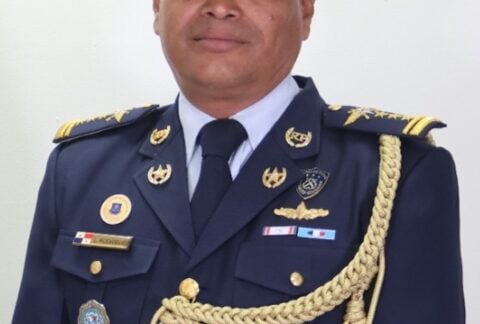


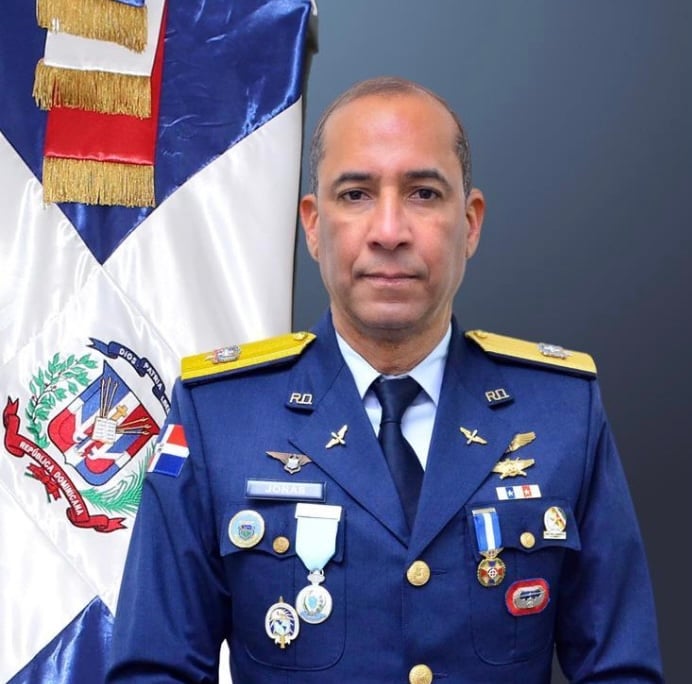
With nearly three decades of service in the Dominican Air Force and extensive experience in joint operations, intelligence, and international cooperation, Brigadier General Jonás Reynoso Barrera, executive director of the National Antiterrorism Directorate (DNA), has played a key role in strengthening the country’s defense and security capabilities. His career includes serving as liaison officer to Joint Interagency Task Force South (JIATF-S), directing the Dominican Armed Forces’ Command, Control, Communications, Cybersecurity, and Intelligence Center (C5I), and completing professional military education at the Inter-American Defense College, the George C. Marshall European Center for Security Studies, and the U.S. Air Force Air University.
During the 2026 Space Conference of the Americas, held in Miami in April, Brig. Gen. Reynoso spoke with Diálogo about strengthening space and cybersecurity capabilities, expanding information sharing with regional partners, and the role of international cooperation in countering terrorism and transnational organized crime.
Diálogo: What does participating in the Space Conference of the Americas mean for the Dominican Republic, and how can this cooperation strengthen national security?
Dominican Air Force Brigadier General Jonás Reynoso Barrera, executive director of the National Antiterrorism Directorate: This is an important hemispheric forum and an extraordinary experience. It allows us to advance a process of cooperation with the United States to integrate the Dominican Republic into future space capabilities and technologies. For us, this is the beginning of a path that other countries in the hemisphere have already taken. It’s particularly important because President Luis Abinader and Minister of Defense Lieutenant General Fernando Onofre have made the development of space capabilities a national defense and security priority. We aspire to work alongside U.S. Southern Command (SOUTHCOM) and allied nations to share space-based information and information from other domains.
Diálogo: How can space-based capabilities — such as satellite data and monitoring — strengthen the Dominican Republic’s ability to detect, track, and respond to transnational threats?
Brig. Gen. Reynoso: At the Armed Forces’ Command, Control, and Cybersecurity Center, we have already begun using satellite imagery to analyze population growth, changes in terrain, and weather patterns. One of the Center’s priorities is border security. To support that mission, we have employed commercially available space-based capabilities and open-source resources. If we are able to expand this level of cooperation in the near future, it will become a fundamental tool in the fight against transnational organized crime, terrorism, and other threats affecting our country. It is an essential capability.
Diálogo: Cyber threats are increasingly targeting critical infrastructure across the region. From your perspective, what are the main challenges in protecting these systems, and how is the Dominican Republic strengthening its cyber resilience?
Brig. Gen. Reynoso: The Command, Control, and Cybersecurity Center, which I have the honor of leading, serves as the National Center for Cybersecurity, Cyber Defense, and Cyber Offense for all branches of the Armed Forces and the specialized national security agencies. The minister of defense has issued a national cybersecurity strategy that establishes a roadmap for continuing to strengthen our capabilities. The Dominican Republic faces cyberattacks on a constant basis, and fortunately we have the tools needed to respond. Nevertheless, it is essential that we continue strengthening our capabilities because, as our country becomes more regionally integrated, more attractive, and more economically developed, we will also become more exposed to these types of threats.
Diálogo: The fight against terrorism depends on timely, actionable information. How is the Dominican Republic improving information sharing among agencies and with international partners to strengthen decision-making and operational response?
Brig. Gen. Reynoso: When it comes to information sharing, I had the opportunity to serve as liaison officer at Joint Interagency Task Force South (JIATF-S) between 2010 and 2012. That experience showed me firsthand that sharing intelligence and actionable information is essential to combating terrorism and narcoterrorism. The Dominican Republic remains a strong ally of the United States, and that exchange of information continues to expand. Today it no longer involves only the agency responsible for combating narcoterrorism, but also other organizations that coordinate and share information, making us much more effective.
Within the C5I, we have a department that coordinates directly with JIATF-S and SOUTHCOM. This actionable information allows us to respond quickly and effectively without having to wait for orders. We have sensors that enable timely and highly effective responses to these threats.
As you know, our geographic location in the heart of the Caribbean continues to make the Dominican Republic attractive to narcoterrorist organizations. We remain a transit country for illicit shipments coming from South America through different routes and methods. Although their operating methods have evolved over the years, we continue to be an effective partner in the fight against narcoterrorism.
Diálogo: What has been the key to strengthening this type of cooperation?
Brig. Gen. Reynoso: I believe one of the most important factors has been the development of the Dominican Armed Forces over the past several years. We have experienced significant progress in developing our personnel, technological capabilities, quality of services, equipment, logistics, and sustainment. All of these strengths allow us to respond more effectively.
If you look at the investments made over the past four years in defense, security, processes, and systems, you will see that we have become a more reliable, more capable, and more effective partner. That enables us to coordinate responses more efficiently, not only against narcoterrorism but also against other threats. This progress is visible and has produced major changes in recent years.
Diálogo: The Dominican Republic and the United States have also strengthened cooperation through the Cooperative Situational Information Integration (CSII) system, which includes radar-based monitoring and data sharing. How has this capability improved situational awareness and operational response to transnational threats?
Brig. Gen. Reynoso: This integration system has been evolving for many years. When I served at JIATF-S, it was known as Virtual Domain Awareness, and it helped us understand the importance of timely information sharing.
These tools have continued to expand. A few years ago, they were used by only one department. Today they are employed by the C5I, the Navy, the Army, the Air Force, and many other organizations. Cooperation and transparency have increased significantly. When a group of operators detects a threat, it can no longer go unnoticed because multiple institutions are aware of it. The agency responsible must respond, and its actions are visible to everyone involved. That level of transparency has been essential in strengthening information sharing.
Diálogo: How important is it for the Dominican Republic to emerge as a regional leader in innovation, technology, and investment? What does that mean for the country and its people?
Brig. Gen. Reynoso: I can summarize it very simply: socioeconomic development, institutional development, and national growth. That growth also contributes to regional growth.
We can see it in the Armed Forces’ innovation and technological development strategy promoted by the minister of defense, in the national cybersecurity strategy, in the modernization of our equipment, and in many other concrete initiatives that are helping transform the Dominican Republic into a country with visible socioeconomic progress. That is what this is about. Strengthening the Armed Forces contributes directly to strengthening the country. I believe that is the purpose of every state: to promote growth and socioeconomic development.
Diálogo: Looking ahead, which capabilities or areas of cooperation will be most critical to strengthening security, cybersecurity, and the effective use of space-based tools across the region?
Brig. Gen. Reynoso: I believe space is the new frontier. It is the next great challenge for our Armed Forces and for our country, and it is part of the vision of Minister of Defense Lieutenant General Fernando Onofre. It is the next step as we continue moving forward, strengthening our integration, and growing together with our allies throughout the region.