

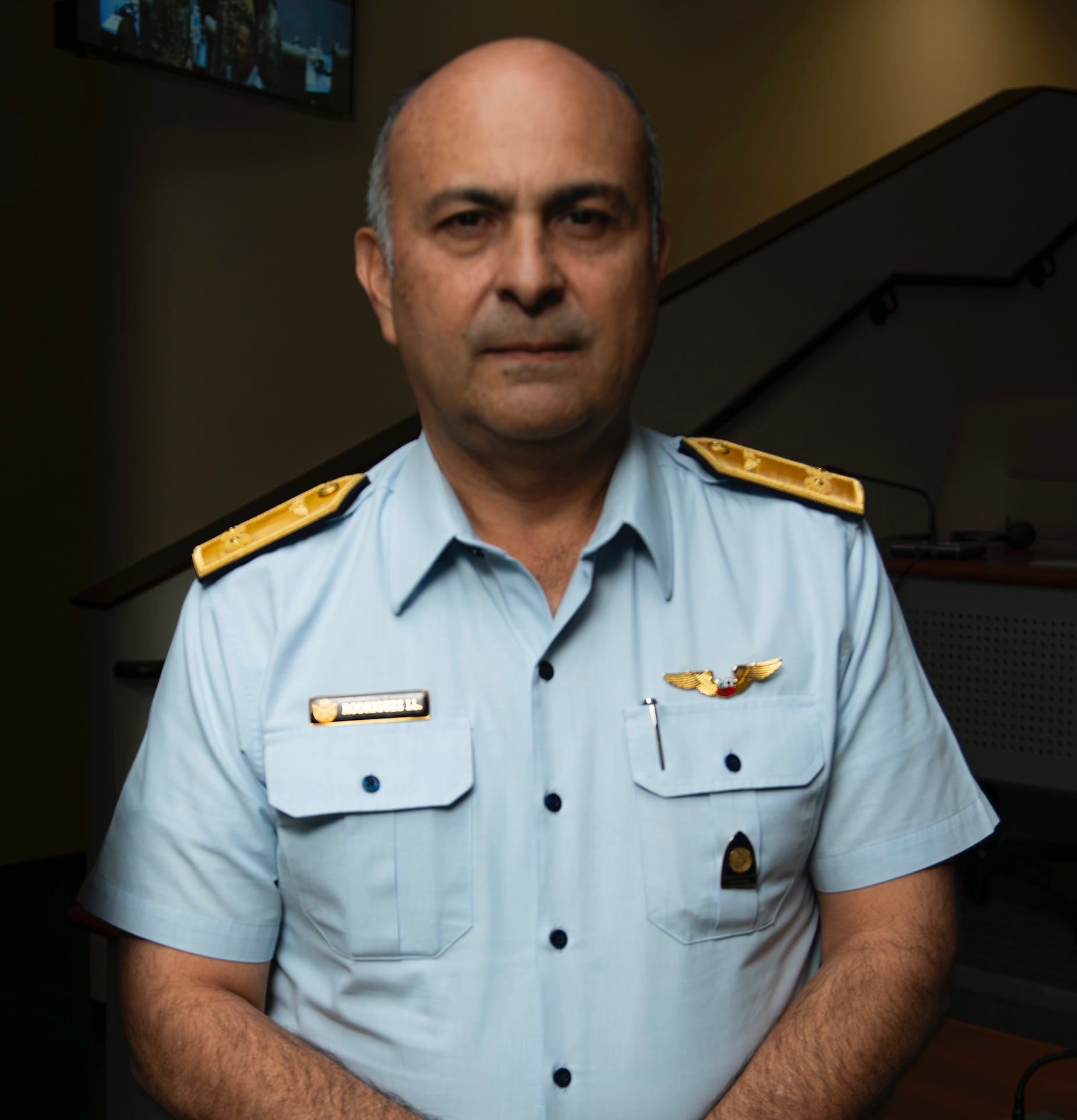
With more than 30 years of service in the Peruvian Air Force, Major General Mariano Nieves Rodríguez Llerena now leads the country’s efforts in two of the most strategic and emerging domains of modern defense: space and cyberspace.
Commander of the Peruvian Air Force Space and Cyberspace Command and a fighter pilot with extensive international cooperation experience, Maj. Gen. Rodríguez spoke with Diálogo during the Space Conference of the Americas 2026, held in Miami, Florida, about the development of sovereign space capabilities, the protection of critical infrastructure, cooperation with the United States, and the growing role of cyberspace in regional security.
Diálogo: What impressions have you taken away from this regional gathering?
Major General Mariano Rodríguez Llerena, commander of the Peruvian Air Force Operational Cyber Defense Command: I am representing the Peruvian Air Force on behalf of Air Force Commander General Mario Raúl Contreras Leoncarti. He designated three officers to participate in this conference. I serve as the Air Force’s Space and Cyberspace Commander.
Our command, as a force command, was created two years ago. We changed our organizational structure through an update to the institutional strategic development plan. This new domain is reaching all nations worldwide, and Peru is no exception.
Peru has operated a satellite for approximately 10 years, primarily focused on research and development through CONIDA [the National Commission for Aerospace Research and Development], where an active Air Force general also works in that field. However, the security and defense component remained separate.
With the creation of the space command and its integration with cyberspace, we are advancing new objectives and capabilities in defense and security, especially to contribute to regional and global security.
Diálogo: You mentioned PeruSAT-1. How does this satellite support missions such as disaster response or the fight against illicit activities?
Maj. Gen. Rodríguez: The support is very direct. We have a submetric observation satellite with a resolution of 70 centimeters, which represents a very significant capability. To this day, I believe it remains one of the most capable satellites in South America, at least among neighboring countries.
It is an Airbus satellite that we launched approximately 10 years ago. The expected lifespan is normally 10 years, so it is reaching its operational limit. However, we believe it can continue operating for several more years thanks to the capability and training of our personnel, who have efficiently managed fuel consumption, one of the most important factors for the survival of these systems in space.
We have a National Operations and Image Processing Center that also operates the satellite. Peru is fully autonomous in its operation. The satellite passes over the national territory four times a day and downloads the programmed imagery.
These images are used to support different sectors of the government and contribute directly to monitoring deforestation in the Amazon, combating illegal mining — one of the topics also discussed during this conference — and countering illegal fishing within our 200-mile maritime domain. There are many foreign vessels exploiting our resources, and through these satellite images, our Armed Forces can take more effective action.
Diálogo: Peru has strengthened cooperation with partners such as the United States and NASA in the space domain. What specific capabilities or advantages has the country gained from these partnerships?
Maj. Gen. Rodríguez: CONIDA functions as Peru’s space agency. There is very close coordination between the space agency and the Air Force’s space command.
NASA maintains a direct relationship with CONIDA, and the cooperation is very close. In fact, in May Peru hosted one of the meetings related to the Artemis Accords.
Much of this cooperation is focused on research, development, and international cooperation. In the field of national defense, our observation satellite is mainly oriented toward disaster-risk management and emergency response.
We have five strategic roles: external defense, support to internal security, national development, disaster-risk management, and international cooperation. Many of these roles go beyond the traditional function of the armed forces, and this is where space capabilities greatly support our daily work.
Diálogo: Peru has expanded cooperation with the United States in areas such as space situational awareness and data sharing. How do these capabilities contribute to improving decision-making and operational effectiveness?
Maj. Gen. Rodríguez: As a country, we are only now entering the space domain within the field of security and defense. That is why we need international agreements and the support of the international space community.
Thanks to cooperation with the United States, we have obtained tools that allow us to develop space situational awareness. We could not do anything if we did not know what is happening in space.
Information sharing and tools such as Systems tool Kit (STK), which allow us to conduct simulations and projections, have made it possible for Peru to integrate into the global observation network.
We have also seen during this conference that several countries — including Peru, Argentina, Colombia, Brazil, and, if I am not mistaken, Chile — will receive telescopes donated by the U.S. government. This will improve our direct observation capabilities and allow us to complement software-based analysis with our own observation systems to contribute to global space security.
Diálogo: Space capabilities depend on secure data and communications. What are the main cyber threats to these systems, and how is your command working to protect Peru’s space infrastructure?
Maj. Gen. Rodríguez: Two years ago, we changed the structure of the Air Force through a supreme decree and organized our capabilities by domains: the air domain, responsible for air operations and air defense; the space domain; and the cyberspace domain.
Because we are still developing, especially in the space field, both domains currently operate under a single command. In the future, as we continue growing, each domain will probably have its own independent structure.
I am responsible for both domains, and we work in a very integrated manner because cyber is transversal to all the other domains: land, maritime, air, and space. If we do not have the ability to protect our critical assets, they can be compromised at any moment.
Under my command, we have two permanent operations centers functioning 24/7: the Space Operations Center and the Cyberspace Operations Center. The latter continuously monitors our networks to detect vulnerabilities, possible cyberattacks, and threats against our critical assets, especially ground-based systems.
Diálogo: Transnational criminal organizations increasingly depend on digital tools and communications. How does your command contribute to disrupting these networks, particularly in coordination with other operational domains?
Maj. Gen. Rodríguez: We have our functions and responsibilities clearly defined. The Air Force Cybersecurity and Cyber Defense Command is tasked with protecting our internal networks, data centers, communications, and information services.
The Navy and the Army also have their own cybersecurity units. At the joint level, the Joint Command of the Armed Forces, which is responsible for the operational employment of the joint force, has the COCI, the Cybersecurity Command, which is responsible for protection against cyber threats.
We contribute all our capabilities to the Joint Command, in the same way the Navy and Army do. As I mentioned earlier, cyber is transversal to all operational domains.
Diálogo: As Peru expands its space and cyber capabilities, how does it ensure that cooperation with international partners strengthens national capabilities without compromising sovereignty?
Maj. Gen. Rodríguez: That is a very good question. International cooperation must definitely have clear limits. The objective is to strengthen our own capabilities, as the U.S. government has been doing not only with Peru, but also with other countries that are growing in these new domains.
However, there is a point at which autonomy and national sovereignty cannot be compromised. That is very clear to us, and I believe the United States also understands and respects that limit.
We have received considerable support in training, education, and advisory assistance. We are investing heavily in human capital because, if human talent is not developed first, we would not be able to properly take advantage of technological tools.
Programs and courses such as those offered by the National Security Space Institute and Joint Commercial Operations have allowed our personnel to acquire new capabilities and work in networked coordination with other countries.
In just two years, we have managed to develop our own exercise, HAWA PACHA, without direct interference from any other country. We took lessons learned from exercises such as Resolute Sentinel, CRUZEX, and Global Sentinel — identifying the good, the bad, and the challenges — to build an exercise that completes the entire operational cycle, from threat detection and data processing to the operation of the satellite managed by CONIDA.
These types of exercises strengthen our sovereignty because they allow us to develop our own capabilities while also contributing to international cooperation. We invited the United States and other countries to participate and observe how Peru continues developing increasingly solid national capabilities.
Diálogo: Peru is considered a regional benchmark in this new domain. What does it mean for the country and for the force you represent to assume that leadership?
Maj. Gen. Rodríguez: I greatly appreciate those words. We see them as recognition of the effort we have made to become a reference in the space domain.
In just two years as a space command, I believe we have advanced considerably. The first year was mainly dedicated to study and preparation. We also have personnel with eight to 10 years of experience working in research and development within the space agency.
The transition into the security and defense field was quite natural. Combined with the experience gained from international exercises, this allowed us to promote our own exercise in the space domain.
I believe this leadership has also been reflected in the centers of excellence we seek to develop and in the growth of the HAWA PACHA exercise. We want it to have a second, third, fourth, and fifth edition, each with greater capabilities and participation from more regions of the world.
We have not only had participation from countries in the Americas; we have also had European and Asian participation, which demonstrates the growing interest in these types of initiatives.