

China has emerged as a critical partner for Ecuador’s main criminal organizations in the illicit exploitation of natural resources, establishing a partnership that threatens not only the environment but also the security of the nation and the region.
These Ecuadorian designated terrorist groups, most notably Los Lobos and Los Choneros, have established sophisticated logistics corridors where the outbound transport of cocaine to Central America and the United States is integrated with an inbound trade in illegal shark products. On the return leg of their drug runs, these groups engage in predatory and illegal shark fishing to satisfy the voracious demand of the Asian market, operating with the support of the Chinese distant-water fishing fleet present on the high-seas.
“The species fished by Los Choneros are sold through intermediaries from the Chinese fleet, who offer the best prices and have the highest demand for these marine specimens, according to Navy officials familiar with these investigations,” Arturo Torres Ramírez, director of the Ecuadorian investigative journalism website Código Vidrio, told Diálogo.
The Ecuadorian Public Prosecutor’s Office successfully reconstructed this dual-purpose route while dismantling a specialized criminal cell. This network was pioneered by a veteran fishing boat captain, Leonardo Briones Chiquito, known as Iguana or Mexicano. Although he maintained close ties to the Los Lobos organization — a group that has expanded its portfolio from drugs to include extorsion and illegal mining — his operations often intersected with territory traditionally considered dominated by Los Choneros. His influence was so significant that his assassination in July 2025, south of Manta in the province of Manabí, triggered a wave of retaliatory violence that claimed 18 lives in a single night.
For years leading up to his death, Briones Chiquito used a fleet of specialized vessels to move narcotics toward Mexico and the United States in collaboration with the Sinaloa cartel. Every maritime excursion in this network used the Galapagos Islands as a strategic waypoint, transforming the archipelago into a vital node for transnational crime.
The Galapagos Islands hub
Located approximately 1,000 kilometers west of the Ecuadorian mainland, the Galapagos Islands have evolved into a premier logistics sanctuary for drug-laden vessels. While navigating around the archipelago extends the journey, the vastness of the area makes it difficult to patrol effectively, providing criminal groups with the cover necessary for strategic refueling and cargo transfers.
“The islands are a fuel supply site provided by artisanal fishermen to boats transporting both cocaine and fish,” says Ramírez.
Crucially, these artisanal fishermen have become integrated, specialized members of these criminal factions. Using state-subsidized fuel intended to support local livelihoods, these fishermen engage in lucrative gasoline smuggling, acting as “floating gas stations” for both drug boats and the Chinese vessels waiting in international waters. Beyond fuel logistics, the islands are also used by these criminal cells for the clandestine preservation and storage of illegally caught shark fins destined for export.
Since 2007, Ecuadorian regulations have permitted the commercialization of sharks caught as incidental bycatch. However, the law’s failure to establish rigorous limits on what constitutes legitimate bycatch has create a massive loophole, allowing organized crime groups to exploit this ambiguity to launder industrial quantities of shark fins.
The role of China
The scale of this predation is immense. Between 2024 and 2025, authorities intercepted two Ecuadorian fishing vessels near the Galapagos Islands transporting 27 tons of shark fins destined for the Chinese market. This relationship is defined by a calculated avoidance of territorial waters. As Ramírez explains, “Chinese ships do not enter the protected area of the Galapagos; they receive fuel and species in international waters through Ecuadorian vessels.”
According to the Illegal, Unreported, and Unregulated (IUU) Fishing Risk Index, Ecuador currently ranks 20th among 152 countries most vulnerable to maritime exploitation. Despite international sanctions, regional agreements, and naval patrols, Chinese vessels continue to deactivate their GPS transponders, effectively going dark to prowl the boundaries of Ecuador’s exclusive economic zone. Organizations like WWF Ecuador have warned that these invasive techniques are depleting fish stocks at an unsustainable rate, while Oceana reported that 510 Chinese-flagged vessels accounted for 75 percent of all fishing activity near the Galapagos between 2021 and 2023.
This resource predation is inextricably linked to the rise of violent crime in Ecuador. Intelligence officials have identified a “merchandise exchange” system where the Chinese fleet provides more than just a market for fins. In exchange for drugs, fuel, and marine species, these criminal organizations also receive high-caliber weapons. This influx of arms has contributed to the surge in violence.
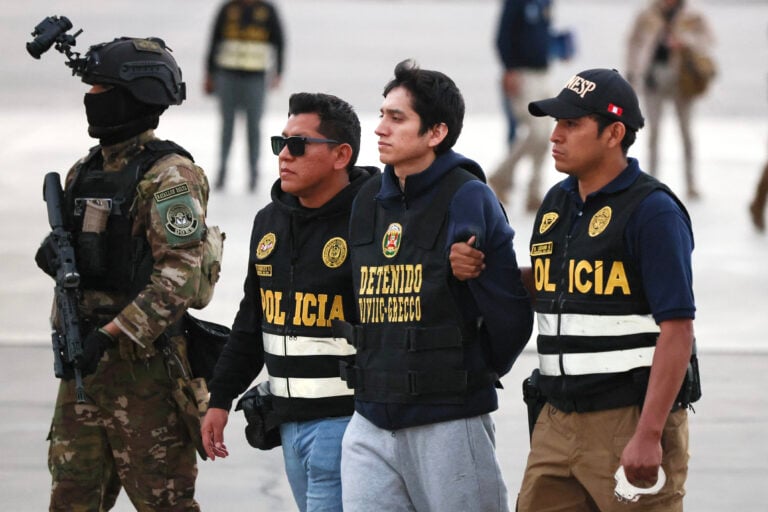
The shark fins captured by these local criminal-fishing cells can fetch up to $1,800 per kilo in the Asian market. This profit motive directly threatens the 65 recorded shark species in Ecuador, 43 of which are already endangered. In April 2025, a joint operation in Manta resulted in the seizure of 15 tons of shark fins and seahorses, leading to the arrest of two of Ecuadorians and one Chinese national, further solidifying the link between local gangs and international buyers.
According to Código Vidrio, the role of the Chinese fleet may extend even further into the global drug trade. Authorities suspect these vessels assist in moving cocaine to the Far East. “We have had cases of cocaine being transported on sailboats and fishing boats that have sailed from Salinas and Manta and have been captured in Australia and South Korea, so it is quite likely that they are also reaching China,” an anonymous intelligence agent told Código Vidrio.
Los Choneros and Los Lobos now serve as the primary domestic enforcers for this transnational network, providing China with protection both at sea and in the ports, as well as a steady supply of illicit products. “They are the main threats to the security of the country and the region, where they have formed alliances with other local gangs and have operatives in all control agencies,” Ramírez concludes.