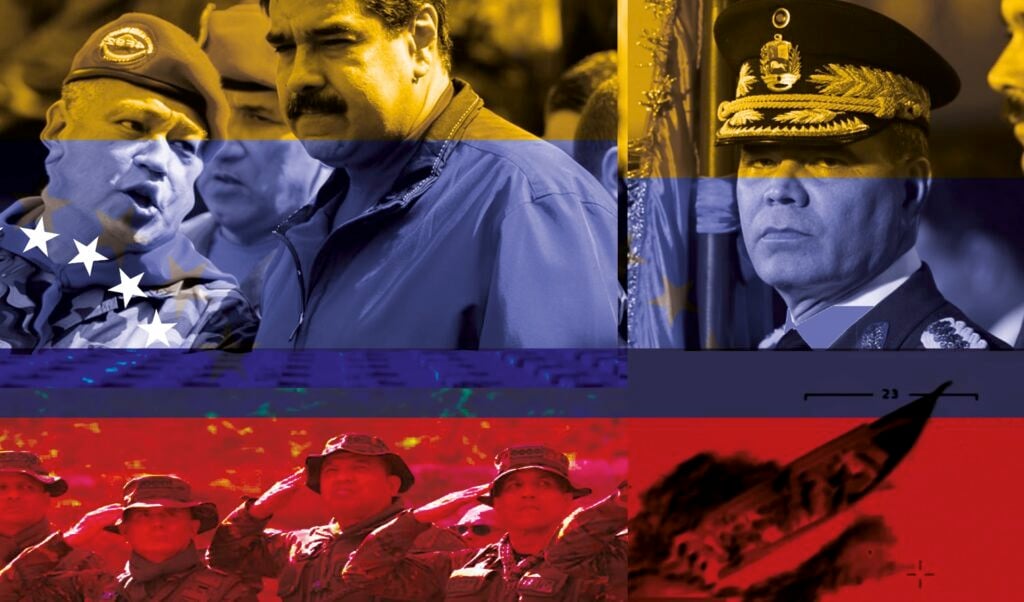
The Venezuelan regime’s key figures, including three individuals wanted since 2020 in the United States, are accused of participating in a narco-terrorist conspiracy, transforming Venezuela into a criminal enterprise at the service of drug traffickers and terrorist groups, while embezzling billions from the South American country.
At the top of the list is Nicolás Maduro, now the subject of a $50 million U.S. bounty. The U.S. Justice Department has also filed charges for drug trafficking and conspiracy to transport controlled substances against Maduro’s Minister of Defense and General of the Bolivarian Armed Forces Vladimir Padrino, as well as against Diosdado Cabello Rondón, who serves as the regime’s minister of Interior, Justice and Peace and vice-president of the United Socialist Party of Venezuela. Both men also face charges for illegal possession of firearms and explosive devices.
Over the years, Maduro’s role in the transnational criminal organization (TCO) known as the Cartel of the Suns has become increasingly significant. The TCO, named after the sun insignia worn by Venezuelan generals on their epaulets, has seen Maduro’s influence and direct involvement in the drug trade eclipse previous estimates. In 2025, several nations of the hemisphere officially designated the Cartel of the Suns as a terrorist organization. This action reinforces the assessment that Maduro is the network’s top leader, a view widely reported in the media since 2020.
The conviction of high-value operators provides crucial corroboration of the regime’s criminal nature. The successful prosecution of Carlos Orense Azócar, alias El Gordo, demonstrated the TCO’s operations, detailing how he conspired with members of the Cartel of the Suns and corrupt Venezuelan military officials to move tons of cocaine. Azocár was extradited from Italy in 2022 and subsequently convicted of drug trafficking in New York in December 2023.
Evidence presented during that prosecution disclosed, among other revelations, that in 2006 Maduro allegedly received $5 million from his associates in the Revolutionary Armed Forces of Colombia (FARC). These funds, the document indicates, were reportedly laundered through the purchase of palm oil processing equipment from Malaysia.
Upon assuming the regime’s leadership in 2013, Maduro reportedly agreed with top FARC leader Luciano Marín Arango, alias Iván Márquez, to continue supplying weapons in exchange for drugs and to provide training for non-state armed groups at a site in Zulia state, on the border with Colombia.
Court testimony and legal filings further stated that at least one of the weapons deliveries to the criminal group, which occurred in 2015, involved the direct participation of Diosdado Cabello. At the exchange, the guerrillas received machine guns, ammunition, and rocket launchers. “Cabello and others discussed the fact that the weapons were a partial payment for cocaine that the FARC had delivered to members of the Cartel of the Suns,” the documentation indicated. Maduro appointed Cabello as his minister of Interior, Justice and Peace by Maduro in August 2024, placing an alleged cartel leader at the head of the country’s security apparatus.
Other high-ranking military officials involved in this criminal structure include Major Generals Clíver Alcalá Cordones and Hugo Carvajal. The former was sentenced in 2024 to nearly 22 years in prison after signing a plea agreement, while Carvajal (former Venezuelan intelligence czar) pleaded guilty to narco-terrorism and drug trafficking charges in June 2025 and awaits sentencing in the United States.
Power structure
The Cartel of the Suns’ organizational hierarchy is considered non-traditional, consisting of clandestine cells embedded within the main branches of the Venezuelan Armed Forces, including the Army, Navy, Air Force, and the Bolivarian National Guard. According to InSight Crime, an organization dedicated to the study of organized crime in Latin America, “These cells operate autonomously, without a defined command structure, making it difficult to identify a clear chain of command.”
The Cartel of the Suns has not only forged alliances with the FARC, but with FARC dissidents and the National Liberation Army (ELN), who are the main drug suppliers in Venezuela, experts contend. These alliances allow them to maintain a constant flow of cocaine and other illicit products.
The Cartel maintains a significant foothold in border states with Colombia, such as Apure, Zulia, and Tachira, where most narcotrafficking activity is concentrated. According to InSight Crime, the Bolivarian National Guard plays a pivotal role in controlling these areas and protecting drug trafficking routes.
“The main role of the Venezuelan military involved in drug trafficking is to allow the safe passage of cocaine shipments and to approve the arrival and departure of aircraft, which transport the drugs to other countries,” InSight Crime indicated. This organization has facilitated the smuggling of cocaine into the region and the United States for more than 20 years, experts say.
For Carlos Tablante, former president of Venezuela’s National Commission against the Illicit Use of Drugs (Conacuid) and a former member of Venezuela’s 1999 National Constituent Assembly, this situation transcends a mere drug trafficking conspiracy. He argues it represents an entire regime co-opted by illegal activities, which is “engrained into power.”
“The Venezuelan regime maintains a criminal state, where one component of criminal activities is drug trafficking. But I don’t know if it’s the most important, or in any case it wasn’t the most important when we had an income from oil production and from the differential exchange business,” Tablante told Diálogo in an August 2024 interview.
With reduced oil production, drug trafficking has gained prominence. “I have no doubt that the members of the Cartel of the Suns are the main operators of this kleptocratic structure,” he concluded.
Note: This article is a revised and updated version of a report originally published in September 2024.