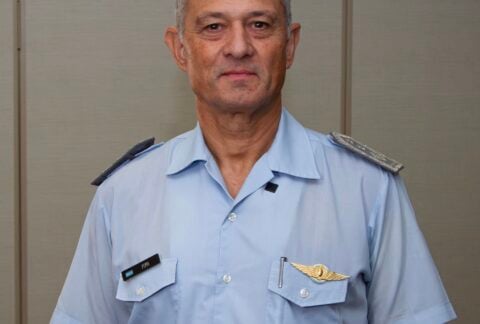



Under the leadership of Vice Admiral Antonette Wemyss-Gorman, chief of Defense Staff of the Jamaica Defence Force (JDF), the JDF has been playing a key role in strengthening the fight against common threats in the region for a more secure Caribbean. Diálogo had the opportunity to speak with Vice Adm. Wemyss-Gorman during the early December 2024 Caribbean Security Conference (CANSEC), held in Trinidad and Tobago. Vice Adm. Wemyss-Gorman, the JDF’s 13th chief of Defense Staff, a career Naval Officer with more than 30 years of service, and the second woman in history to command a military force worldwide spoke about her challenges, assisting the Multinational Security Support (MSS) mission in Haiti, and the importance of cooperation with partner nations, among other topics.
Diálogo: You are entering your third year as Chief of Defense staff of the JDF. In your years leading the force, what have been your greatest accomplishments and challenges?
Vice Admiral Antonette Wemyss-Gorman, chief of Defense Staff of the Jamaica Defence Force: Let me start with the challenges. I think leading a military organization in today’s world, the challenge is how to lead a generation with whom there’s a significant generational gap, in how they consume information and how they respond to leadership. So, you have to be very dynamic to try and get them to do what it is that you need them to do, and adjust leadership style and change the culture of your senior leadership, so that they can relate to the younger enlisted and the younger commissioned officers in the force. That has been, I would say, a big challenge.
Of course, operationally and regionally, we have the situation in Haiti where Jamaica is leading the CARICOM joint task force to support the MSS mission and that has been one of our more recent operational challenges.
Internally, in Jamaica, we continue to have the same challenges as other Caribbean nations face with gang violence, illegal immigration as a result of the instability in Haiti, but also our internal security has been significantly impacted by the arms and ammunition that come into our region. Our capacity to intercept is not as robust as it could be and the efforts of partners who manufacture weapons to stop them coming into the Caribbean is not as robust as it could be.
Diálogo: In September 2024, the first Jamaican troops joined the MSS mission in Haiti. How have these troops prepared for this mission?
Vice Adm. Wemyss-Gorman: We were always anticipating a deployment or an intervention. In the back of our minds, we always thought that we would contribute to whatever force or intervention there would be. So, when it came to a multinational deployment that was endorsed by the United Nations, we started training a cohort of persons. We were able to achieve that with the assistance of our very strong partner Canada and the United States. We had partner nations as well, Caribbean nations, who had committed to sending troops to Jamaica, about 50 from Belize and 50 from the Bahamas, so we did an extensive, more than six months of training. We culminated in an exercise, exposed to human rights training, peacekeeping training, tactical, internal security operations, and that’s how we prepared. Our initial deployment consists of 22 Jamaican service members and I think a couple from Belize. They are there to assist the Kenyans who have the majority of the personnel in theater now to conduct operational planning and preparation for the follow-on troops that are just in a holding pattern waiting to deploy. They continue to keep up with their tactical skills while we set the conditions for them to deploy.
Diálogo: During the 2023 U.S. Southern Command- (SOUTHCOM) sponsored CANSEC, hosted by Jamaica, you stressed the importance of a cohesive and coordinated approach to transnational organized crime due to the Caribbean’s shared geographic space and challenges. What kind of engagements has the JDF carried out with partner nations of the Caribbean, Latin America, and SOUTHCOM to strengthen the fight against common threats?
Vice Adm. Wemyss-Gorman: SOUTHCOM is a significant partner, and Jamaica has participated in all the major exercises that are geared toward preparing troops for interoperability and for countering these threats that we all face, but outside of that, Jamaica has led with the assistance of the United Nations Office on Drugs and Crime (UNODC). We have led a significant exercise, Event Horizon, and that is specifically arranged around scenarios in that regard, to strengthen the fight against common threats. It’s particularly maritime and air and cyber type scenarios, where we have had 11 countries participating from across the Caribbean and Latin America. That is now growing into a very significant regionally led exercise outside of those others that are done. The Dominican Republic also strengthened their partnership with us, as well as other Spanish speaking partners. I have a Memorandum of Understanding with the Dominican Republic Armed Forces; we just recently hosted the planning conference for one of their leading exercises, exercise Poseidon. I visited Colombia to meet with the Colombian head of Navy and we are renewing our bilateral arrangements. We have a longstanding bilateral operational agreement with Colombia. We are refreshing that, and we have been doing joint operations with them in our joint maritime space as well.
Diálogo: You served as Brigade Commander of the Maritime Air and Cyber Command. How has your experience at the head of this command combined with your years of service in the JDF shaped your vision for the force in cybersecurity and cyber defense?
Vice Adm. Wemyss-Gorman: By trade I’m a naval officer and I had the honor of having established the Maritime Air and Cyber Command. That caused me to become acutely aware of, or invested in threats from the cyber domain and that command really educated me and shaped my vision for what the force’s cyber capacity or capability needed to be. I also had the honor of crafting or updating our strategic defense review, which looked at how the force was going to develop for the next couple of years, which we are about to review again, and during that review we identified that establishing the ability to force generate in the cyber domain was very important. So, we have an institute of cyber science within our academy. Since it started operations, we have delivered about 16 cohorts of courses for basic cyber training to multiple agencies and countries. I think so far, a total of about 159 persons have been trained at the cyber institute and we’re continuing to build out partnerships to do that, because as you well know, the human resources in that domain are very scarce. We are very close to establishing our military cyber core to initial operating capability in the first quarter of 2025.
Diálogo: How has regional cooperation and exchange of best practices with partner nations and the United States, in exercises such as Tradewinds or conferences such as CANSEC, supported the JDF in strengthening its cyber capabilities and contributed to national efforts to counter cyber threats?
Vice Adm. Wemyss-Gorman: I think cyber is the area that everyone is looking at now and all those exercises, the last couple of CANSEC, the last two Tradewinds, and a lot of the exchanges that we do with our major partners and regional partners have had a cyber focus. I think that we are all aware of that threat, we are aware of all the gaps, and we seek to address those through these forums as best as possible.
Diálogo: What is the next step for the JDF?
Vice Adm. Wemyss-Gorman: We have a plan, and the plan is always a basis for change. The force will just continue generally along our planned trajectory and adjust as financial constraints or resources are available, as threat environment changes.
We have to be adaptable and flexible. I couldn’t tell you this is my next step, or this is exactly what I’m going to do, we’re going to go along with the plan and see where it goes. I can say with certainty that the cyber domain will continue to be a significant focus but military intelligence is also one of my areas of focus as well. We do have five lines of effort that we concentrate on and a very important one to me is youth engagement. I believe we have to put a lot of effort into influencing the younger generation if we’re going to have an overall impact on the level of crime that we have in our country. So, many things in the next steps, but we are taking it one day at a time.