

The wildfires that broke out in Ecuador throughout 2024 affected 22 of its 24 provinces, consuming 45,363 hectares of forests, El Comercio newspaper reported in late October. “The fires, which began on January 1, impacted 163 cantons and 624 parishes throughout the country and not only left environmental destruction behind, but also affected thousands of Ecuadorian families.”
In late September, the Ecuadorian government took measures to receive international support and humanitarian aid to strengthen its emergency response. The Ecuadorian Foreign Ministry “mentioned, for example, the delivery of humanitarian assistance from the United States to the government’s National Risk Management secretariat with specialized fire-fighting equipment,” La República reported.
According to El Comercio, 25 Forest Fire Response Brigades and 86 aerial interventions were activated with the collaboration of the Peruvian Air Force, the Ecuadorian Armed Forces’ Joint Command, and local firefighters. “The call for support in the face of the emergency that Ecuador is going through was launched […] through the System of Cooperation between the Air Forces of America (SICOFAA), for which the maneuvers carried out to extinguish the fires were executed jointly with the Republic of Peru, who has also joined efforts in this mission,” the Colombian Air Force (FAC) said in statement.
“Through SICOFAA, we sent the information of the need for air support, as well as other types of assistance, and in this case, Peru responded with two Spartan aircraft and also with two helicopters of the Peruvian Air Force […] to try to mitigate and extinguish this fire,” said Ecuadorian Air Force Brigadier General Luis Fierro Urresta, commander of the Air Operations and Defense Command. “Thanks to this coordination we were able to request the FAC, and they provided us with some Bambi Bucket systems […].”
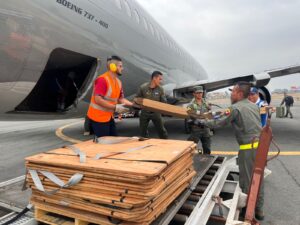
The Colombian government, through the FAC and the National Unit for Risk Management, lent special equipment to the neighboring country’s firefighting efforts. “Following a request from the Cooperation Mechanism in Case of Disaster, the C-40 aircraft was deployed to transport 20 boxes of the Guardian Caylym system [a fire extinguishing system that can release 1,000 liters of retardant per unit], three Bambi Bucket systems, a pool with a 10,000 liter-capacity of fire retardant per unit, and military personnel trained and qualified in aerial firefighting operations, to strengthen the work being carried out in Ecuador’s affected areas,” the Colombian Armed Forces’ General Command (CGFFMM) told Diálogo.
As part of SICOFAA, the FAC transferred knowledge about the Guardian and Bambi Bucket systems by sending personnel to Ecuador, said FAC Major Jorge Guevara, head of the Operational Security Office of the Military Air Transport Command Camilo Daza. Two teams were formed to provide support in each of the systems, so that they could be used in Ecuador.
Each year, the armed forces of the region prepare to face disasters thanks to the lessons learned and good practices in disaster risk management from the Inter-American Defense Board; understandings between armed forces staffs; the participation in simulation exercises of the Conference of Defense Ministers of the Americas; as well as courses on planning, management, and response to crises and humanitarian relief with the Western Hemisphere Institute for Security Cooperation (WHINSEC), among others, the CGFFMM said.
“Countries such as Chile, Brazil, Ecuador, Peru, and the United States have been the main ones to carry out the experience exchanges in disaster response,” the CGFFMM added.
In 2024, the CGFFMM said, “we took part in the CENTAM SMOKE exercise, a military and emergency response exercise that takes place twice a year, led by Joint Task Force Bravo [of U.S. Southern Command]. This training seeks to strengthen cooperation and disaster response preparedness in the region.”
Currently, the CGFFMM added, the main challenges faced for disaster risk management are related to climate change. Therefore, technical and specialized personnel foresee that the effects will intensify the frequency and severity of natural phenomena such as floods and droughts. “This complicates disaster planning and response, as climate predictions become more uncertain and events more extreme,” the CGFFMM concluded.