This article has been initially published in the Revista Seguridad y Poder Terrestre (Vol. 1 N.º 1 [2022]: July – September) of the Peruvian Army Center for Strategic Studies (CEEEP)https://ceeep.mil.pe/2022/06/30/chinas-digital-advance-in-latin-america/?lang=enDOI: https://doi.org/10.56221/spt.v1i1.5 Abstract This work examines activities by the People’s Republic of China (PRC) and its companies in digital technologies and associated economic sectors in Latin America, including telecommunications, surveillance, eCommerce, fintech, data centers, and smart cities.…
Browsing: Academia
Forums and Influence: Chinese Competitive Strategy and Multilateral Organizations in Latin America and the Caribbean
The recent Summit of the Americas in Los Angeles was Washington’s big push to showcase the importance of multilateral forums in Latin America and the Caribbean as a shaping tool for developing a regional agenda and fostering coordination. Of course, the administration of President Joe Biden did not extend an invitation to the People’s Republic of China (PRC), but China…
The Caribbean in the Crossfire, Between COVID-19, Narcotics, China, and Russia’s Invasion of Ukraine
Strategic Importance of the Caribbean Basin. The Caribbean is strategically vital as the southeast maritime approach to the United States. It is a key hub and transit area for commercial logistics serving the eastern coast of the United States as well as the Atlantic side of Central and South America. The region is connected to the United States through ties of…
Colombia as a Case Study for US Foreign Policy A Strategic Policy Proposal for the United States of America
Creating and Maintaining non-Binary Strategic Foreign Policy The foreign policy of the United States of America is in danger of failing to innovate to meet the challenges of a developing, changing, and increasingly competitive world. The growing threat to developing tailored strategic foreign policy has grown from the academic channelization of two basic different schools of thought. These have evolved…
Emotional Intelligence: A Key Feature for Army Leaders
Nowadays, changes are taking place in political, economic, and social scenarios, and people increasingly adapt quickly to new models of social interaction. Even though these interactions may bring advantages, they also show problems and challenges to overcome. Human behaviors and the complexity of this interaction are some factors that show how leaders should be adaptive and able to be dynamic…
The Transitional World Order: Implications for Latin America and the Caribbean
Russia’s invasion of Ukraine—indirectly underwritten by the People’s Republic of China (PRC) and with the Western response hampered by the threat of nuclear war—highlights a world transitioning away from the institutional, economic, and ideological order that has prevailed since the end of World War II. The transition will have significant and grave implications, and its dynamics are likely to be uneven, with the U.S.…
The Impact of Russia’s Invasion of Ukraine on the Global Strategic Environment and Latin America
Modern history is punctuated by decisive events that both directly impact the strategic environment and change the calculations of global actors. Russia’s February 2022 invasion of the Ukraine is arguably one such event. The impact of the invasion on the global strategic environment, including Latin America and the Caribbean will be profound and principally negative for Western democracies and the…
Terrorism in the MAGHREB
Extreme poverty, lack of opportunities, mistrust of democratic institutions representing the state and religious radicalisms that take advantage of these dramatic conditions are some of the reasons that create the ideal breeding grounds for the emergence and development of terrorist organizations. The Maghreb is a region in northwest Africa that includes the following countries: Mauritania, Morocco, Algeria, Tunisia, Libya and…
Chinese Influence Operations: A Machiavellian Moment
For a long time, it could be said that China, unlike Russia, sought to be loved rather than to be feared; that it wanted to seduce, project a positive image of itself in the world, and arouse admiration. Today, Beijing has not given up on seduction, on its attractiveness, and on its ambition to shape international norms. Not “losing face”…
US SOUTHCOM Fights Through COVID-19
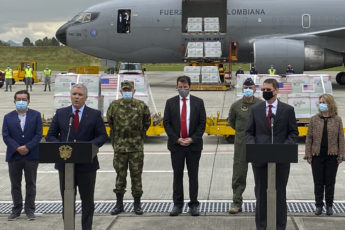
As I boarded my flight in Bogotá, Colombia, to return to the United States on March 14, 2020, after participating in the joint Colombia-U.S. Exercise Vita in the Guajira Peninsula, the reality of how the COVID-19 pandemic was going to affect our lives over the next year began to manifest. Arriving back in Miami, where I was the Military Deputy…
Fighting Russian Lies
Disinformation in Southeast Europe Since the end of the Cold War, the countries of Southeast Europe have pursued Euro-Atlantic integration with varying degrees of success. In recent years, however, that process has lost momentum as prospects for further NATO and European Union enlargement appear to have stalled. Even countries that achieved membership in those organizations face challenges for which they…
Putin Has Painted Himself into a Corner
Two years after the 1962 Cuban Missile Crisis brought the world to the brink of a nuclear war, the Soviet Politburo ousted its leader, Nikita Khrushchev. Then-Politburo member Pyotr Shelest told me that many believed Khrushchev’s predisposition for unacceptable risk would again put the USSR in needless danger. This history begs the question: What level of risk on the part…