
Maritime corridors in the Caribbean and Eastern Pacific have become one of the Western Hemisphere’s principal security frontiers. In addition to sustaining global trade and regional fishing industries, these routes now operate as logistical arteries for transnational organized crime involved in drug trafficking, arms smuggling, chemical precursor trafficking, and other illicit activities.
According to the United Nations Office on Drugs and Crime (UNODC), nearly 80 percent of global cocaine seizures are linked to maritime routes. The tightening of land controls and restrictions during the pandemic accelerated this trend even further.
“With land borders restricted, criminal organizations intensified the use of maritime corridors and expanded operations toward long-distance oceanic routes,” Juan Pablo Toro, senior researcher at Chilean think tank AthenaLab, told Diálogo.
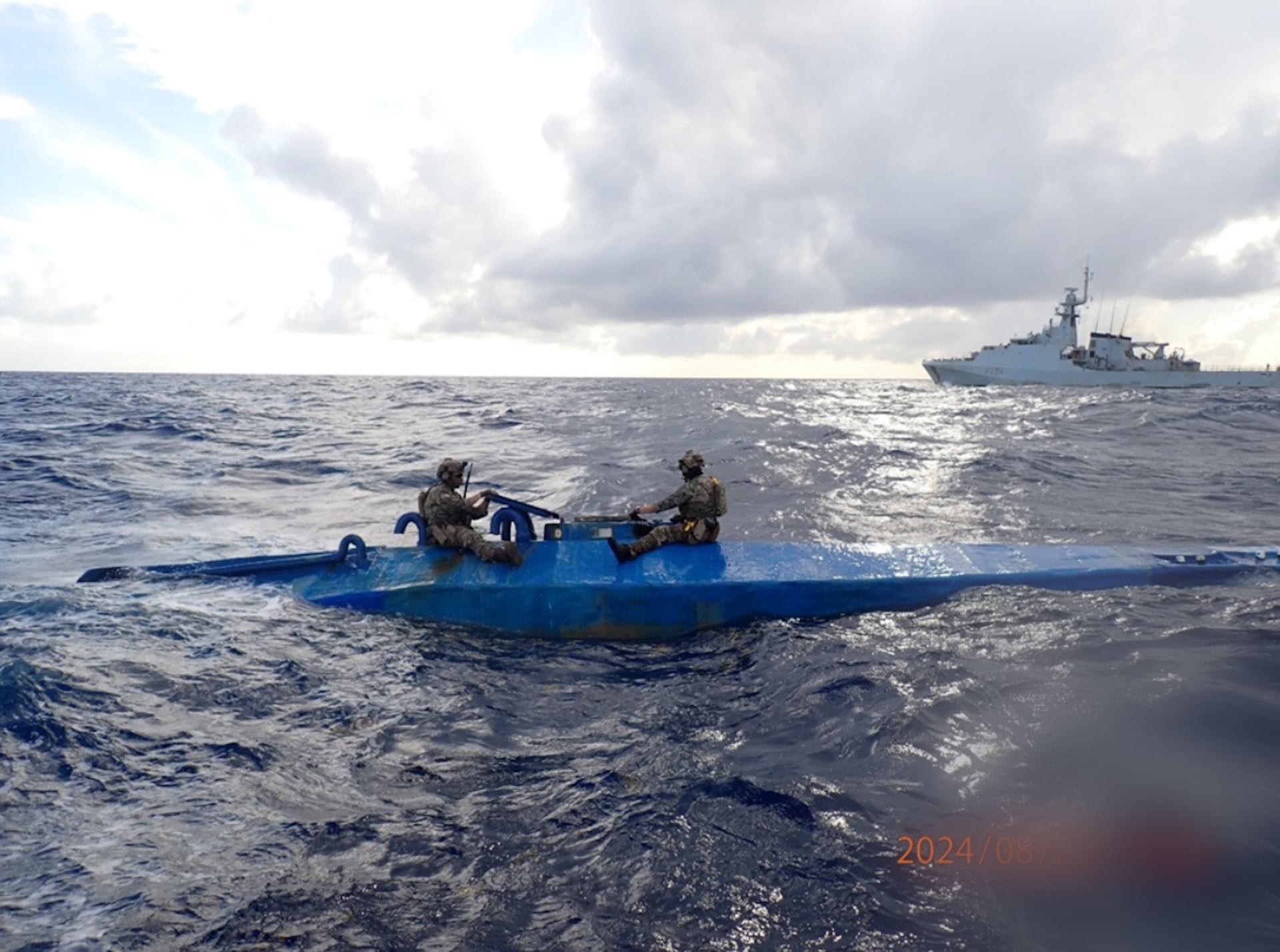
The phenomenon has been accompanied by growing technological sophistication. Criminal organizations have refined the use of go-fast boats, semisubmersibles, and contaminated containers to move illicit cargo through increasingly complex maritime corridors. Narco-submarines are also evolving into more autonomous platforms that are difficult to detect and capable of operating along long-range oceanic routes.
“Basically, they are operating maritime drones to move illegal cargo,” Toro added.
From fragmented responses to a hemispheric strategy
Against this backdrop, countries across the region are progressively moving toward greater hemispheric coordination in maritime security. The new approach combines multinational operations, intelligence sharing, advanced surveillance technologies, and strengthened port resilience.
The objective is no longer solely to intercept illicit shipments, but to dismantle criminal networks before they enter the logistical chains of global commerce.
This transformation responds to a shared reality in which maritime threats are transnational and exceed the capabilities of many countries in the region.
“Latin America is very large and heterogeneous, and the resources available to develop capabilities vary greatly. Shared and cooperative maritime domain awareness is essential,” Toro said.
Joint operations and sustained pressure at sea
The intensification of multinational maritime interdiction operations reflects this transformation. Between December 2025 and January 2026, Operation Southern Triangle, led by Panama together with U.S. Southern Command (SOUTHCOM) and Joint Interagency Task Force South (JIATF-S), deployed naval and aerial assets across the Caribbean and Eastern Pacific to strengthen regional coordination against drug trafficking and other illicit activities.
In parallel, throughout 2025, Operation Pacific Viper, led by the U.S. Coast Guard alongside SOUTHCOM and regional partners, maintained sustained pressure on Eastern Pacific maritime corridors through a continuous interdiction campaign that resulted in the seizure of more than 45 tons of cocaine.
“When we say the Coast Guard is surging counter-drug operations, we mean it. Together with our partners and allies, our maritime force is tracking smuggling routes across the Eastern Pacific and dismantling narco-terrorist networks,” said Rear Admiral Jeffrey Novak, deputy commander of the U.S. Coast Guard Pacific Area.
This pattern continued with Operation Pulpo, carried out in March 2026 in the Eastern Pacific. In less than 24 hours, Ecuadorian forces, the U.S. Coast Guard, and the DEA executed simultaneous interdictions off Ecuador’s coast, seizing more than 2 tons of cocaine and disrupting strategic corridors used by narcoterrorist organizations.
Technological cooperation and integrated intelligence
This cooperation is advancing alongside the development of shared technological capabilities. Intelligence fusion centers, satellite monitoring, synthetic aperture radar (SAR), automatic identification systems (AIS), and maritime domain awareness platforms are redefining maritime surveillance.
The convergence of these capabilities allows information to be integrated in near real time, combining radar signals, satellite tracking, and AIS data to reduce the operational space available to illicit networks.
Within this ecosystem, JIATF-S has consolidated itself as a key multinational coordination hub, integrating intelligence among military forces, security agencies, and partner nations to build a common operational picture of the maritime domain.
The integration of these systems has also strengthened transjurisdictional tracking, enabling authorities to anticipate routes, identify patterns, and coordinate interdictions with greater precision.
Examples are increasingly common. In March 2026, the U.S. Coast Guard intercepted a self-propelled semisubmersible in the Eastern Pacific during a coordinated maritime surveillance operation, highlighting both the growing use of low-detectability platforms by narcoterrorist organizations and the operational integration of aerial, naval, and intelligence capabilities across the hemisphere.
Ports: A new critical security frontier
Ports have become another central axis of maritime security. While they are essential nodes of global commerce, they also function as infiltration points for criminal organizations that conceal illicit goods within legitimate logistical chains.
“Criminal groups’ efforts to diversify revenues through metals, minerals, illegal timber, and chemical precursors have turned ports into a strategic priority,” Christopher Hernández-Roy, acting director and senior fellow of the Center for Strategic and International Studies (CSIS), told Diálogo.
The phenomenon is not limited to the export of illicit goods. It also includes the entry of weapons and the importation of chemical precursors from Asia for the production of synthetic drugs.
The complexity of the port system facilitates these dynamics: Millions of containers, multiple operators, and limited controls create vulnerabilities that criminal networks exploit through increasingly sophisticated methods. The World Customs Organization (WCO) identifies techniques such as “blind hook” operations and container contamination at different stages of the logistical chain.
Adding to this is a growing geopolitical dimension. Strategic and security analyses have warned about the risks associated with the expansion of Chinese state-owned enterprises into critical port infrastructure, citing concerns related to transparency, logistical access, strategic dependence, and potential civilian-military dual-use functions.
“If you have a port fully managed by China, such as Chancay in Peru and, to some extent, Paranaguá in Brazil or Kingston in Jamaica, then a criminal ecosystem will develop around that port,” Hernández-Roy warned.
Cooperation and critical infrastructure
The phenomenon has prompted new regional and international cooperative responses.
In January 2026, Guayaquil inaugurated the first Port Intelligence Fusion Center under the EUFORT-EC project, funded by the European Union. The center integrates the capabilities of Ecuador’s National Police and Navy to detect container contamination and track illicit routes toward Europe.
The trend is regional. In Panama, exercises such as PANAMAX-Alpha 2025 strengthened the protection of critical infrastructure and interoperability for the defense of the Panama Canal and other strategic nodes linked to hemispheric maritime commerce.
A new security architecture
As transnational organized crime continues to adapt, the hemispheric response is evolving toward an increasingly integrated model. Maritime security no longer depends solely on isolated actions, but rather on a network of coordinated operations, intelligence sharing, interoperability, and strategic partnerships.
This shift reflects a broader regional dynamic.
“Today, countries that were not previously at the center of the problem, such as Costa Rica, Ecuador, Chile, or Uruguay, are already confronting crime as a security priority,” Toro said, highlighting both a shared concern and a growing opportunity for hemispheric cooperation.
Taken together, this emerging architecture is positioning itself as a replicable model in which multinational cooperation, integrated intelligence, and institutional resilience are becoming central elements in confronting transnational crime.