

Ecuador’s criminal landscape continues to rapidly evolve, as a response to the Daniel Noboa administration’s military pressure campaign. This evolution is marked by an ongoing diversification and fragmentation of major criminal organizations and the proliferation of smaller armed groups and local gangs. The government response and criminal groups’ adaptation are increasing instability and driving a surge in violence across a growing number of localities nationwide.
“The fragmentation of criminal groups in Ecuador is primarily due to power struggles among individuals who held mid-level positions within these groups, but also to leadership absences or vacuums resulting from the assassination of their leaders,” Renato Rivera Rhon, a senior researcher at the Global Initiative Against Transnational Organized Crime (GI-TOC) — a Switzerland-based network that promotes global dialogue on organized crime — told Diálogo.
According to the Armed Conflict Location and Event Data Project (ACLED), between 2025 and early 2026 the number of active criminal groups in Ecuador exceeded 48 — more than double the number compared to 2024. In the coastal province of Guayas alone, where the port of Guayaquil is located, authorities have identified at least 21 criminal organizations, including groups such as Los Chechenos, Los Silenciosos, Los Aviones, and Los Purros.
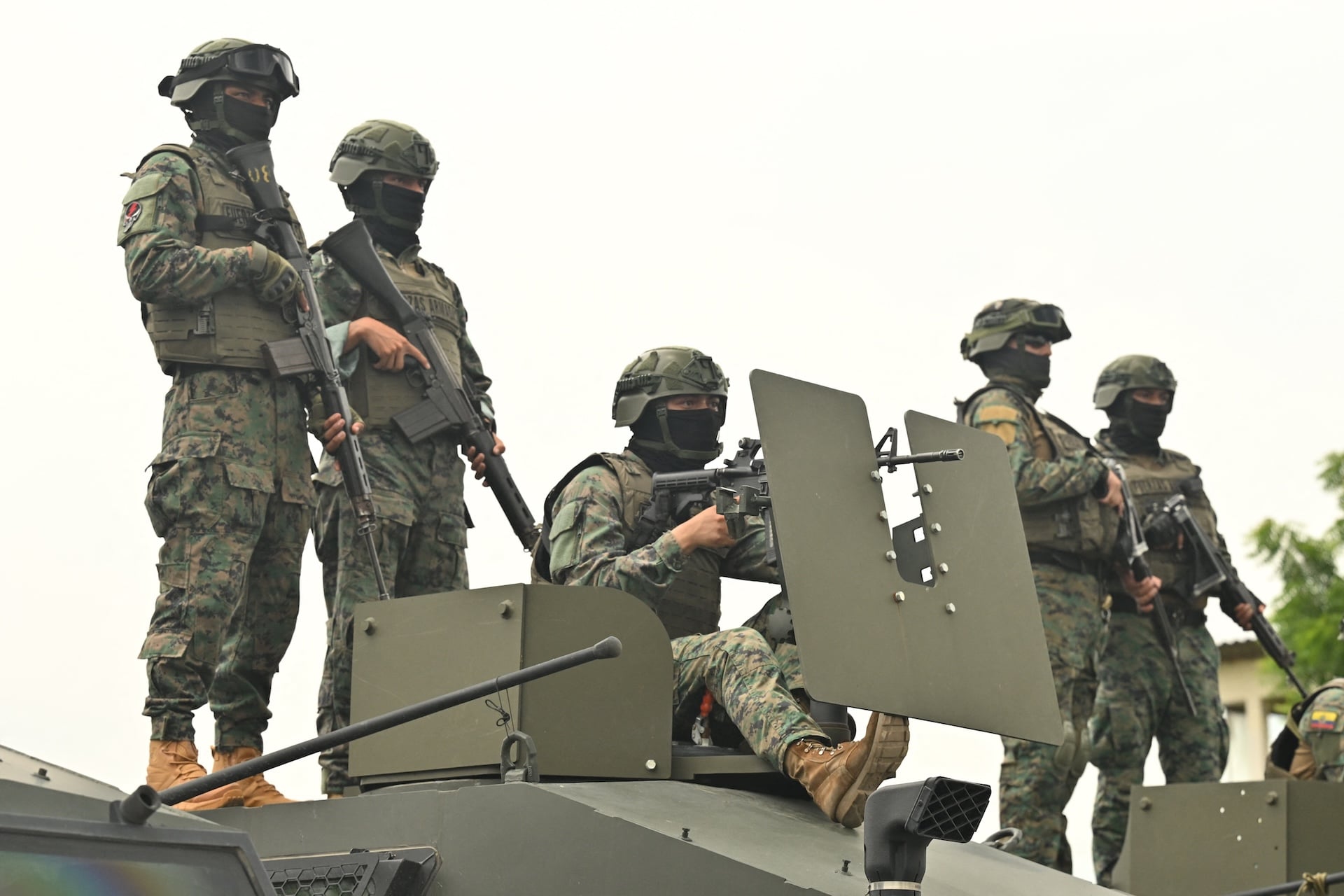
Likewise, the latest of more than 15 states of emergency declared by the Ecuadorian government May 3-18 in nine provinces highlights the government’s continued strategy to apply significant military and law enforcement resources to address the country’s insecurity. Initial official data published by the Ministry of Interior suggest homicides have fallen 14 percent compared to the first months of 2025, though 2026 is already on pace to be Ecuador’s second deadliest year on record.
At the same time, Colombian guerrilla groups active in border areas are also reacting to the government’s increased operations in these areas. These groups include the Comandos de la Frontera, dissidents of the Revolutionary Armed Forces of Colombia (FARC), the Comuneros del Sur, dissidents of the National Liberation Army (ELN), and Frente Oliver Sinisterra, operating mainly in the Amazonian provinces of Sucumbíos and Orellana.
For security forces, this evolving scenario represents a growing operational challenge. The proliferation of smaller, mobile groups — often lacking a stable hierarchical structure — makes it more difficult to identify leadership, map logistical networks, and track criminal alliances. At the same time, fragmentation intensifies disputes over control of drug trafficking routes, extortion networks, and local illegal economies, increasing the number of armed actors that must be monitored simultaneously.
The causes of fragmentation
According to Rivera, the fragmentation of criminal organizations accelerated following the death or capture of key leaders involved in Ecuador’s drug trafficking networks. “The first wave dates back to 2020 with the assassination of Los Choneros leader Jorge Luis Zambrano González, alias Rasquiña,” Rivera said.
A second phase of fragmentation was marked by a series of high-profile developments, including the December 2024 assassination of Benjamín Camacho, alias Ben 10, leader of Los Chone Killers. It also followed the trajectory of Los Tiguerones leader William Joffre Alcívar Bautista, alias Negro Willy, who relocated to Spain in 2023, was arrested in 2024, and later released in 2026 amid complications in the extradition process. Likewise, the extradition to the United States in July 2025 of Los Choneros leader José Adolfo Macías Villamar, alias Fito, significantly altered the country’s criminal balance of power. Ecuador’s Los Lobos and Los Choneros groups — aligned with the Jalisco New Generation Cartel and Sinaloa Cartel, respectively — were designated Foreign Terrorist Organizations by the United States in September 2025.
According to Rivera, “the elimination of these criminal leaders has generated internal divisions within the gangs and intensified the conflict over access to and control of illicit economies, particularly cocaine trafficking.” Rather than definitively weakening these organizations, the decapitation of their leadership has produced more fragmented, flexible, and unpredictable groups. Every power vacuum generates new disputes over control of ports, urban microtrafficking, and international drug routes.
Los Lobos, Rivera added, are expanding their influence in urban neighborhoods through alliances with local networks or through extortion schemes linked to microtrafficking. “In cases of microtrafficking, what they do is start collecting payments; they begin by essentially using their name,” Rivera explains, referring to smaller groups forced to pay to continue operating.
Unlike traditional criminal organizations, which tend to be more centralized and hierarchical, these newer networks operate through independent cells and temporary alliances that can quickly adapt to enforcement pressure. As a result, each arrest or elimination of a leader risks generating new splinter groups, further complicating efforts to dismantle criminal structures.
The Spread of violence
According to Ecuador’s National Police, the fragmentation of criminal organizations has become one of the main drivers of the country’s security crisis. The partial dismantling of large gangs has not reduced the operational capacity of criminal networks; instead, it has multiplied the number of armed actors competing for control and resources.
The direct consequence has been an increase in violence. New factions seek to assert control over territories, microtrafficking markets, drug routes, and extortion networks through the systematic use of force. Although a significant portion of the violence remains concentrated along the coast — particularly in Guayaquil — by 2025 the phenomenon had spread to growing number of cantons across the country. Homicides in Ecuador’s capital, Quito, increased by 22 percent in 2026, according to official data.
This expansion has heightened insecurity among the population, with communities increasingly exposed to extortion, shootings, and the forced recruitment of young people by criminal groups.
According to ACLED, Ecuador now ranks among the countries in Latin America with the highest levels of conflict exposure. In Durán, one of the cities with the highest homicide rates in the country — reaching approximately 140 murders per 100,000 inhabitants — the fragmentation of groups such as Los Chone Killers has contributed to a rise in violence, particularly among young people recruited as hitmen or drug couriers.
“We are not only seeing an increase in homicides, but also an increase in massacres — that is, multiple homicides occurring in areas of conflict,” said Rivera. According to ACLED, in 2025 there were more than 300 multiple homicide events in the country.
International cooperation and new strategies
In a context defined by fragmentation and criminal groups’ diversification of their illicit activities into areas such as mining and human trafficking, international cooperation is more essential than ever given these groups connections to Mexican cartels, U.S. and European cocaine markets, and logistics networks across the Americas.
Fragmentation and illicit diversification also complicate investigative work. Leaders can coordinate operations from abroad, rely on local intermediaries, and rapidly move financial resources across various segments of the economy and weapons across jurisdictions. For security forces and partner institutions this requires coordination, intelligence sharing, and the ability to track networks as well as individuals.
In this context, the opening of a permanent FBI office in Ecuador takes on strategic importance, facilitating improved intelligence exchange, joint investigations, and efforts to combat money laundering and other crimes.
According to Rivera, it is necessary to target the economic, financial, and logistical networks that allow criminal groups to regenerate. “If you do not eliminate or disrupt the finances of criminal organizations and their link to money laundering, it is very likely that you will not succeed in disrupting the structure as a whole.”
The challenge lies not only in capturing criminal leaders and containing immediate violence, but also in generating meaningful economic opportunity for youth who are heavily recruited by criminal groups and in preventing these organizations from regenerating through financial networks, transnational alliances, and new forms of territorial control. As criminal groups continue to adapt and fragmentation continues to change the security landscape, both targeted and comprehensive measures — combining improved strategy, enforcement, financial disruption, and international cooperation — are increasingly required to address the evolving threat.