

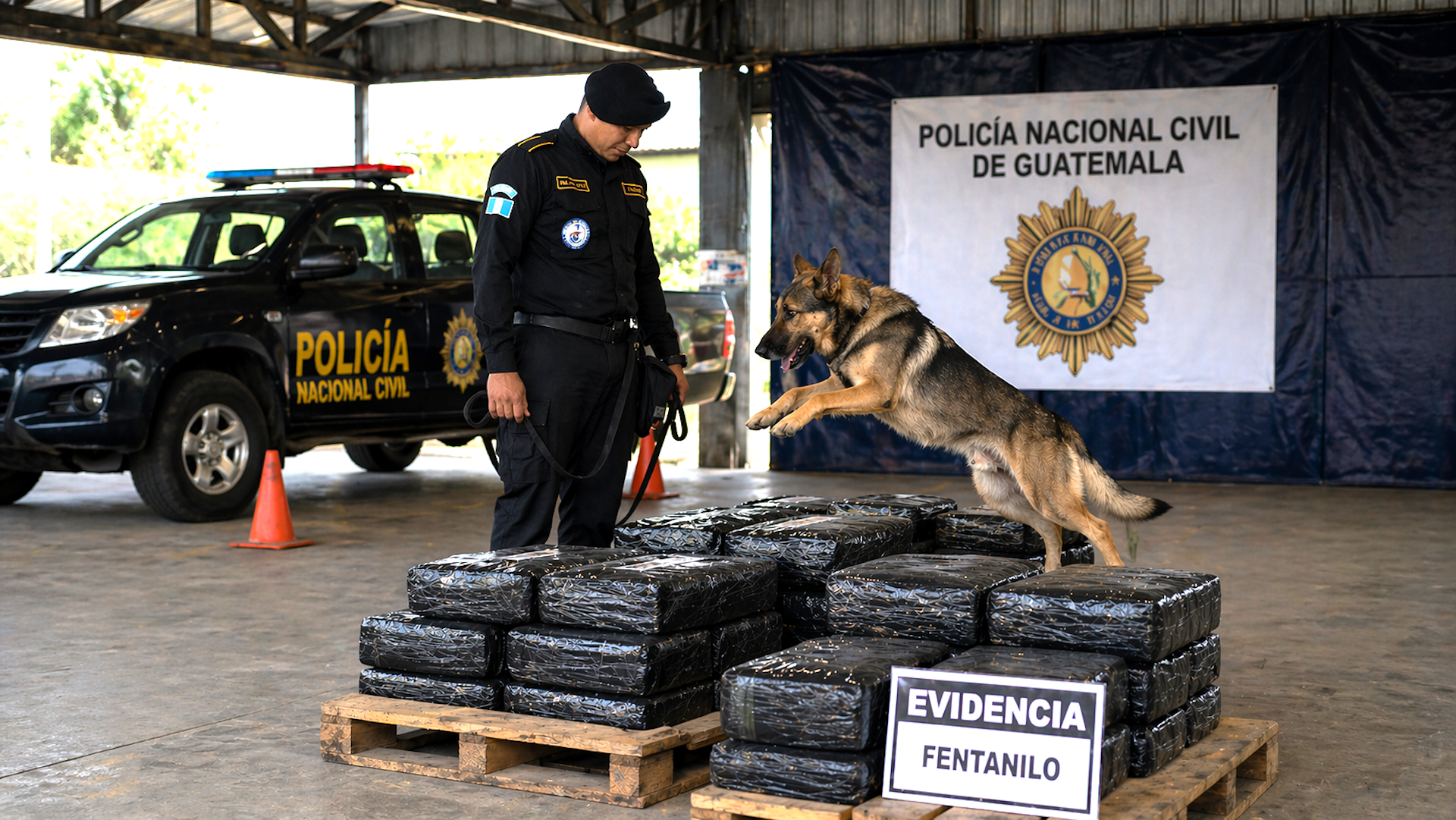
As synthetic drug trafficking expands across the hemisphere, Guatemala is strengthening its ability to detect fentanyl through specialized K-9 training — part of a broader effort to address emerging supply chains that increasingly involve precursor flows through Central America.
The initiative reflects a growing regional emphasis on early detection and interdiction, as security forces adapt to a drug that has reshaped trafficking dynamics due to its high potency, small volume, and ease of concealment.
From March 2–27, the Central American School of Canine Training (ECEC), located some 47 kilometers south of Guatemala City, hosted the Second International Fentanyl Detection Training Course, bringing together Guatemalan K-9 handlers and agents from Costa Rica and Honduras. Established more than three decades ago with support from the United States as part of broader counternarcotics efforts in the region, the school has become a regional hub for K-9 training.
During the course, teams trained with simulated fentanyl scent samples, allowing the dogs to associate the odor with reward-based stimuli. The program combined theory and practice, including advanced search techniques, scent imprinting, behavior conditioning, and operational protocols designed to maximize effectiveness in real-world scenarios.
These K-9 units operate at airports, ports, border crossings, and correctional facilities, where they complement existing technologies with a level of precision that helps overcome the limitations of other detection methods, Mario Mérida, Guatemala’s former deputy minister of the Interior and a security expert, told Diálogo.
“Guatemala has established itself as a regional leader in the training of K-9 units, contributing significantly to efforts to combat fentanyl trafficking in the Northern Triangle [El Salvador, Guatemala, and Honduras] and Central America,” Mérida said.
The rise of fentanyl and shifting trafficking dynamics
The emergence of synthetic drugs — particularly fentanyl — has transformed drug trafficking dynamics in Latin America and the Caribbean. According to a report by the Institute of the Americas at Georgetown University, Mexican cartels have diversified their operations, expanding from traditional drugs into the production and export of fentanyl for international markets.
This shift has intensified competition over routes and strategic nodes, increasing pressure on transit countries and contributing to rising levels of violence. According to France 24, in less than a decade, fentanyl has rapidly expanded within international illicit drug markets, driven in part by the availability of chemical precursors originating from China.
At the operational level, criminal organizations have adapted to enforcement pressure by altering the composition of fentanyl-based pills, resulting in highly potent and often inconsistent doses that increase both lethality and detection challenges.
In parallel, InSight Crime has documented how these groups are adopting increasingly innovative methods to support trafficking and surveillance activities. Among them is the reported use of trained dogs to move or monitor illicit goods — practices linked to groups such as the Jalisco New Generation Cartel, according to Mexican outlet Milenio.
Emerging threat and strategic response in Guatemala
In Guatemala, trafficking in fentanyl and its chemical precursors represents an evolving threat tied to transnational criminal networks. During the first quarter of 2025, authorities reported several seizures linked to this drug, pointing to the presence of organizations with sophisticated logistical capabilities and cross-border reach, Diario de Centro América reported.
In 2026, the country was also identified as a transit point for chemical precursors originating in India and linked to networks associated with major cartels such as the Sinaloa Cartel, El País reported.
This dynamic has drawn increased international attention. In April 2026, the United States imposed sanctions on a network involved in supplying precursor chemicals from Asia to criminal organizations, including shipments routed through Guatemala, highlighting the country’s role within broader synthetic drug supply chains.
In response, authorities have expanded efforts to track the financial and logistical structures that sustain precursor trafficking. Investigations have identified the use of front companies to import chemicals, payments to suppliers in Asia, and falsified documentation designed to conceal the origin and destination of shipments.
These patterns allow authorities to detect anomalies within legitimate trade systems, anticipate potential trafficking activity, and disrupt illicit flows before they reach production or distribution stages.
Within this broader strategy, strengthening detection capabilities at ports, borders, and transportation hubs remains critical. Tools such as K-9 units provide flexible, rapid-response inspection capacity that complements financial tracking and intelligence efforts, particularly in environments where traditional detection systems face limitations.
International cooperation and strengthening of K-9 capabilities
Guatemala’s response has been reinforced through international cooperation, particularly with the United States, which has supported training and infrastructure development for K-9 units.
Regional collaboration has also been key. Joint training and information-sharing initiatives involving the United States, Mexico, and Central American partners are helping standardize detection capabilities and improve coordination against trafficking networks.
“The sustainability of these capabilities requires not only regional cooperation but also the continuity of bilateral agreements, periodic evaluations, and the strengthening of training and equipment for K-9 units,” Mérida said. He also highlighted the importance of maintaining agile operational coordination among Guatemala, Honduras, and Costa Rica, with common protocols that enable proactive responses to cross-border crimes.
Through these efforts, Guatemala is adapting to the evolving dynamics of synthetic drug trafficking while strengthening its role in regional detection and interdiction — an increasingly critical function as precursor flows expand across Central America.